
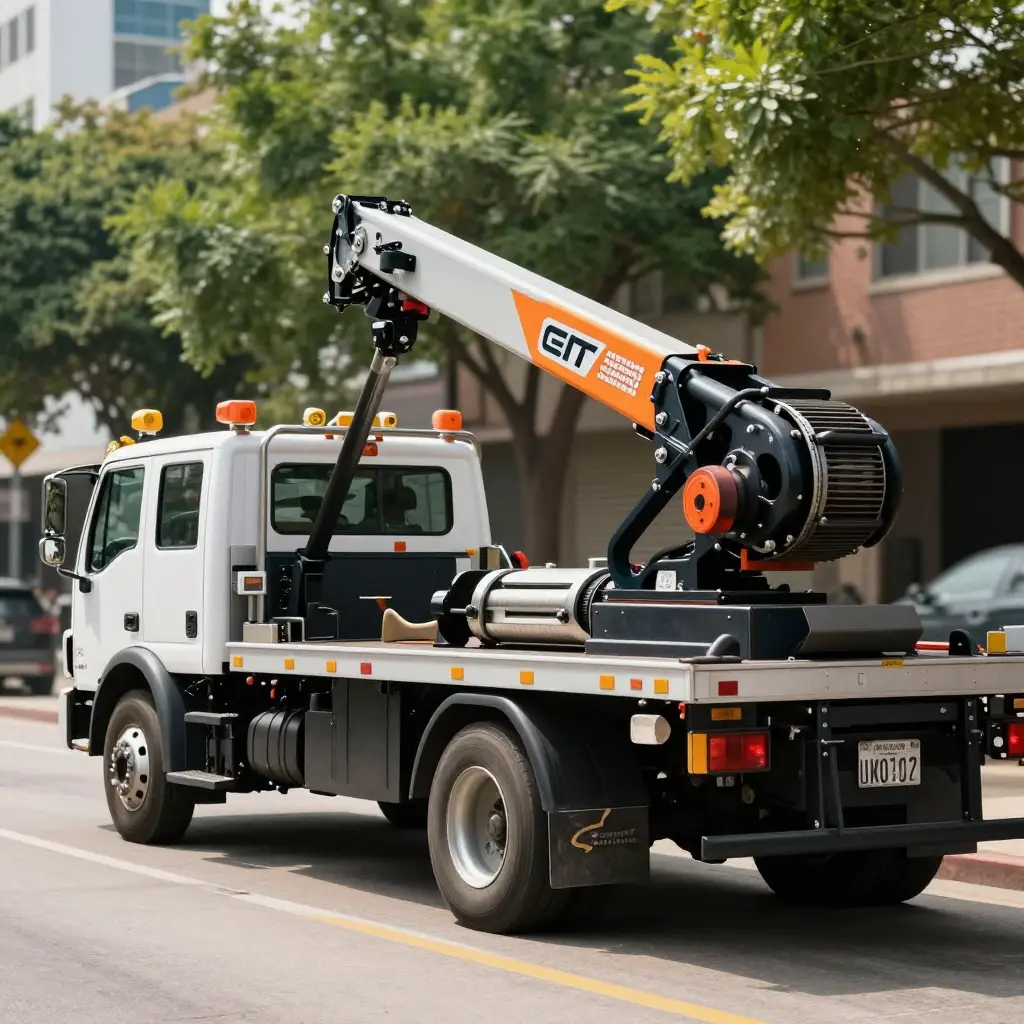
Boom Capacity vs. Winch Line Pull: Two Ratings, Two Different Forces
Two rated figures decide what a heavy-duty tow truck in Houston can actually be sent to do: boom capacity and winch line pull. Buyers mix them up more often than any other pair of numbers on the spec sheet, and the mistake is expensive, because the two figures measure forces acting on different structures of the truck.
Boom capacity is the load, in pounds or tons, that the boom and mast assembly is rated to lift and hold at a stated boom angle and load radius without exceeding its structural or stability limits. Winch line pull is the force the winch can develop on the wire rope at a stated drum layer. Line pull governs the resistance the truck can drag or winch through. It says nothing about holding a load in the air.
The two figures interact. They do not convert into each other. A 35-ton boom bolted to a 50,000-lb winch does not add up to 60 tons of capacity, and specifying a truck on winch pull alone remains an expensive habit across the Houston towing and recovery market, where soft ground, tight industrial yards, and heavy Class 8 casualties load the lifting and pulling systems at the same time. A job that exceeds either rating sits outside the truck’s working envelope, however good the other number looks on the sheet.
The sections below cover manufacturer rated capacity charts, boom angle and reach, drum layer derating, rigging multipliers, and truck class. Rigging geometry, anchor quality, and site conditions are treated as modifiers, not as assumptions.
This article is published by Mike’s Towing as an informational resource for towing operators evaluating equipment and recovery methods.
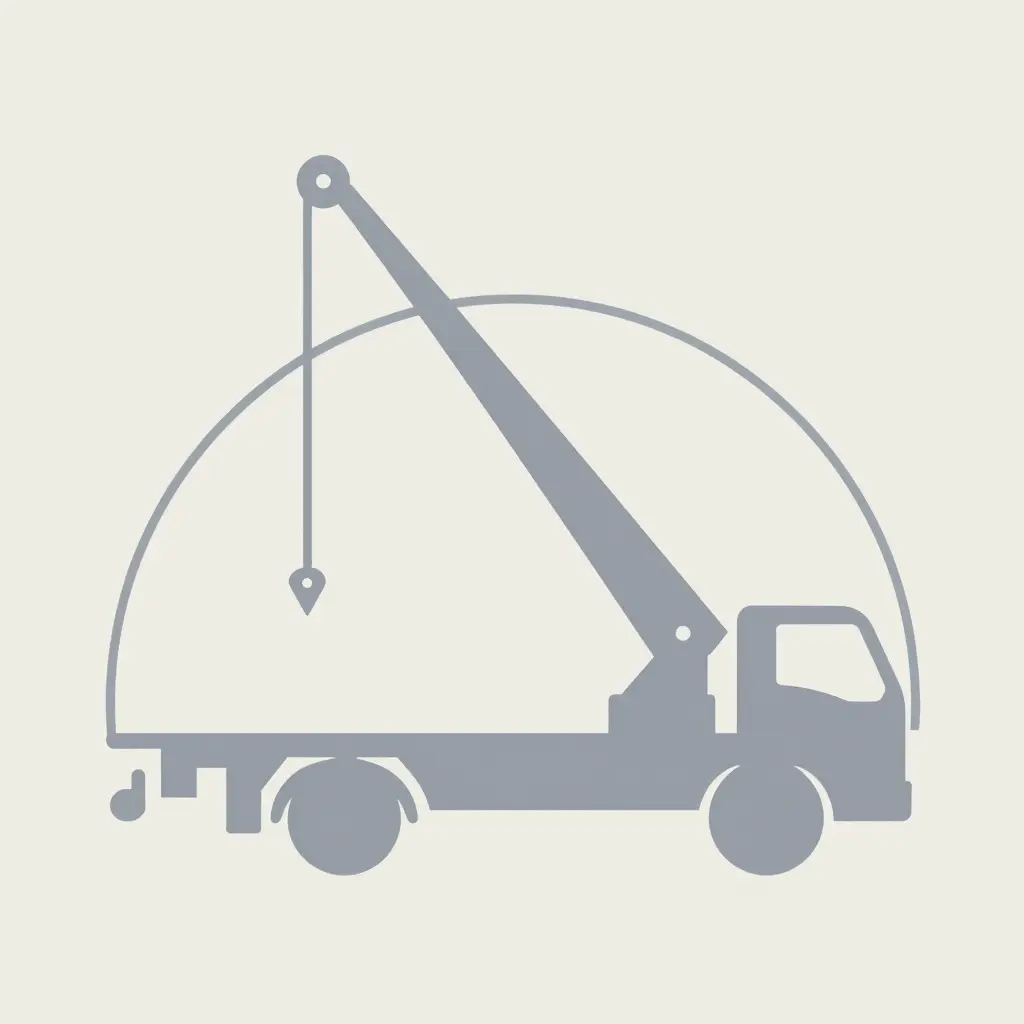
Schematic only: the boom axis carries the vertical and radial load, the sheave redirects horizontal winch line pull, and the curved arc at the pivot marks the load moment that defines boom capacity as a structural and stability limit.
How Boom Capacity Is Rated and Derated
Ask a fleet owner what the wrecker will lift and you usually get one big round number. Ask the engineer who signed the load chart and you get a range of numbers, a date, an outrigger condition, and a long look at you. Recovery jobs go wrong in the gap between those two answers.
Rated capacity begins with structural strength
Rated capacity is the manufacturer-certified maximum load a boom may carry under a defined set of conditions. The figure is not a property of the boom on its own. It answers a question with several parts: how much can this boom carry, at this angle, at this extension, with this equipment configuration?
The boom is a cantilever beam. Every section, pin, cylinder, sheave, and weld carries stress in proportion to the bending it resists, and the bending comes from load moment: the load multiplied by its horizontal distance from the boom pivot. Ten tons at six feet out and five tons at twelve feet out both put 60 ton-feet into the structure. The boom has no opinion about the load by itself, only about the moment.
Two consequences follow:
- Reach costs capacity. Telescoping the boom moves the load away from the pivot, and every extra foot of horizontal distance multiplies the moment arm.
- Angle changes the number. A steeper boom shortens horizontal reach at the same boom length, so it can carry more, but a steep boom also loads the structure differently and can push the machine toward tipping instead of bending.
Structural rating versus stability rating
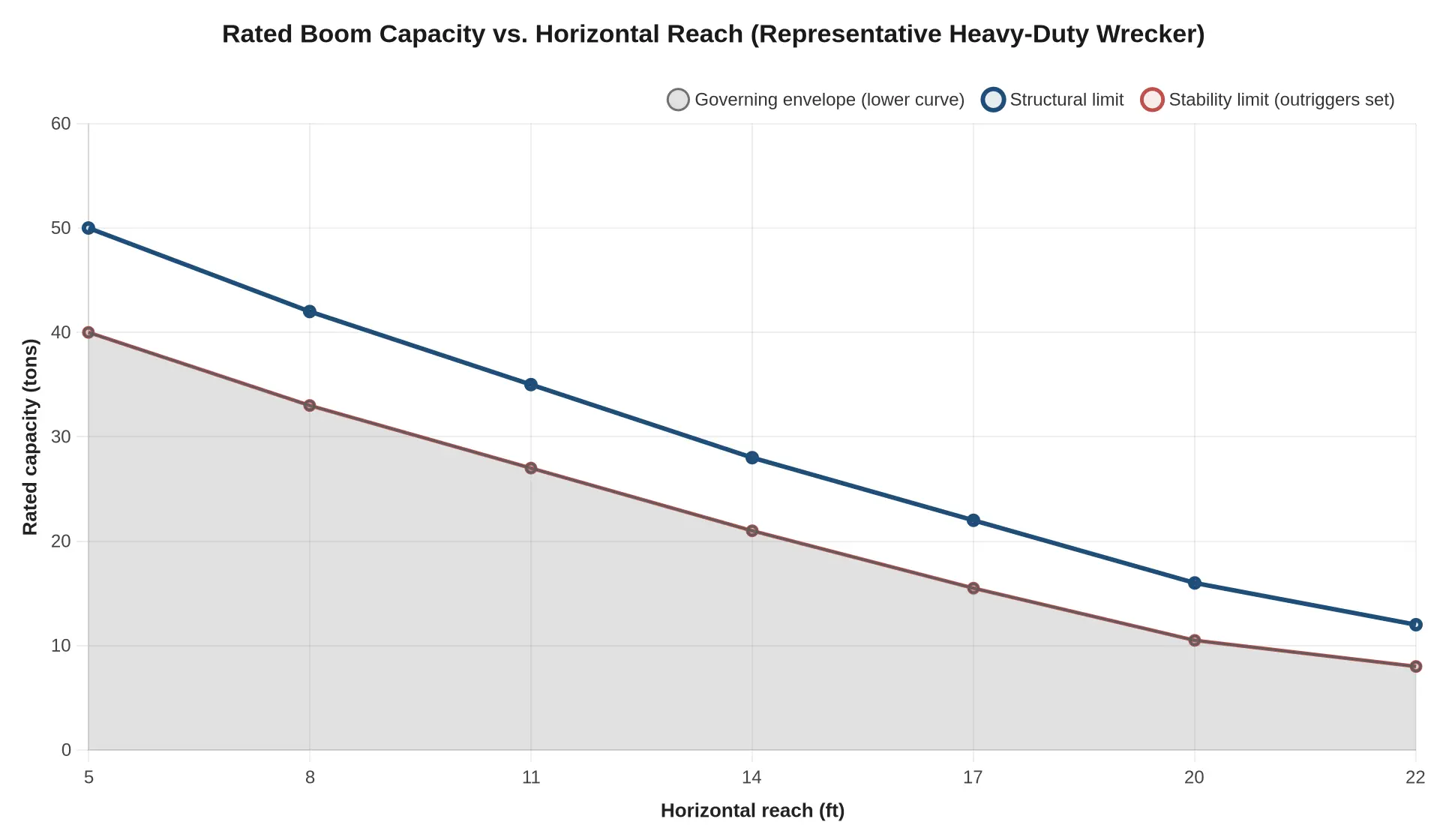
Manufacturers publish two distinct limits, and the usable capacity is always the lower of the two.
| Limit type | What it protects | Governs when |
|---|---|---|
| Structural rating | Boom sections, pins, cylinders, welds, turret | Short reach, high angle, strong footing |
| Stability rating | Truck against tipping, outrigger reaction, ground bearing | Long reach, low angle, soft or sloped ground |
Steel and hydraulics fix the structural number. Stability depends on the machine’s footprint: outrigger spread, counterweight, chassis, and how well the ground accepts the reaction force. A truck rated at 50 tons structurally can be cut to 40 tons by tipping resistance the moment the outriggers are set, and to far less if they are never set at all.
Outriggers and spade footings are part of the rating
Outriggers turn a narrow, tippy truck into a wide, stable platform by moving the tipping line outward, and the spade footings push that reaction into the ground through a footprint measured in square inches. Around Houston, where asphalt, expansive clay, and construction fill sit next to each other, ground bearing is often the weakest link in the chain. A 12-inch spade on bare asphalt under a heavy side load can punch through long before the boom reaches its structural limit. Load-spreader pads, cribbing, and a setup somebody actually evaluated are inputs to the rated capacity, not accessories bolted on at the end.
How operators should read a load chart
Read from the conditions inward, not from the headline number outward. Confirm what the chart assumes first: outriggers fully extended, boom and jib combination fitted, counterweight position, and whether the figures cover work over the side, the rear, or the front. Then find the row or curve for the boom length and angle you will really run, and convert it to horizontal reach. Subtract the rigging weight, since shackles, slings, and the hook block eat capacity before anything is on the hook. Compare what is left against the lowest applicable rating on the chart and keep a margin for dynamic load. Check that the chart is the current revision for that serial number. Do not interpolate past the published envelope, and do not borrow a number from a truck that looks similar.
The practical consequence for heavy-duty recovery
That is where jobs get decided. A wrecker that lifts 50 tons with the boom tucked in may be down to 20 tons at 14 feet of reach and 12 tons at 20 feet. In heavy-duty recovery the load is rarely close in: an overturned tractor-trailer 18 feet off the pavement edge, a mired excavator that has to be reached across a ditch, a rollover pinned against a barrier. Geometry sets reach, and reach sets capacity. A truck that looks generous for a parking-lot lift can fall below requirement on a freeway shoulder, and an under-matched unit turns a one-hour recovery into a wrecked boom and a second callout.
So start from the worst-case reach and angle of the work you intend to do, not the best-case headline figure. Operators running heavy-duty tow trucks in Houston should match boom capacity, outrigger geometry, and ground conditions to the environments they actually serve. Winch line pull gets a vehicle moving. Boom capacity is what keeps the truck and the crew intact while it does.
Winch Line Pull, Drum Layers, and Line Speed: Reading the Numbers Like a Recovery Operator
Winch line pull is the horizontal force the drum can develop at the wire rope. That definition is narrower than most buyers assume. Line pull is not lifting capacity, it is not boom capacity, and it is not a fixed number, because it changes with every wrap of rope that goes onto the drum. A spec sheet can look impressive and still fall short on a stalled load that has to be dragged a hundred feet before it will roll, which is ordinary work in heavy-duty towing.
What a Published Rating Really Tells You
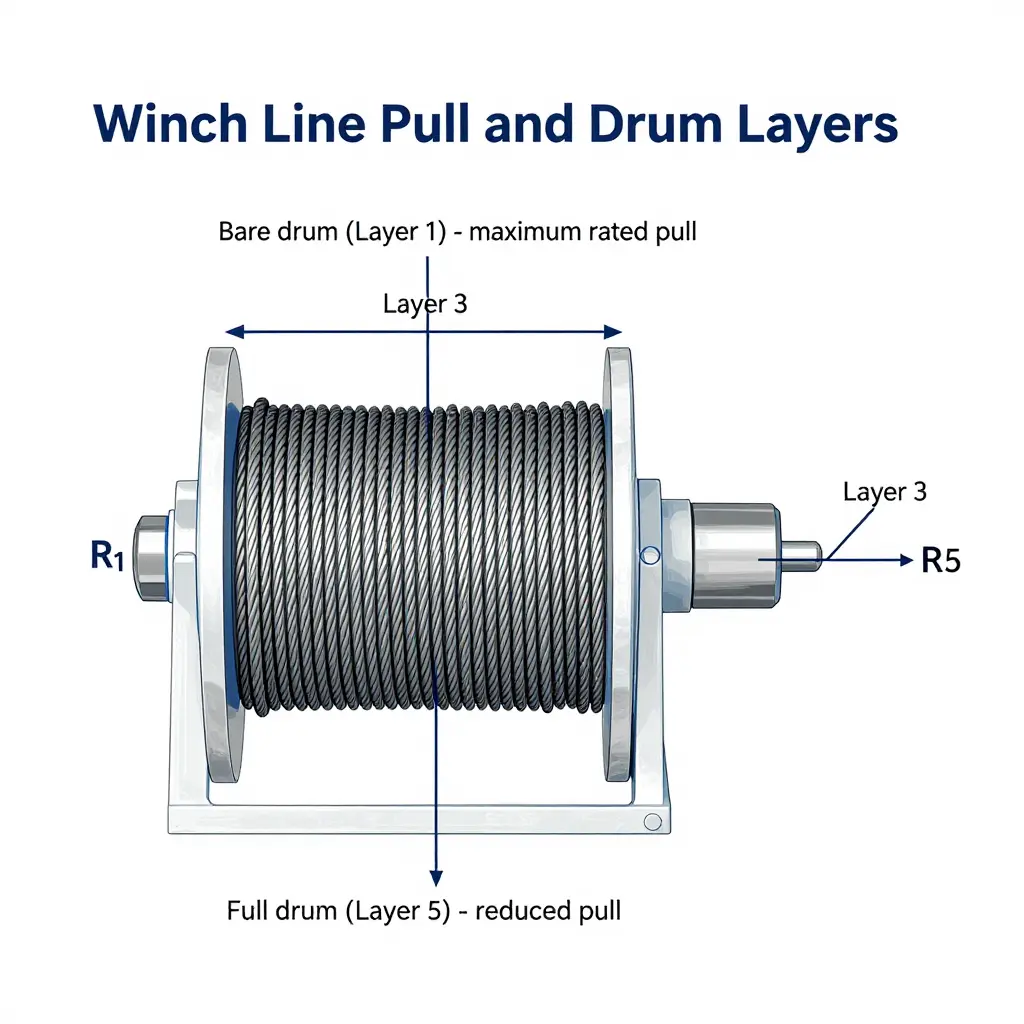
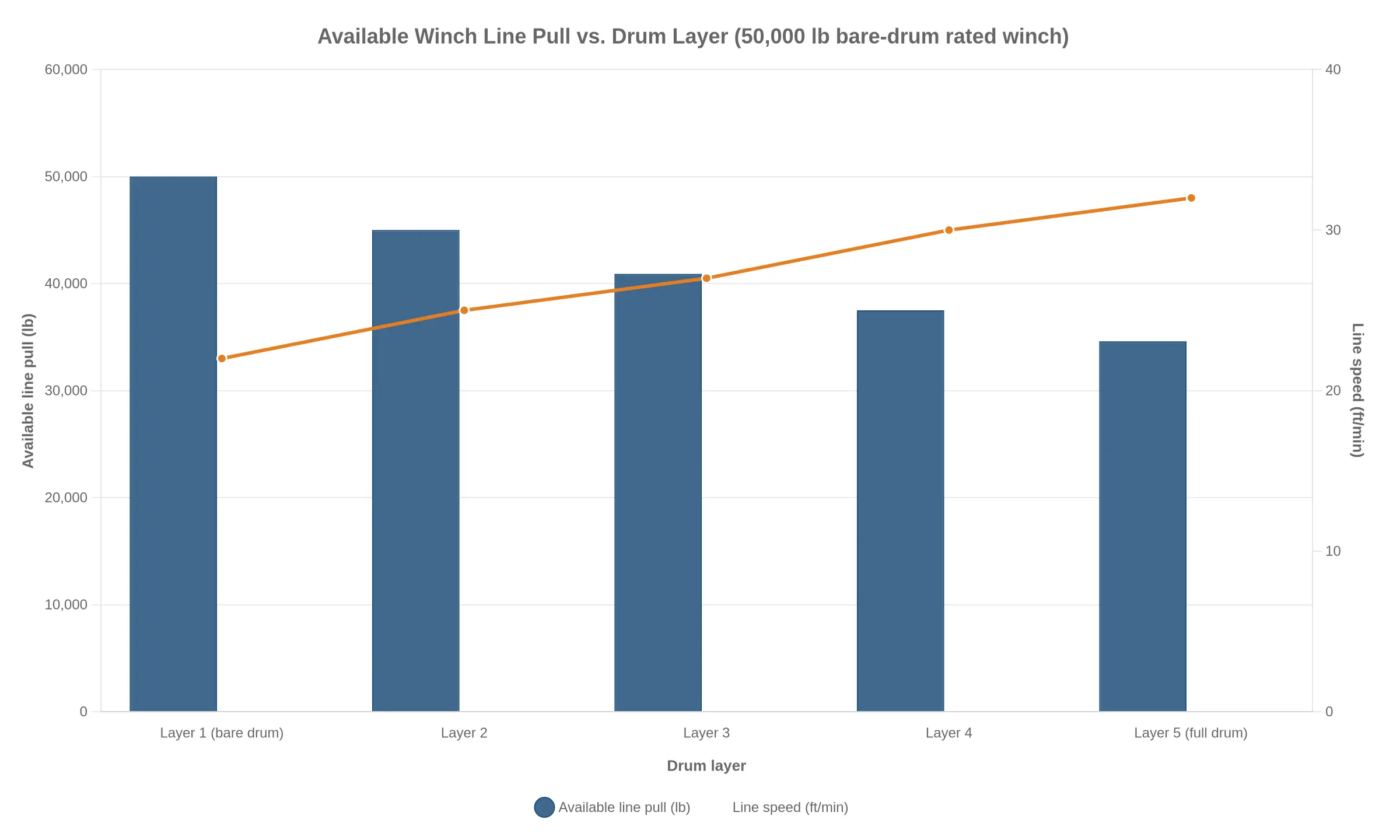
Manufacturers usually publish the maximum at the bare drum, or first layer, where the effective radius is smallest. Each additional drum layer increases that radius, and since drum torque stays roughly constant, rope force falls in proportion. A winch rated 50,000 lb on the first layer may deliver only 34,000 to 36,000 lb at full drum. Some builders publish the whole layer-by-layer table. Others publish one headline figure and leave the buyer to assume it holds everywhere, which it does not.
Line speed moves the other way. At a fixed drum rpm the rope travels farther per revolution on a bigger radius, so the winch pulls less but faster at the outer layers and more but slower near the bare drum. Pull times speed stays roughly constant, and that product is the winch’s available power showing itself.
Bare-Drum vs. Full-Drum Ratings
| Drum layer | Effective radius | Available line pull (lb) | Line speed (ft/min) |
|---|---|---|---|
| Layer 1 (bare drum) | 4.5 in | 50,000 | 22 |
| Layer 2 | 5.0 in | 45,000 | 25 |
| Layer 3 | 5.5 in | 40,900 | 27 |
| Layer 4 | 6.0 in | 37,500 | 30 |
| Layer 5 (full drum) | 6.5 in | 34,600 | 32 |
Calculating Available Pull at a Given Layer
You do not need a factory table to estimate layer four. Use the radius ratio:
Available pull = Bare-drum rating x (bare drum radius ÷ layer radius)
With a 4.5 in bare drum and a 6.5 in full drum: 50,000 x (4.5 ÷ 6.5) = about 34,600 lb. The same arithmetic works for a working layer in the middle of the spool. Measure to the centerline of the rope, not to the outside of the flange. Crews who plan a heavy pull off a full drum and then wonder why the truck bogs down are fighting this math, not the load.
Hydraulic vs. Mechanically Driven Winches
Hydraulic winches run a motor and planetary gear set off the truck’s hydraulic system, which buys variable speed control, cooler running on long sustained pulls, and clean integration with a boom or underlift circuit. Mechanical winches take power through a driveline, PTO, or chain case: simple, rugged, often very high bare-drum pull, with coarser speed control and more heat to manage on extended pulls. Both types obey the same drum-layer physics. The argument worth having is about duty cycle and control, not brand loyalty.
Wire Rope Diameter, Construction, and Fleet Angle
Wire rope sets the ceiling above the drum’s rating. A 3/4 in 6×19 IWRC rope and a 7/8 in 6×37 rope carry different minimum breaking strengths, and the winch should be matched so the rope’s working load comfortably exceeds the maximum drum pull. Independent wire rope core (IWRC) resists crushing under multi-layer spooling better than fiber core, which matters if you routinely run four or five layers deep.
Fleet angle, the angle between the rope and a line perpendicular to the drum flange, should stay small, about 1.5 degrees or less on smooth drums. A wide fleet angle produces uneven spooling, rope stacking, and rubbing against the flange, which damages rope quietly and costs usable capacity. Fairlead and sheave placement is part of the winch system, not an accessory.
Line Pull Moves the Load; Boom Capacity Lifts It
Line pull moves a load along the ground. Boom capacity lifts and holds it. A truck can be winch-rich and boom-poor, with a heavy single-line pull and a modest boom, or the reverse: a strong boom and a small winch. Houston recovery work often wants both, dragging a loaded tractor-trailer out of soft shoulder soil and then holding a corner while the load is stabilized. When comparing heavy-duty tow trucks in Houston, read the two ratings separately, note the drum layer each one assumes, and match the truck to the work rather than to the biggest number on the door.
Specification Comparison Across Tow Truck Classes
Representative industry ranges for heavy-duty tow truck classes, useful for recovery planning rather than for pricing a specific unit.
| Truck class / configuration | Typical boom capacity range | Typical winch line pull range per winch | Number of winches | Typical boom reach | Primary recovery role |
|---|---|---|---|---|---|
| Light-duty wrecker | 4 – 8 tons (8,000 – 16,000 lb) | 8,000 – 12,000 lb | 1 | 15 – 20 ft | Cars, SUVs, light pickups |
| Medium-duty wrecker | 12 – 20 tons (24,000 – 40,000 lb) | 20,000 – 35,000 lb | 1 – 2 | 20 – 28 ft | Box trucks, buses, medium commercial vehicles |
| Conventional heavy-duty wrecker | 30 – 50 tons (60,000 – 100,000 lb) | 35,000 – 50,000 lb | 2 – 3 | 25 – 35 ft | Loaded tractor-trailers, straight trucks |
| Integrated heavy wrecker | 50 – 80 tons (100,000 – 160,000 lb) | 50,000 – 75,000 lb | 2 – 3 | 30 – 40 ft | Loaded semis, rollovers, off-road recoveries |
| Rotator | 75 – 130+ tons (150,000 – 260,000 lb) | 50,000 – 100,000+ lb | 2 – 4 | 35 – 50+ ft | Complex multi-point recoveries, overturned loads |
Every range here is an envelope, not a promise. Boom capacity peaks with the boom retracted and drops fast as reach extends. Winch line pull is usually quoted on the bare-drum first spool and falls off as line builds up on the drum.
Configuration therefore matters more than any single headline figure. Axle count, counterweight, boom geometry, and winch count all change what the machine can do, and two units advertising the same boom capacity can perform very differently on a Houston overpass or a soft-shoulder recovery. Match the heavy-duty tow truck to the load chart and the site before you commit.
Pair the class to the job and the rating to the load, and a heavy-duty recovery becomes a plan instead of a gamble.
Two Ratings, Two Different Questions
Treating boom capacity and winch line pull as interchangeable is the common mistake in heavy-duty recovery. They answer different questions. The boom answers whether the truck can lift and hold the load. The winch answers whether it can generate enough horizontal force to make that load move. A truck can pass one test and fail the other, which is why the selection process runs twice, separately, before anything is dispatched.
Step 1: Calculate the Required Winch Line Pull
Line pull is about overcoming resistance, not lifting weight. Build the figure from three components:
- Rolling resistance: weight on the tires multiplied by a surface coefficient, roughly 0.02 on asphalt, 0.05 on gravel, 0.10-0.15 in soft dirt or mud.
- Grade resistance: weight times the grade as a decimal. A 6% grade adds about 6% of the load weight as pull.
- Damage-induced drag: locked or seized brakes, bent axles, buried frames, plowing soil, suction in mud. This is the term crews underestimate, and it can exceed rolling and grade together.
Add the three, then apply a working margin of 25-50%. Now derate the candidate truck’s advertised pull. Line pull falls as rope stacks on the drum, so use the layer you will actually work from rather than the bare-drum figure if the pull is long. Take a few percent per sheave for friction through the blocks, and remember that reeving multiplies pull while dividing line speed. Compare the derated result, not the brochure number, against the required pull.
Step 2: Calculate the Required Boom Capacity
Boom capacity is a moment problem. Multiply the load weight by its horizontal distance from the boom pivot (reach times the cosine of the boom angle), add the weight of rigging and the boom itself, then apply a dynamic amplification factor of 1.1-1.5 for shock loading as the load breaks free. Compare that figure against the load chart value for the actual radius and angle. Never against the headline maximum, which is valid only at minimum radius.
| Check | Inputs | Compare Against |
|---|---|---|
| Line pull | Rolling + grade + damage drag + margin | Bare-drum pull, derated for wraps, reeving, friction |
| Boom capacity | Load x horizontal reach, plus rigging, plus dynamic factor | Load chart at actual radius and boom angle |
The Two Failure Modes
An under-boomed truck cannot lift or hold a load. It may pull beautifully on flat ground and then hit the chart limit the moment the load leaves the pavement. What follows is a stalled lift, an overloaded boom, or a stability failure with nothing broken and everything lost.
An under-winched truck cannot generate enough horizontal force to break a load free. It has the lift, but the load stays stuck in mud, against a curb, or behind locked brakes. Crews then abuse the equipment: shock-loading the rope, double-reeving past the structural limit, dragging the truck with the parking brake set. That is how winch lines part and drums fail.
When a Heavy Wrecker Is Enough – and When It Is Not
A heavy wrecker alone will do the job when the load breaks free below the derated line pull, the lift sits comfortably inside the chart at the actual radius, the ground is firm and level, and the recovery is a straight pull off a single pick point. That covers most highway breakdowns and upright tractor-trailer recoveries.
Step up to a rotator or a multi-winch configuration when the two numbers diverge:
- A rollover down an embankment or into a ditch, where the load has to be lifted and pulled at once.
- Suction, deep mud, or locked drivelines that push required pull past what a single drum can deliver.
- Multi-point picks where two lines must hold tension independently without side-loading the boom.
- Confined or off-angle sites where a rotating boom lets the crew work from a safe position instead of dragging cable across a live lane.
A rotator wins because it separates the jobs: independent rotation, dual or quad winches, and boom geometry that lifts and pulls at the same time without inducing side load. Two heavy wreckers in tandem can stand in when the boom is adequate but pull is short. That usually costs less than mobilizing a rotator, and it is slower and harder to coordinate.
Run both calculations every time. The smaller of the two margins decides the equipment, and matching that margin to the site is what safe heavy-duty recovery comes down to. Operators comparing chassis and rating options in the region can review available Houston tow truck configurations before committing a unit to a job.
Boom Capacity vs. Winch Line Pull: Two Ratings That Do Not Rise in Step
Owners shopping for recovery equipment in Houston often expect the two headline numbers to move together, as if a bigger boom should always come with a bigger winch. The chart below shows why they do not, and why the mismatch is worth looking at when you match a truck to a job.
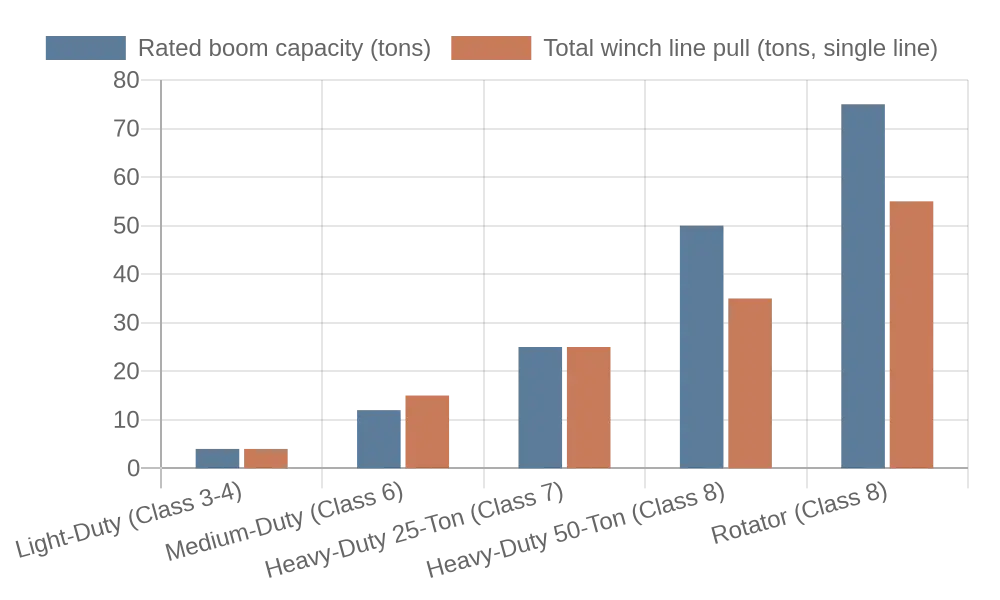
| Truck class | Rated boom capacity (short tons) | Winch line pull, single line (short tons) | Winch-to-boom ratio |
|---|---|---|---|
| Light-duty (Class 3-4) | 4 | 4 | 1.00 |
| Medium-duty (Class 6) | 12 | 15 | 1.25 |
| Heavy-duty 25-ton (Class 7) | 25 | 25 | 1.00 |
| Heavy-duty 50-ton (Class 8) | 50 | 35 | 0.70 |
| Rotator (Class 8) | 75 | 55 | 0.73 |
How to Read the Gap
- Where the bars are near equal, the truck is a balanced wrecker: it lifts roughly what it can drag, which suits routine tractor-trailer work and most highway breakdowns.
- Where winch pull exceeds boom capacity (the medium-duty tier), the truck is really a pulling machine. It recovers out of mud and ditches well and should not be treated as a lifter.
- Where boom capacity runs well ahead of winch pull (the 50-ton and rotator tiers), the truck earns its money on geometry, not on drum torque. Rotators close that gap with multi-part reeving and multiple winches, which means the nameplate line pull understates what they can recover.
Boom rating tells you what the truck can hold; winch line pull tells you what it can drag. Only the pair tells you what the machine will do on a Houston recovery scene. If you need to check which class a specific job requires, our team can walk through the right tow truck for the load.
The Spec Sheet Selection Checklist Every Operator Should Run
A spec sheet only protects you if you read it the way the engineers who wrote it did. Before committing capital, run every candidate unit through the same checklist and work the calculation in order instead of cherry-picking the most flattering number on the page.
- Confirm where the drum layer derating bites. First-layer line pull is not what you get on the fourth layer.
- Check the boom angle limits and whether charted capacity still holds at the steepest angle you realistically pick from.
- Measure outrigger spread against the shoulders, overpasses, and tight yards you actually work in.
- Count the winches and confirm they run independently. A two-winch setup changes recovery geometry more than most spec lines suggest.
- Inspect the wire rope for condition, lay, and certification before trusting any published pull figure.
- Match sheave and snatch block capacity to the rope diameter and the heaviest load that line will ever see.
- Insist on legible load charts mounted on the unit and traceable to the manufacturer’s current revision.
- Ask whether a rating reflects structural capacity or stability. The two fail in different ways.
- Write every derating factor into the purchase file, so the next operator inherits your assumptions instead of guessing at them.
Once the paperwork checks out, size the equipment in four steps:
- Find the load weight, including fluids, cargo, and anything still bolted to the frame.
- Work out rolling resistance and grade percentage for the recovery path you will actually use, not the ideal one.
- Calculate the line pull you need, then the boom capacity you need at the planned reach.
- Compare both against the derated ratings on the chart, and walk away if either margin is thin.
If the numbers do not clear with room to spare, it is the wrong truck at any price. Operators who want a reference point can look at how our Houston tow truck fleet is specified for heavy recovery, then apply the same discipline to their own buying decision. Run the checklist every time and the spec sheet becomes a decision tool instead of a sales brochure.
Houston Operating Conditions That Affect Equipment Selection
Equipment specs live on paper. Houston conditions take them off paper fast. When owners ask whether to buy for boom capacity or for winch line pull, the city votes more decisively than the brochure does. Four conditions do most of that work: climate, ground, road network, and traffic mix. Each one leans the answer a particular way.
Heat and Humidity: A Thermal Problem Before It Is a Mechanical One
Houston runs long stretches of high temperature with high humidity, and that combination is harder on hydraulic systems than dry desert heat, because humid air and condensing moisture degrade fluid quality over time. Add stop-and-go service and long recovery pulls and fluid temperatures climb quickly. Hot fluid thins out, pressure holds soften, and seals and hoses age faster.
That argues for two things. More winch line pull reserve, so a crew can finish a pull in fewer and shorter duty cycles with cooling time between them instead of holding the winch at its ceiling until the brake or gearbox heat-soaks. And more boom capacity headroom than the load alone would suggest, because a heat-derated hydraulic system does not deliver the brochure number. Crew fatigue belongs in the same arithmetic: heat stress slows rigging decisions, and a truck that does more of the work with fewer manual steps keeps a crew safer and sharper deeper into a shift.
Coastal Terrain: Soft Shoulders, Expansive Clay, and Drainage Channels
Houston is flat, which sounds forgiving and is not. The region’s expansive clay soils swell when saturated and shrink when dry, so bearing capacity changes with the weather and the season. Shoulders soften after rain, and the drainage channels and ditches sit exactly where a driver would like to put a rear outrigger.
Truck positioning may therefore be a hundred feet from the casualty rather than fifteen. Reaching from firm pavement to a load in soft ground or at a channel edge loads the boom at a longer radius, and rated boom capacity falls off sharply as radius grows. The answer is a boom still adequate at that extended radius, plus outrigger pads and a wider effective stance. When the truck cannot get close at all, the recovery becomes a pulling job rather than a lifting job, which pushes the specification toward more winch line pull and often more winches, so mechanical advantage comes from snatch blocks instead of brute force. This is where heavy-duty recovery planning starts with the ground, not the load.
Freeway Networks and Industrial Corridors: Tight Space, Low Ceilings
Houston’s freeway system and the industrial corridors around the Ship Channel and the petrochemical belt carry heavy traffic and leave very little room to work. Shoulders are narrow. Gantries, signs, pipelines, catwalks, and loading structures limit overhead clearance, and access roads are often one lane in each direction with nowhere to stage.
A truck that needs its boom at full height before it can pick is a liability in that environment. What helps is a configuration that develops boom capacity at short radius with the boom low, plus a winch package that can pull a load laterally or drag it clear without a vertical pick at all. Multiple winches earn their keep: a second or third drum lets a crew control a rolling trailer, correct a drift, or pull from two directions without re-rigging in live traffic. Operators scouting heavy-duty towing Houston assignments weigh access and clearance alongside raw capacity for exactly this reason.
Traffic Mix: Loaded Class 8 Trucks, Dump Trucks, and Heavy Iron
Houston moves an enormous volume of freight. Loaded tractor-trailers at or near 80,000 pounds GVW, dump trucks hauling aggregate and spoil, and construction equipment moving between sites are the routine workload, not the exception. A loaded tractor-trailer on soft ground is a rolling-resistance problem before it is a weight problem, and a trailer with a failed brake system is a drag problem.
That mix makes winch line pull the workload driver, with boom capacity sized for the lift-and-set portion of the job and extra winches for multi-line pulls that spread load across drums. For a sense of how these conditions play out on real calls in the region, this overview of towing in Houston is a reasonable starting point.
Condition-to-Specification Summary
| Houston Condition | What It Stresses | Spec Argument |
|---|---|---|
| Sustained heat and humidity | Hydraulic fluid temperature, winch duty cycle, crew alertness | More winch line pull reserve; boom capacity headroom for hot derating |
| Soft shoulders and expansive clay | Outrigger footing, truck positioning radius | Higher boom capacity at extended radius; more line pull for distant drags |
| Drainage channels and ditches | Safe outrigger placement, staging space | More winch line pull; more winches for off-angle pulls |
| Narrow shoulders, low clearance structures | Boom height and reach, staging footprint | Boom capacity at short radius; winch-dominant recovery technique |
| Loaded Class 8 trucks, dump trucks, heavy equipment | Rolling resistance, braking drag, sheer mass | More winch line pull; extra winches for multi-line pulls |
Houston rarely rewards a truck that is excellent at one thing. It rewards equipment with the boom capacity to reach from firm ground, the winch line pull to move a load that will not roll easily, and enough drums to build mechanical advantage when the site gives you nothing convenient to work with.
The Selection Sequence, Step by Step
The two numbers answer different questions, and most selection mistakes come from treating them as interchangeable. The flowchart below lays out the order in which they should be evaluated, so that no truck gets committed to a job it can only half-perform.
Reading the Logic
- Weight comes first. Everything downstream is a function of the load you are really lifting, not the number on the door sticker.
- Rolling resistance and grade next. They set how much resistance the load generates before a wheel leaves the ground, and they are why a flat-lot recovery and a Houston-grade pull produce very different line pull targets.
- Line pull is computed before boom capacity, because a winch that stalls mid-recovery turns a controlled lift into a rigging emergency.
- Boom capacity is evaluated at the planned reach and angle rather than the manufacturer’s maximum, which is where derating enters the sequence.
- Drum layer and boom angle derating are applied together. Both quietly reduce the number you thought you had.
- Comparison against candidate trucks comes last, followed by a single decision: select the configuration, or loop back.
Used consistently, the sequence turns equipment selection from a judgment call into a repeatable check, and it is the same discipline our operators apply on every heavy-duty call. It is also why our Houston tow truck assignments are matched to the job rather than to availability.
Rigging Configuration: Snatch Blocks, Multi-Part Lines, and the Forces They Create
Rigging is where the relationship between boom capacity and winch line pull stops being theoretical. The winch is rated for pull at the drum. The boom is rated for load at the tip. Everything between those two points, meaning blocks, parts of line, sheaves, and fleet angle, decides whether a recovery is controlled or catastrophic.
How a Snatch Block Multiplies Pull
A single-part line delivers what the drum produces. Put a snatch block on the load and run the rope back to a boom tip sheave and you have two parts of line sharing the work: available pull doubles while line speed halves. A third part triples the pull and cuts speed to a third. Force multiplies, velocity divides, and the trade is the same every time.
A 25-ton winch line pull becomes 50 tons on a two-part line and 75 tons on three parts, before friction and sheave efficiency losses, typically 3 to 5 percent per sheave. That arithmetic, rather than a bigger winch, is why crews rig multi-part on a hard pull.
More Pull Does Not Mean More Boom
Adding parts of line multiplies line tension, not boom capacity, and the difference separates a competent rigger from a lucky one. Boom capacity is a structural rating set by the manufacturer. The boom, cylinders, and mounting are engineered for a rated load at a radius, and no reeving arrangement changes that number.
Added parts can also cost effective capacity. As tension climbs, more of it resolves into down-load and side load at the boom tip instead of pure horizontal pull. A three-part line pulling 75 tons does not ask the boom to carry 75 tons of lifting load, but it does hang three legs of 25 tons each on the boom tip, the sheave pin, the rope, and every shackle in the system. High tension off a poor lead angle will also drag the boom sideways, and side loading is one of the fastest ways to bend a boom that was never rated for it.
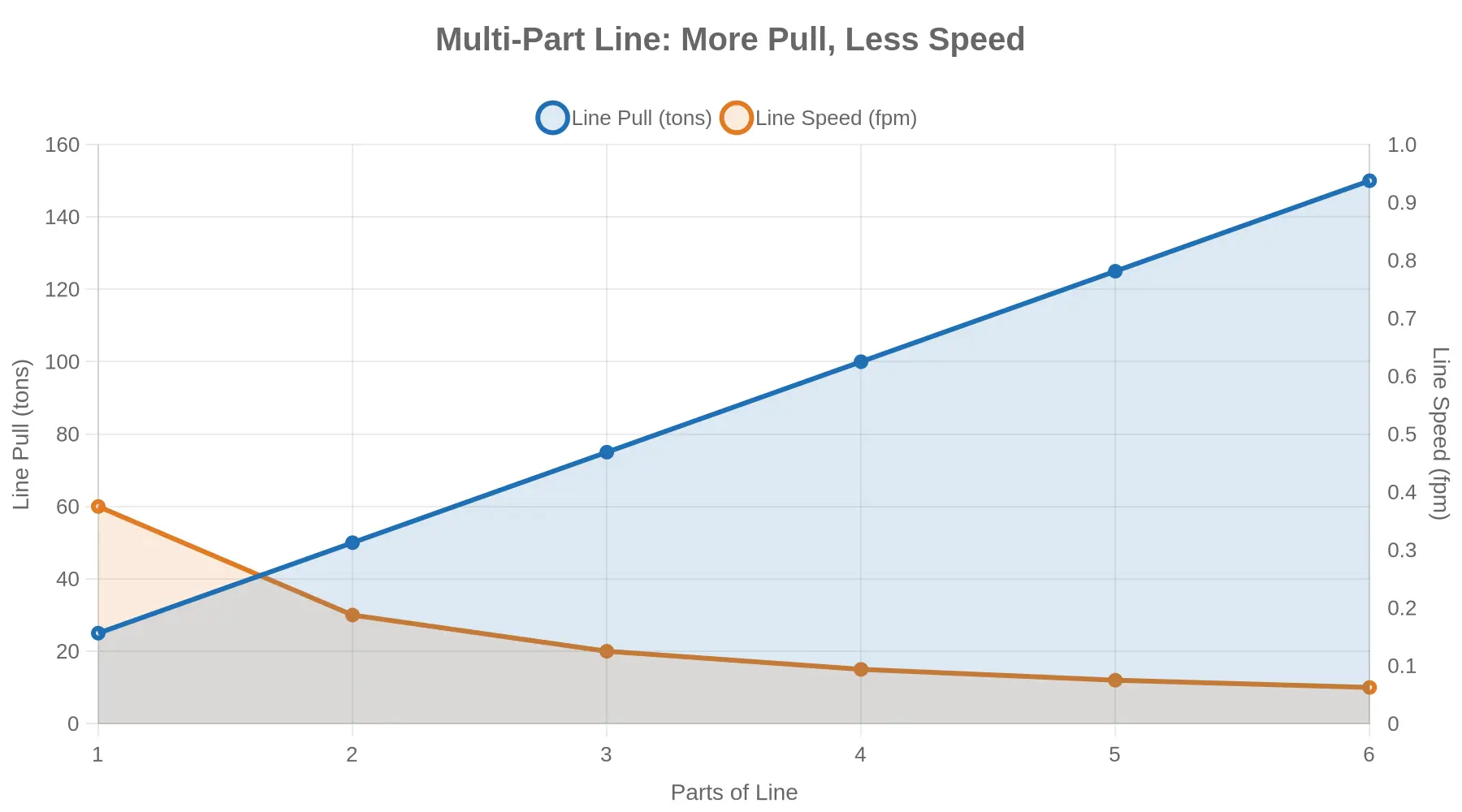
| Parts of Line | Resulting Line Pull (25-ton drum) | Line Speed | Load Carried at the Boom Tip |
|---|---|---|---|
| 1 | 25 tons | 60 fpm | 25 tons (one leg at 25 tons) |
| 2 | 50 tons | 30 fpm | 50 tons (two legs at 25 tons) |
| 3 | 75 tons | 20 fpm | 75 tons (three legs at 25 tons) |
| 4 | 100 tons | 15 fpm | 100 tons (four legs at 25 tons) |
Friction ignored: allow roughly 3 to 5 percent per sheave. Legs are counted at drum tension, and all of them hang from the boom tip.
Fleet Angle, Spooling, and Load Path
Fleet angle, the angle the rope makes between the sheave and the drum flange, should generally stay under about 1.5 degrees for a smooth even wrap. Beyond that the rope piles on one side of the drum, buries wraps, and creates shock loads when a buried wrap suddenly releases. Poor spooling also forces the rope to cross-wrap, abrading strands from the inside out.
Geometry matters at the load end too. Snatch blocks must be aligned with the line of pull, the boom tip has to stay inside its rated working arc, and the load path should be as close to straight as the site allows. Every extra angle multiplies the resultant load on anchors and hardware.
Match Hardware to the Higher Number
Shackles, hooks, snatch blocks, sheaves, slings, and end fittings have to be rated for the greater of two figures: the drum’s line pull multiplied by parts of line, or the load the boom tip actually sees. Sizing shackles to the winch rating while running a four-part line that develops four times that tension is a common and costly error. The rope has to match as well, because a wire or synthetic rope rated below the resulting tension is the weak link no matter how strong the winch is.
Experienced crews in heavy-duty recovery check three things before the first pull: the boom’s rated capacity at the working radius, the total tension the reeving will develop, and the working load limit of every component in the path. When those three line up, multi-part rigging is a genuine force multiplier. When they do not, the boom becomes the fuse. Operators evaluating equipment for this work can start by reviewing tow trucks in Houston rated for combined boom and winch duty.
Rigging multiplies line pull, not boom strength. Configure the reeving for the tension you need, keep fleet angles tight, over-rate the hardware, and treat boom capacity as the fixed ceiling it is.
Winch Line Pull Derating: Why the Number on the Spec Sheet Is Not the Number at the Hook
When you compare recovery trucks, the published winch rating is almost always a bare drum figure: the pull available on the first, tightly wound layer of wire rope. Put more rope on the drum and the number drops. That is mechanics rather than marketing, and it is not a sign of a weak winch. Every additional layer increases the effective radius of the drum, so the same torque produces less pull at the hook.
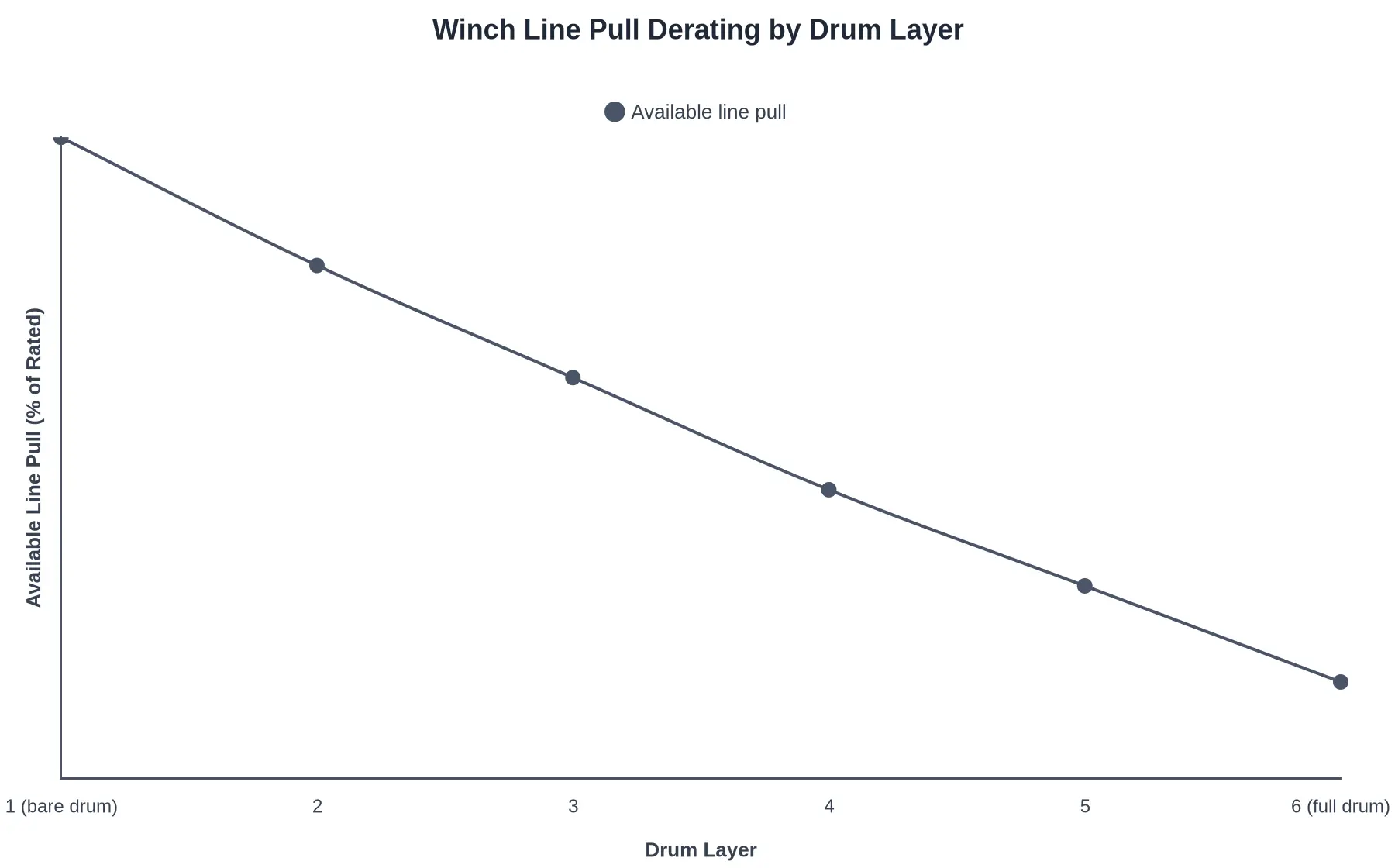
The chart above plots the principle in its purest form: drum layer across the horizontal axis, percentage of rated line pull up the vertical. The line starts at 100% on the bare drum and declines steadily toward roughly two-thirds of rated capacity at the full drum. No spikes, no plateaus, just a smooth predictable loss worth planning around.
Reading the Derating Curve in the Field
A winch advertised at 30,000 lb of line pull is a 30,000 lb winch on layer one only. Spooled full, you may be working with something closer to 20,000 lb. That gap matters on Houston’s I-45 shoulder with a loaded tractor-trailer on the hook, or pulling a piece of equipment out of soft ground on the East Side.
| Drum Layer | Approximate Line Pull Retained |
|---|---|
| 1 (bare drum) | 100% |
| 2 | 92% |
| 3 | 85% |
| 4 | 78% |
| 5 | 72% |
| 6 (full drum) | 66% |
Values are representative of typical multi-layer spooling and differ slightly from the 4.5-6.5 in drum example above, where the rope builds radius faster; consult the specific manufacturer’s performance curve for exact figures.
What This Means for Truck Selection
Three things are worth doing when you evaluate heavy-duty rigs:
- Compare derating curves, not headline numbers. A winch with a flat curve across layers will outperform a higher-rated unit that falls off a cliff once spooled.
- Size the winch to the worst-case layer. Recovery plans usually depend on long scope, which means the full-drum pull is the number that matters, not the bare-drum figure.
- Balance winch pull against boom capacity. A boom rated for 25 tons with a winch that cannot match it at full drum leaves recovery capability on the table. Ideally both systems run out at about the same load.
Operators building out a heavy-duty tow truck fleet in Houston should ask for the full derating table alongside the boom chart. That one document says more about real recovery performance than any single specification line.
Keep It in Perspective
Derating is one variable among several. Rope condition, sheave and snatch block losses, drum wrap quality, and operator technique all compound on top of it. A well-maintained winch with a clean, even spool will recover a truck that a neglected unit with a badly crowned drum cannot touch, even with identical nameplate ratings.
Treat the rated line pull as a ceiling reached only at the bare drum, and plan every recovery from there. That habit alone prevents most of the overloaded-winch situations that turn a routine pull into a shop visit.
FAQ: Ratings and Selection Questions from Operators
Can a higher winch line pull rating compensate for lower boom capacity?
No. Boom capacity and winch line pull describe two separate load paths, and one cannot substitute for the other. The boom rating limits the structural load the boom, cylinders, and turret can carry at a specific radius, while the winch rating limits the tension the drum, wire rope, and hook can develop. A truck with an 80,000 lb winch and a 30,000 lb boom rating still fails structurally if the load is picked above 30,000 lb at that radius, because the excess tension has nowhere to go except into the boom and the truck’s frame. Exceeding either rating also shifts the failure mode from a controlled stall to a sudden structural break or a tip-over.
How do I read a boom load chart at extended reach?
Match four variables at once: boom length, boom angle, load radius (horizontal distance from the center of rotation to the hook), and configuration, meaning outriggers extended, boom retracted or telescoped, and work over the rear versus the side. Capacity falls steeply as radius increases, so the extended-reach column is always far lower than the retracted short-radius column, even at the same boom length. Subtract the weight of the hook block, slings, shackles, and any attached rigging from the charted figure before you compare it to the load. Stay on the published values for your exact configuration, and never interpolate between lines or read a chart printed for a different boom.
Does adding parts of line increase lifting capacity?
Adding parts of line raises the force available at the hook and roughly divides the required tension per line, but it does not raise boom capacity. Two or three parts of line let a winch develop more hook force within its own torque limit, at the cost of line speed and some efficiency loss from sheave friction, typically a few percent per sheave. Once hook force is sufficient, the limiting element becomes the boom structure or the truck’s stability, not the drum. Increase parts of line to control a load safely, never to exceed the charted boom capacity for the radius.
How does drum layer affect usable line pull?
A published winch line pull rating is normally the bare-drum, first-layer figure, which is the maximum the unit can produce. Every additional layer of wire rope increases the effective radius at which the rope wraps, and line pull drops in inverse proportion to that radius. A typical heavy-duty winch retains around 90 percent of rated line pull on the second layer and falls to roughly 65 to 70 percent at a full drum. For a heavy pull, spool down to the lower layers or use the manufacturer’s per-layer rating table, and keep the fleet angle at about 1.5 degrees or less so the rope spools evenly.
Is a rotator necessary for heavy-duty recovery work in flat terrain?
A rotator is not strictly necessary in flat terrain, because much of its advantage comes from articulation, off-road mobility, and multi-directional pull geometry rather than grade capability. A conventional heavy-duty tow truck with adequate boom capacity, two winches, and properly rated rigging can complete many straight-line recoveries on pavement, including uprighting and rolling a tractor-trailer. A rotator earns its cost when the job requires continuous rotation, dual boom-tip winches, or complex off-axis rigging on overturned or confined loads. Base the decision on rigging complexity, load geometry, and cycle time rather than on terrain alone.
What documentation should an operator request before purchasing a used heavy-duty tow truck?
Request the OEM build sheet keyed to the VIN, the matching boom load chart plate, winch model and serial numbers, and confirmation that the installed boom, winches, and body correspond to the original specification. Ask for a third-party structural inspection with nondestructive testing of the boom and turret, a current proof-load or load-test certificate, and wire rope and sheave service logs. Maintenance and hydraulic service records, hour-meter readings, and repair invoices should be provided and reviewed for gaps. Also obtain the title, axle and GVWR ratings, and any accident or out-of-service history. Buyers comparing options can review heavy-duty tow truck configurations in Houston to see how these ratings are specified in practice.
Bringing It Together: Two Ratings, One Decision
Boom capacity describes how much the structure can hold at a given radius. Winch line pull describes how much resistance the drum, rope, and hydraulic system can overcome. Neither figure alone tells you whether a truck can do the job, and a machine can pass one test while failing the other, so selection has to satisfy both, with both derated for boom angle, reach, and drum layer.
The calculation is short enough to run on every job. Establish the load and the geometry of the lift, read the derated boom capacity at your worst-case radius, then work out the line pull required after reeving and friction. Compare both against the ratings with a working margin, and finish by confirming pull at the drum layer you will actually be spooled to, because effective line pull drops as rope stacks on the drum.
Configuration and winch count carry as much weight as the headline numbers. Boom length, boom extension, outrigger spread, sheave arrangement, and the number of winches all change what a truck can do on scene, particularly in heavy-duty recovery work where the load is stuck, off-axis, or simply unpredictable.
Before the cable takes tension, verify three things: the manufacturer’s load chart for the exact configuration in front of you, the working load limit of every rigging component in the system, and the thermal duty limits of the winch and hydraulics during long stalled pulls.
For crews who want background reading on towing and recovery practice, Mike’s Towing maintains a public information resource on towing and heavy-duty recovery guidance. Treat it as a reference point for planning, not as a replacement for your own load charts and engineering review.