
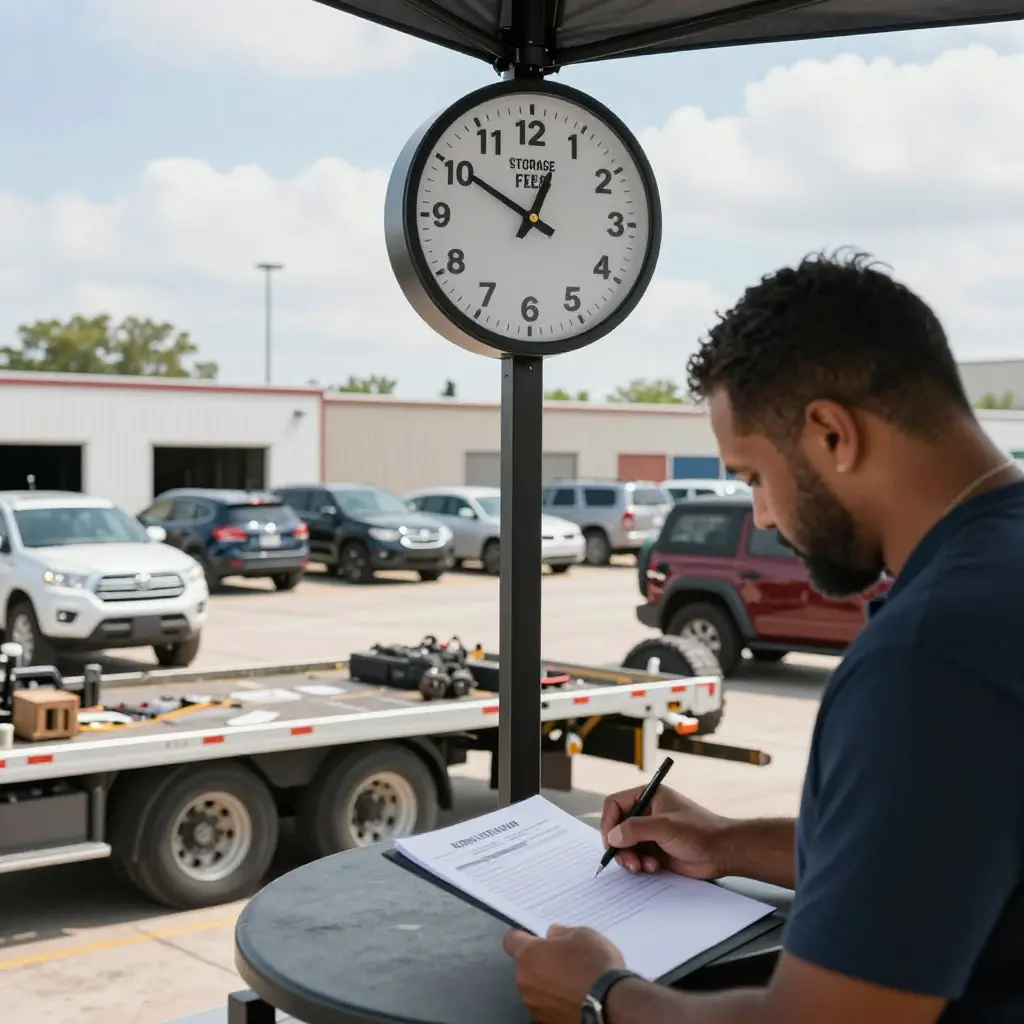
The Storage Fee Clock, Defined
A Houston towing storage yard is a secured, permitted lot where a tow operator holds a vehicle after removing it from private property, a public street, or a crash scene. In state licensing language, it is a vehicle storage facility, or VSF. Once a car is inside the gate, a daily storage fee starts to run. Texas caps that fee and sets the rules for when it may be charged; city rules can lower the tow rate itself.
Most arguments over a release bill come down to two questions: when the storage fee legally started, and who is allowed to sign the car out. Gate hours and payment methods matter too, but they are easier to pin down.
- When the storage clock starts. The fee attaches when the VSF receives the vehicle. It is charged for each day or part of a day, and the day begins and ends at midnight. The intake record and the tow ticket are the documents that show those times, so ask for both.
- Who may sign the release. The registered owner, or someone who can prove authority with one of the documents Texas accepts. Missing paperwork is one of the usual reasons a release trip ends with the car still behind the fence.
- What to verify before paying. An itemized invoice that separates tow charges from storage charges, the posted daily rate, and the notice record. Texas limits which fees a VSF may add to the bill.
Owners who want the paperwork trail explained before they arrive can read about the release process through this Houston towing company.
Key Terms Used in Texas Towing Storage Rules
Invoices, tow notices, and release forms use a small vocabulary of their own. These are the terms that matter when you question a charge or collect a car in Houston or anywhere else in Texas. For broader context, see these notes on local towing and storage practices in Houston.
- Tow – Moving a vehicle from one location to another without the owner or operator driving it, usually with a tow truck, wrecker, or wheel-lift unit. A tow may be ordered by a property owner, a law enforcement agency, or the vehicle’s owner or authorized driver.
- Storage yard – A secured lot where towed vehicles are held until they are released to someone with a legal right to claim them. A licensed VSF keeps intake records identifying each vehicle, the date and time it arrived, and the person or entity that ordered the tow.
- Daily storage fee – The charge added for each day, or part of a day, that a vehicle remains in custody. Texas caps the daily rate and treats a day as midnight to midnight. At the last published adjustment, the cap was $22.85 a day for a vehicle 25 feet or shorter and $39.99 for a longer one. If a car stays at the facility less than 12 hours, the yard may charge for no more than one day.
- Notification of tow – The notice a VSF must send to the registered owner and any lienholder. For a Texas-registered vehicle, it goes by certified mail within five days of receipt but no sooner than 24 hours; out-of-state registrations get 14 days. The notice identifies the vehicle, the reason for the tow, the yard, and the first date a storage fee is assessed.
- Vehicle release – The process of returning a stored vehicle to a person who has proven a legal right to claim it, normally after towing and storage charges are paid. The person must present photo identification and one accepted ownership or authorization document, and sign the release form.
- Authorized signer – The person permitted to sign the release and take custody of a stored vehicle on behalf of its owner. That can be the registered owner, a documented agent, or another person the owner has authorized in writing.
- Lienholder – A lender or other party holding a security interest in a vehicle, such as the financing company named on the title. A lienholder has a right to be notified of the tow and, with the proper paperwork, may recover or redeem the vehicle.
How the Storage Fee Clock Runs, at a Glance
The process has three anchor points: the tow, the notification, and the release. In the diagram below, the shaded block on the right is the daily storage charge. It keeps growing after the car lands in the yard, and it does not pause because the owner is still hunting down a title or waiting on a lienholder.

The meter starts when the yard takes the car in, not when you notice it is gone. Notice is required, and a late notice can delay when charges begin, but once notice is sent the meter runs. Release is the only step that stops it. Every day between the tow and the release shows up on the invoice.
That is why a fast, correct release usually saves more than a fight over the daily rate. If you do not know which yard has the car or who needs to sign, a towing company in Houston can often point you to the right lot and the right signature line on the first call.
When Does the Daily Storage Fee Clock Start?
The clock starts when the vehicle enters storage, not when the owner finds out. A common assumption is that the first daily storage fee begins on the day the owner notices the car is missing. Under Texas VSF rules, that is not how it works. The storage clock is tied to the tow-and-intake sequence, and it keeps ticking whether or not anyone has realized the car is gone.
Three records establish the fee start point. A properly run Houston towing storage yard documents its charges with a paper trail that anchors the start time to recorded events rather than a clerk’s recollection.
| Record | What it establishes |
|---|---|
| Tow ticket | When and where the vehicle was towed, who ordered the tow, and the operator’s license |
| Yard intake record | When the vehicle was logged into the storage lot |
| Notice record | When and how the owner and lienholder were notified, and when the tow was reported to law enforcement |
The fee start point should trace back to these entries, not to a verbal estimate. Texas rules also require a VSF to keep records on each vehicle for two years, including the tow date and location, the authorizing party, and the identification of the person to whom the car was released.
A late notice limits the bill. The notice limit is where a bill can change materially. A VSF may not charge more than five days of storage before the required notice is mailed or published. If the notice goes out late, the daily fee may not begin until 24 hours after it was sent. A missing notice is not a technicality; it can cut the storage portion of a bill down to a few days. For a Texas-registered car, the notice must go by certified mail within five days of the yard receiving it, and no sooner than 24 hours. Cars registered out of state get 14 days.
There is no general grace period, and weekends count. A day begins and ends at midnight, and any part of a day can be charged. The one firm limit is the 12-hour rule: a car that stays at the facility less than 12 hours may be charged for no more than one day. A car delivered at 11:50 p.m. can be billed for that day, so the intake timestamp fixes which date counts as day one. That is another reason to ask for it. Some yards keep limited release hours, so a car that is ready for pickup on Sunday may not leave until Monday, with another day on the bill.
Ask for the timestamps before you pay. Request the tow ticket, the intake record, and the notice record together, then compare the day count against the posted rate. A VSF must let you see the tow ticket before you pay. A yard that keeps its records in order can produce those times without being pushed, and you can ask for them in writing. A professional tow service in Houston, TX should do the same.
Fee-Clock Start Rules by Tow Category
Storage charges start in the same basic way for most nonconsent tows, but the paperwork and notice rules change with the category.
| Tow Category | Documented Start Point | Notification Requirement | Practical Owner Action |
|---|---|---|---|
| Private-property tow (no consent) | When the VSF receives the vehicle | Property signage must comply with state and city rules; the VSF must report the tow to local law enforcement within two hours | Photograph the sign, then ask for the intake time and tow ticket |
| Law-enforcement-ordered tow | When the VSF receives the vehicle; the tow itself is documented by the ordering agency | Law enforcement tow record, plus the VSF report where required | Request the incident or tow order number tied to the vehicle |
| Accident or abandonment removal | When the VSF receives the vehicle | Notice depends on whether the vehicle is classified as accident-related or abandoned | Ask which classification applies, since the notice and sale rules differ |
| Commercial or fleet vehicle tow | When the VSF receives the vehicle; a service contract does not change the fee rules | Contract terms can designate a company contact, but the yard still requires the release documents listed above | Bring a company authorization letter and the unit number, plate, and VIN |
| Vehicle held for lien or title issues | When the VSF receives the vehicle; storage does not wait for title work | Written notice to the registered owner and lienholder | Confirm the lienholder on record and ask what release documents are required |
This table summarizes general categories. The rule that governs a specific yard should be confirmed with the yard and with TDLR – for local guidance, see towing in Houston.
Who Is Authorized to Sign the Vehicle Release
The registered owner of record is the default authorized signer. That name appears on the title and registration, and the release counter checks it against the photo identification presented. When the owner cannot appear, Texas rules allow a release to someone who can show authority. A notarized power of attorney signed by the owner, a court order or letters testamentary for an estate, a lienholder or insurer with the proper claim or lien documents, and a company representative with written authorization on letterhead all fit. A phone call or verbal permission does not.
At the counter, the yard needs government-issued photo identification plus one accepted document that proves ownership or authority: a driver’s license whose name matches the DMV registration record, an insurance card naming the person as an insured, a certificate of title, a notarized power of attorney, a tax collector’s receipt with a registration renewal card, a current lease or rental agreement, or the TDLR removal and inspection form. If the name on the license matches the registration on file, that one card can satisfy both requirements. A VSF cannot hand a car to an unidentified third party, because it bears liability for releasing stored property to someone without a legal interest. That is also why the paperwork matters to you: storage fees keep accruing for every day the car sits, and a second trip costs another day. A reputable Houston tow company will state its documentation requirements in advance so the right person arrives with the right papers.
In practice: valid photo ID, one accepted ownership or authorization document, and the correct person at the counter. Nothing verbal.
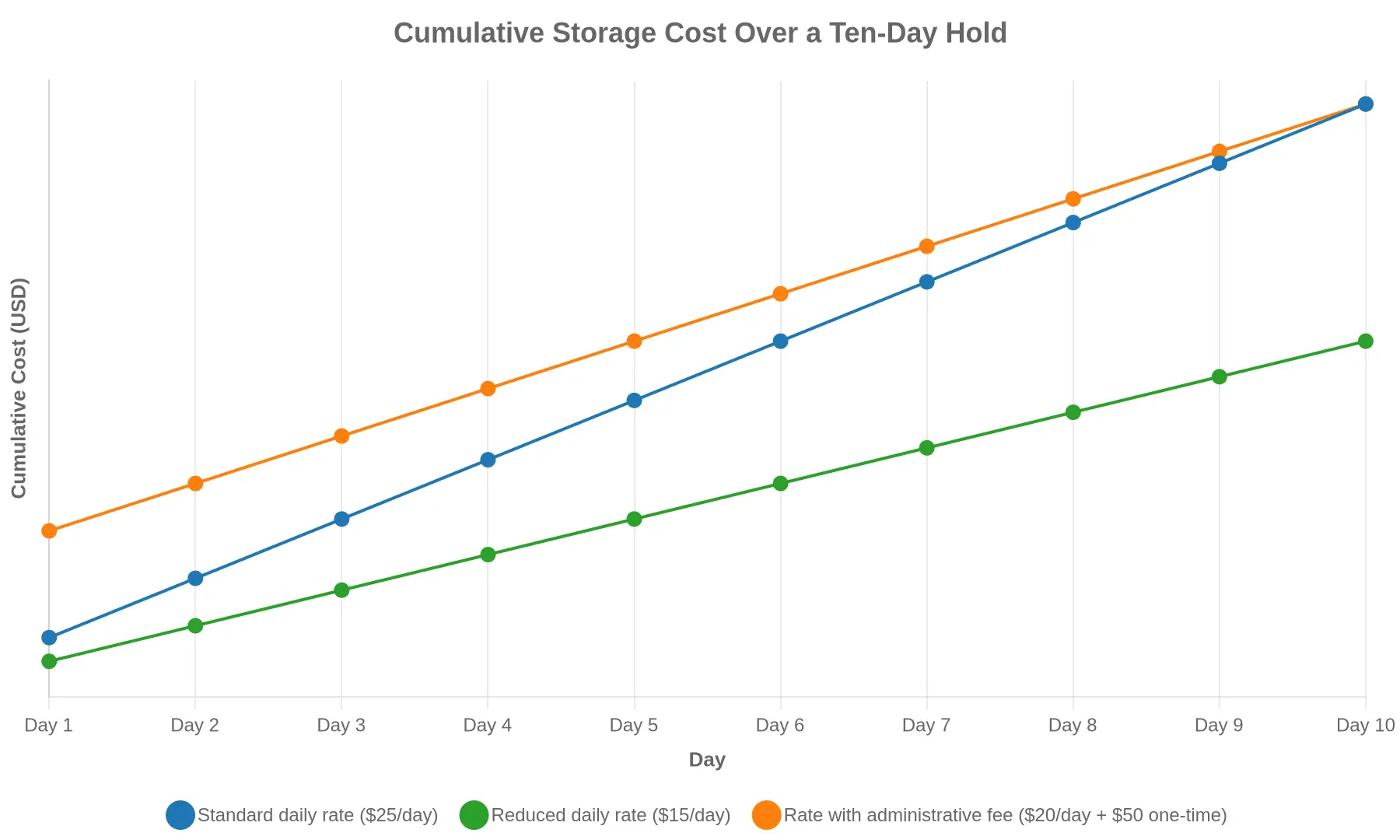
Cumulative Storage Cost Over a Ten-Day Hold.
Caption: This chart shows how a daily charge compounds; it is not a survey of Houston rates. A rate that looks a few dollars cheaper on day one can produce a different total by day ten. Actual rates are capped by state rule and posted at the yard.
Step-by-Step Vehicle Release Procedure
Knowing the order of events saves a second trip across town and a second day of storage charges. The vehicle release procedure follows a predictable sequence, and each step depends on the one before it. If you are still trying to locate the vehicle, start with a provider of Houston towing near me so you are working from the correct yard address and phone number.
- Confirm the yard name, address, and tow record number with the towing company or the property that ordered the tow.
- Bring a valid driver’s license or other government-issued photo ID.
- Bring one accepted ownership document: title, registration receipt with tax receipt, insurance card, notarized power of attorney, lease, or the TDLR removal form.
- If you are collecting a car registered to someone else, bring a notarized power of attorney or court order naming you.
- Ask for the tow ticket and an itemized invoice before paying, and check the daily rate and the number of days charged. A VSF must accept cash, debit cards, and credit cards.
- Ask whether a law enforcement hold or release is required before the car can be returned.
- Sign the release and get a copy showing the date, time, and the name of the yard representative.
- Keep the itemized receipt showing tow charges and storage charges separately.
- Inspect the vehicle, photograph its condition and odometer, then remove it within the yard’s posted hours.
Why the Order Matters
Skipping ahead costs a day. Arrive without an accepted ownership document and you will be sent home while the meter runs. Pay before a hold is cleared and your money sits with a car you still cannot drive. Ask the clerk when the storage fee started, keep the paperwork in one folder, and photograph the car before you leave, so a later disagreement is about records rather than memory.
Fleet drivers should carry a signed authorization on company letterhead plus photo ID. Putting that packet together before a tow happens saves a second trip.
Documentation, Receipts, and Disputing Charges
A trip to a Houston towing storage yard usually ends at a payment window, with a number on a screen and a car waiting behind a gate. What separates a clean pickup from weeks of follow-up is the paperwork you leave with. The itemized invoice, the tow ticket, and the signed release do most of the work. Gather them before you drive away, and every charge has a written origin you can point to later.
What to collect at the counter
| Document | What it should show | Why it matters |
|---|---|---|
| Tow ticket | Towing company, operator license, time and location of the tow, who authorized it, and itemized tow charges | Establishes when the tow happened and what the tow itself costs |
| Itemized VSF invoice | Storage days and daily rate, plus any notification, impoundment, or government fee, kept separate from tow charges | Lets you check each line against the posted rate and the allowed fee list |
| Signed release | Your name, identification type and number, date and time, the yard representative’s name, and any condition notes | Confirms who authorized the release and when the car left |
| Payment receipt | Amount, method, date, and receipt number | Ties the money paid to the invoice |
| Photos | Vehicle condition at pickup, plus the odometer reading | A baseline if condition questions come up later |
The itemized invoice: the three lines that matter
A lump-sum figure tells you almost nothing. Ask for an itemized invoice that separates the flat tow charge, the daily storage fee, and any other allowed fee. Texas limits VSF add-ons to a notification fee of no more than $50, an impoundment fee, government or law enforcement fees, and the daily storage charge. “Administrative” or “after-hours release” is not a separate category a VSF may invent. Because towing storage fees accrue per day, the daily rate and the number of days charged should appear side by side.
Asking for that breakdown before you pay is routine, not an accusation. If the itemization is not offered, ask for it.
The tow record and its timestamps
Ask for a copy of the tow ticket as well. It answers the practical question of when billing started: the time the car was hooked up, the time it was checked into the yard, and who ordered the tow. Those entries are what a day count is built from. With them on paper, you are comparing dates to dates instead of recalling a phone call.
The signed release
Whoever signs the release takes responsibility for the vehicle. For a personally owned car, that is normally the registered owner with a valid ID. Fleet managers and business drivers should bring a company authorization letter and the unit number, plate, and VIN, and should ask that the signer’s name and title appear on the release copy. Keep your own copy showing the release date and time.
Why the paper trail matters
A written record is the basis for any later fee question. If a line on the invoice does not match the posted rate, or the day count differs from the intake timestamp, send a short written request for clarification with copies attached. That keeps the conversation specific.
If the yard will not correct an overcharge, a tow hearing at a justice of the peace court in the county where the car was towed is the formal route. The request must be filed within 14 days of the tow, and the court can review whether the tow, storage, or fees complied with the rules. A TDLR complaint is separate and can be filed at the same time.
Fleet operators can simplify this by keeping one folder per unit with the invoice, tow ticket, release, and photos, then noting the date, time, and name of the person who handled the release. It also helps to know the posted maximum before treating a number as normal, and an affordable towing service in Houston can give you a local comparison.
Keep the invoice, the tow ticket, and the release together. If a charge is wrong, those three documents are your case.
For Fleet Operators and Company Vehicle Owners
When one of your vans or trucks is hauled in, the daily fee clock on company vehicle towing storage starts at intake, when the vehicle is logged onto the yard’s lot sheet. It does not wait for a manager to get the message. Yard staff will release a fleet vehicle only to the registered owner or someone who can show written authority from the company, usually a letter on letterhead naming the person, plus photo ID. Ask whether the yard will keep an authorization letter on file; doing that before a tow can save the next trip. Keep title and registration copies accessible, whether in a fleet binder or as clear digital copies a driver can pull up on a phone. Without them, the release stalls even when the right person is standing there. Providers of tow trucks in Houston will usually say which documents they need before you arrive.
A delayed retrieval gets expensive in ways that are easy to miss. Every day the vehicle sits adds another storage fee, and weekends and holidays do not pause the meter. A unit waiting on an unavailable signer can end up costing more than the tow itself, on top of lost revenue from a truck that is not running routes. Name a backup signer before you need one.
Where a Towing Storage Bill Comes From
A Houston tow-and-storage bill is not one number. It is a stack of charges that behave differently over time. The doughnut chart below is an illustrative example of how a bill can break down, not an average of Houston bills:
- Base tow charge (45%) – the flat fee for the hook-up, mileage, and delivery to the yard. It is generally the largest single line item and is fixed once the tow is completed. Statewide caps apply to private-property tows – at the last published adjustment, $272 for a vehicle up to 10,000 pounds – and cities can set lower ones.
- Daily storage fees (30%) – charged per day or part of a day while the vehicle is stored, up to the rate cap set by state rule.
- Notification and administrative fees (15%) – in Texas, the allowed VSF add-ons are narrow: a notification fee capped at $50 (plus publication cost in some cases), an impoundment fee, and government fees. A general “administrative” charge is not allowed.
- After-hours or specialty handling (10%) – winching, dollies, and low-clearance equipment belong on the tow ticket. A VSF may not add a separate after-hours release fee.
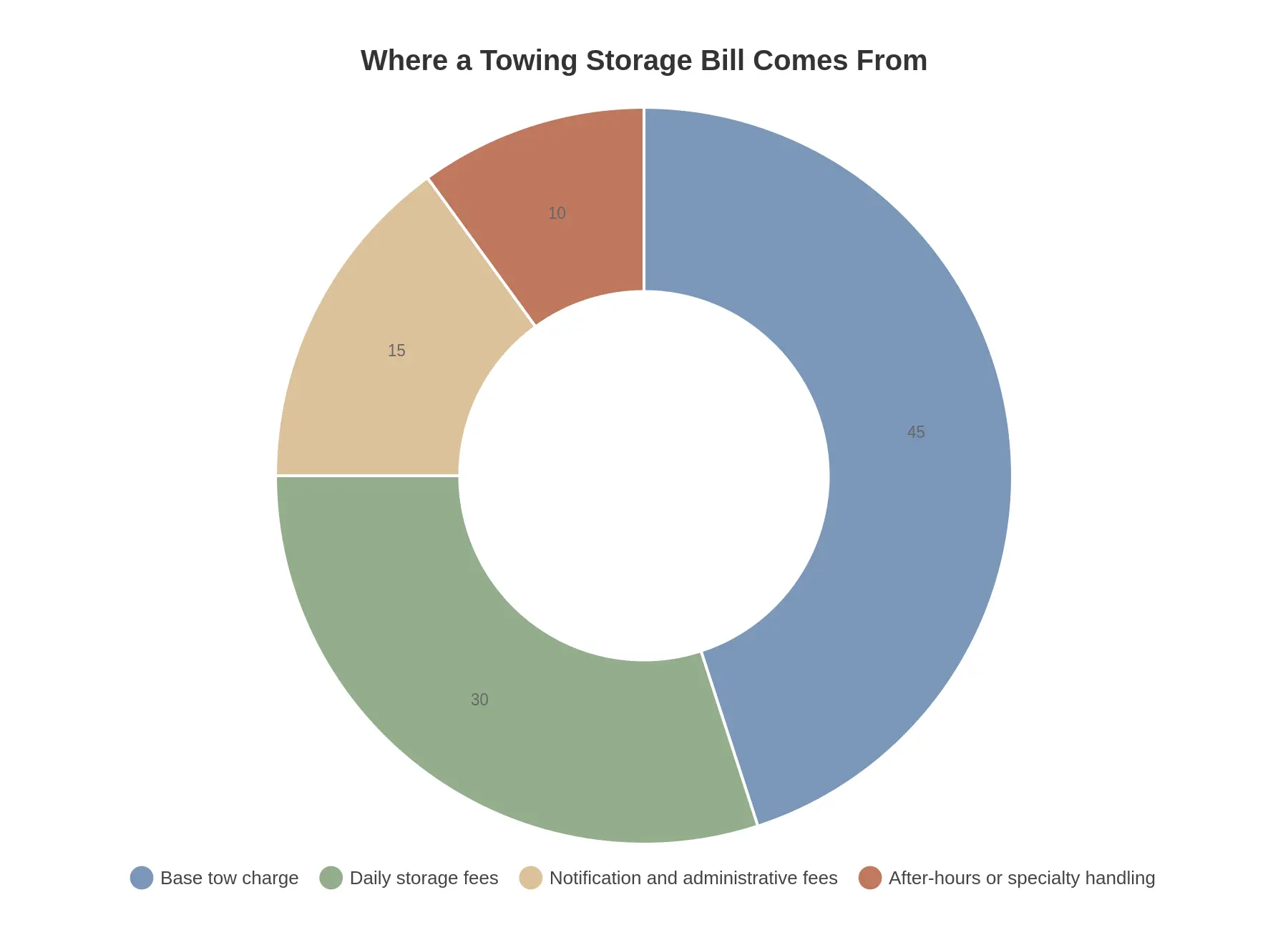
Daily storage fees grow as a share of the bill the longer a vehicle is held. A two-day stay may keep the base tow charge dominant, while a two-week hold can push storage past half the total. The chart is an illustration; the day the fee clock starts, not the day you learned about the tow, is the number worth pinning down.
Under Texas rules, storage charges generally begin when the VSF receives the vehicle, not on the date of the first notice. A car towed on a Friday afternoon and claimed the following Thursday can carry more days than the owner expects. Understanding how Houston tow service pricing is structured before a tow happens makes it easier to challenge a line item that looks inflated. When in doubt, ask the yard for a written breakdown showing the tow date, the storage start date, and the daily rate, then compare it with the release paperwork.
Frequently Asked Questions
Does the storage clock start the day of the tow or the next day?
The clock starts the day the vehicle enters the Houston towing storage yard, not the following morning. If your car was towed and delivered on a Tuesday, Tuesday is day one and it is billable. If it reached the yard after midnight, the next day is day one. A day runs from midnight to midnight, and any part of a day can be charged, though a stay of less than 12 hours may be billed for only one day. Picking the vehicle up the same day you learn it was towed is still the cheapest move.
Can someone other than the registered owner sign the release?
Yes, if they bring photo identification and one accepted document showing authority: a notarized power of attorney from the owner, a court order, a title, a lease or rental agreement, an insurance card naming them as an insured, or another document on the state’s list. A verbal OK from the owner is not enough, and the person signing should be the person named in the authorization. The yard records the identification of whoever takes the car.
Is the daily fee charged for partial days?
Yes, any part of a day can be charged, and the day begins and ends at midnight. The exception is a stay of less than 12 hours, which may be charged as no more than one day. Arriving at 9 a.m. instead of 5 p.m. on the same day does not change that day’s fee, but arriving a day earlier does. Confirm the posted rate before you drive over.
Who must be notified after a tow?
The VSF must notify the registered owner and any recorded lienholder. For a Texas-registered vehicle, that notice goes by certified mail within five days of the yard receiving the car, but not sooner than 24 hours; out-of-state registrations get 14 days. The VSF must also report the tow to the local law enforcement agency with jurisdiction, generally within two hours. The towing company must give the owner a tow ticket for a nonconsent tow. If you believe notice was never sent, ask the yard for its notice records and keep them.
What documents are needed to pick up a vehicle?
Bring a government-issued photo ID and one accepted ownership or authorization document: a driver’s license matching the DMV record, an insurance card naming you as an insured, a title, a notarized power of attorney, a tax receipt with registration renewal card, a lease, or the TDLR removal form. Then pay the tow and storage charges. You do not need to produce every document on the list, but the one you bring has to match the person and the car.
Can storage fees be questioned after payment?
Yes. Paying does not waive the right to dispute a charge. Ask for an itemized receipt showing the tow fee, each day of storage, and any other allowed fee, then raise an improper line item with the yard in writing. If the two sides cannot resolve it, a tow hearing can be requested at a justice of the peace court in the county where the car was towed within 14 days of the tow. Complaints about licensed tow operators and VSFs can also be filed with the Texas Department of Licensing and Regulation. A company that runs an organized operation, like Mike’s Towing, should hand over itemized receipts without being asked.
Still have questions about a specific vehicle? Call the yard, ask for a written breakdown of charges, and get the name of the person who gave you the total.
Pulling It Together: The Clock and the Signature
Two rules do most of the work. The daily fee follows documented events: when the VSF received the car, when notice was sent, and what the posted rate allows. Possession follows paperwork: photo ID plus an accepted ownership or authorization document. Neither rule requires a lawyer to apply. Ask for the tow ticket and intake time, check the day count against the notice date, and confirm who can sign before you drive over. If the records are in order and the signer is documented, a storage bill is easier to check line by line. The timelines published by Mike’s towing and the release practices described for Mike’s wrecker service are worth reviewing before you pay anything.
Before you drive to the lot, confirm its posted hours, and remember that state rules require it to take cash, debit cards, and credit cards. Bring your identification and one ownership document, plus a notarized power of attorney if you are collecting the car for someone else. Then compare each storage day on the invoice against the intake and notice dates on file.