
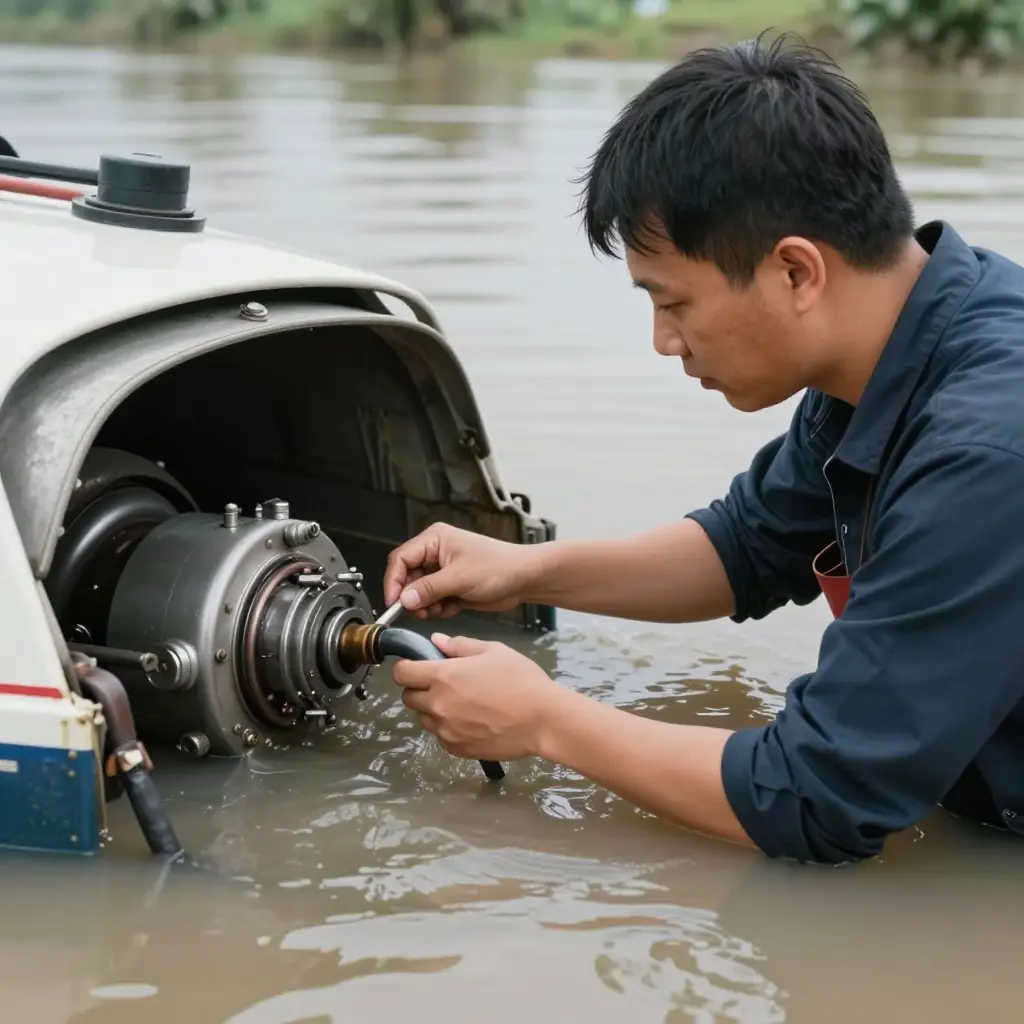
Hydrostatic Lock: The First Check Before Recovering a Submerged Car
A flooded car does not get recovered with a hook and a winch. It gets inspected first. Hydrostatic lock, usually shortened to hydrolock, happens when water gets into an engine’s cylinders and stops the pistons mid-stroke. Air and fuel vapor compress; water does not. Once a cylinder fills with liquid, the piston has nowhere to go, the crankshaft stops turning, and the engine locks against water it cannot shove out of the way.
For a Houston tow operator standing over a submerged car, that check is the difference between a tow and a rebuild. Crank, start, or force a hydrolocked engine and you can bend connecting rods, crack the block, or break pistons – and a car that might have been dried out and saved becomes a total loss. Checking first protects the engine, the operator, and the owner’s insurance claim.
The steps below are written for tow operators, mechanics, vehicle owners, and insurance adjusters working flooded-vehicle recovery, with the mechanical reasoning behind each one. For background on how local crews run these calls, Houston towing operations is a useful reference.
The Mechanical Reasoning Behind Hydrostatic Lock
A four-stroke engine is built to compress gas, never liquid, and that one assumption is where hydrostatic lock comes from. On a normal compression stroke the intake valve admits an air-fuel mixture, the piston sweeps upward, and the charge simply packs into a smaller volume. Water will not do that. It is effectively incompressible at the pressures an engine produces, so once water in cylinders fills the combustion chamber, the piston has no volume left to claim.
Where the Stroke Stops
The piston keeps rising until it meets an immovable column of water in the clearance volume. The stroke stops there, but the rotating assembly is still carrying kinetic energy and the starter is still applying torque, and that energy has to go somewhere. Three parts take the hit:
- Connecting rod – The rod is loaded in compression far past its design limit. Slender and weak in bending, it buckles instead of crushing, which is why a bent connecting rod is the classic sign of engine hydrolock.
- Crankshaft – The crank throw and main journals take a violent torque spike that can twist the shaft, damage bearings, or shear a rod bolt.
- Starter motor – Driving a crank that cannot turn, the starter pulls massive current, stalls, and can burn out its windings or break its drive.
Why Forcing Rotation Causes Damage
The damage comes from trying to turn the engine, not from the water sitting in it. Turn the key, or drag the car in gear so the wheels back-drive the engine, and torque travels down the crankshaft into a hydraulic lock with nowhere to yield. The connecting rod bows, the piston skirt scuffs the cylinder wall, and in bad cases the pressure cracks the block or lifts the head off its bolts. That is why an operator checks cylinder condition before recovery, and why a trained professional tow service in Houston, TX that knows flood-recovery procedure protects both the vehicle and the customer’s insurance claim.
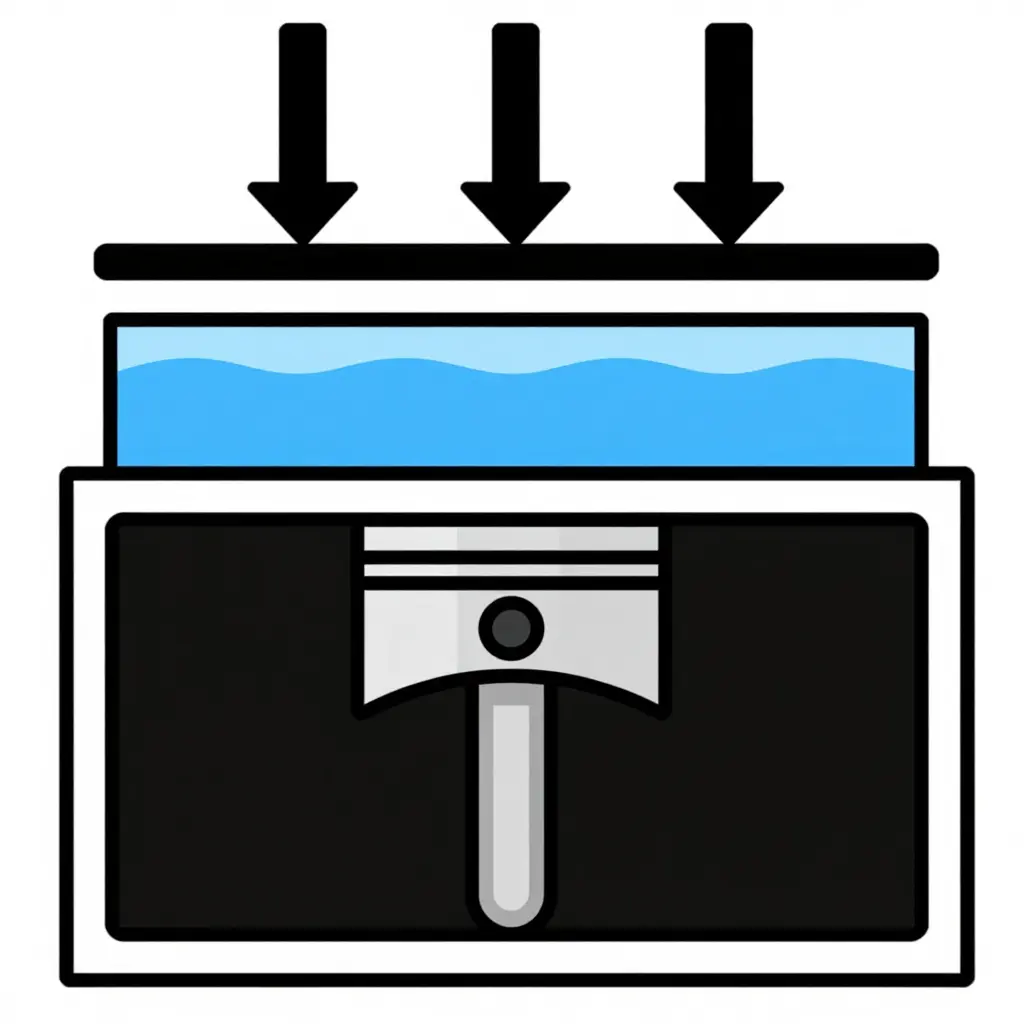
Figure: A simplified cross-section of a single engine cylinder showing how a trapped layer of water sits above the piston. Because water is effectively incompressible, it blocks the upward compression stroke, which is the core mechanism behind hydrostatic lock in a flood-submerged engine.
Visualizing the Cost Curve of Flood Exposure
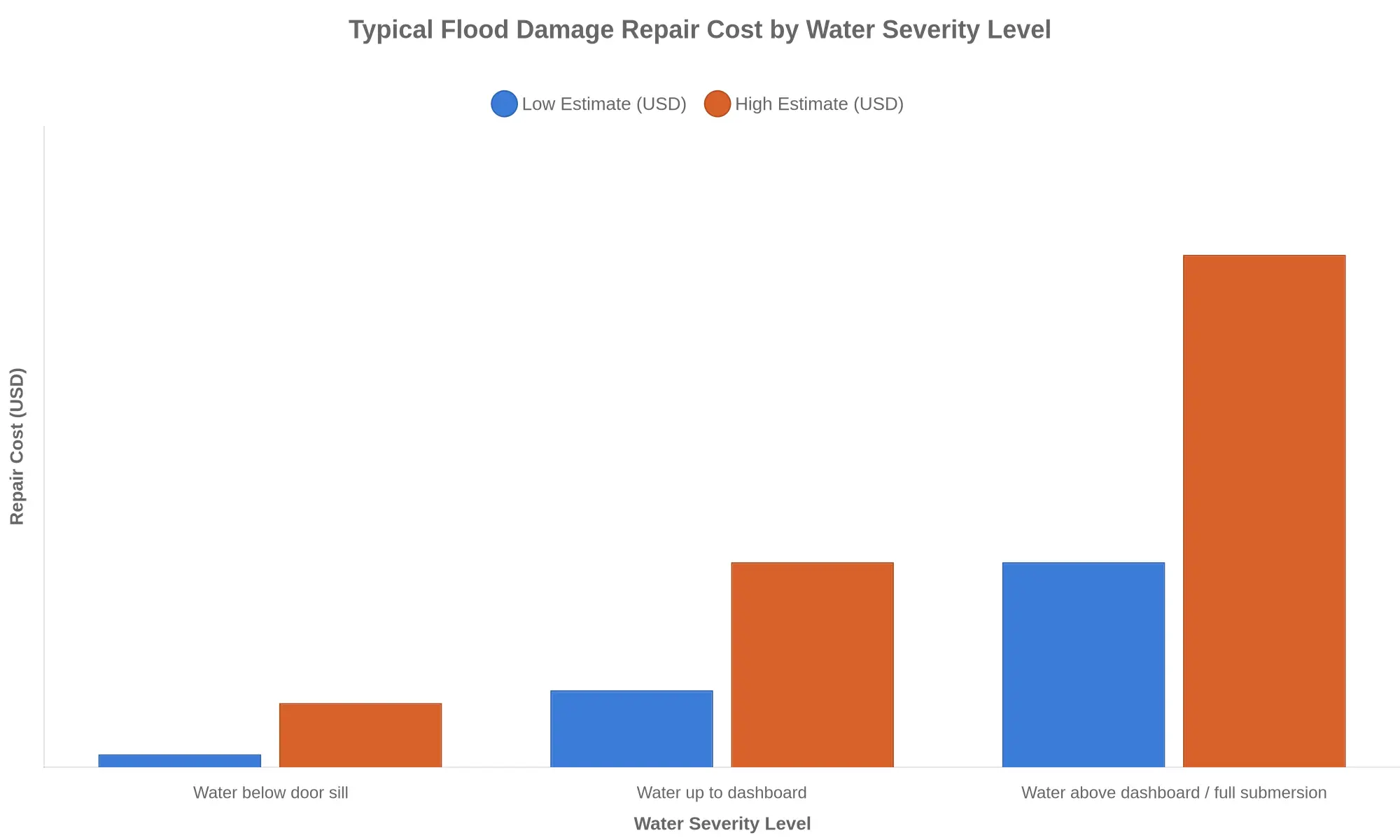
Depth decides the outcome. Water at the door sill is a drying-and-detailing job; water at the dash or the roofline can mean a hydrostatic-lock event that bends rods the moment someone turns the key. The chart plots typical Houston repair-cost ranges for those three levels. Cost does not climb in step with water depth – it accelerates. For an adjuster or tow operator deciding between repair and total loss, that curve is the whole decision.
Why Early Assessment Changes the Numbers
- Water below the door sill is mostly a moisture problem. Dry the cabin, pull the drain plugs, inspect the floor harness, and the bill usually lands in the low-to-mid four figures.
- Water up to the dashboard soaks seat motors, airbag modules, and the body control module, and it can reach the intake if the engine was running. Repair costs climb fast, and electrical faults can keep coming back for months.
- Water above the dashboard or full submersion is where hydrostatic lock lives. Water in a cylinder stops the piston cold, and the energy bends connecting rods or cracks the block. At that point the estimate is mostly engine replacement plus a full harness, and it often crosses into total-loss territory.
Checking for hydrostatic lock before the first pull-and-crank keeps the recovery plan intact: no start attempt means no bent rods, and accurate severity data lets the adjuster price the claim against the right tier on day one.
Embeddable Chart.js Configuration
Drop the data array and config below into any page that loads Chart.js.
const floodDamageCostChart = {
  type: 'bar',
  data: {
    labels: [
      'Water below door sill',
      'Water up to dashboard',
      'Water above dashboard / full submersion'
    ],
    datasets: [
      {
        label: 'Low Estimate (USD)',
        data: [500, 3000, 8000],
        backgroundColor: '#3B7DD8',
        borderColor: '#2E63AE',
        borderWidth: 1
      },
      {
        label: 'High Estimate (USD)',
        data: [2500, 8000, 20000],
        backgroundColor: '#D9622B',
        borderColor: '#B14E20',
        borderWidth: 1
      }
    ]
  },
  options: {
    responsive: true,
    maintainAspectRatio: false,
    plugins: {
      title: {
        display: true,
        text: 'Typical Flood Damage Repair Cost by Water Severity Level',
        font: { size: 18, weight: 'bold' },
        padding: { top: 10, bottom: 20 }
      },
      legend: {
        display: true,
        position: 'top',
        labels: { usePointStyle: true, boxWidth: 12, padding: 16, font: { size: 13 } }
      }
    },
    scales: {
      x: {
        title: { display: true, text: 'Water Severity Level', font: { size: 13, weight: 'bold' } },
        grid: { display: false },
        ticks: { font: { size: 12 } }
      },
      y: {
        beginAtZero: true,
        min: 0,
        max: 25000,
        title: { display: true, text: 'Repair Cost (USD)', font: { size: 13, weight: 'bold' } },
        grid: { color: 'rgba(0, 0, 0, 0.08)', drawBorder: true },
        ticks: {
          stepSize: 5000,
          callback: function (value) { return '$' + value.toLocaleString(); }
        }
      }
    }
  }
};
Reading the Chart as a Recovery Decision Tool
The gap between the low and high bars widens at every step down the water line. At the door sill the spread is a few thousand dollars. By full submersion, the spread alone is wider than the entire low tier of a minor flood job. That widening gap is what makes the early hydrostatic-lock check worth doing: it keeps the recovery and the insurance math tied to what is actually in the cylinders.
Why Pulling a Submerged Car Without Checking for Hydrostatic Lock Causes Damage
Hooking a flooded car and dragging it out looks simple from the driver’s seat. A car that has been sitting in floodwater is not simple. Skip the hydrostatic lock check before the first pull and a recoverable vehicle can turn into a totaled engine and a liability claim against your company. In flood recovery, the order of operations matters as much as the winch.
What Hydrostatic Lock Actually Means
When floodwater gets past the intake and into the combustion chambers, it will not compress. A piston on its way up to top dead center runs into a wall of liquid. If a starter or a running engine is pushing it, something has to give, and it is almost never the water. Connecting rods bend, pistons crack, head gaskets blow, and in bad cases the block fractures.
Towing on an Incline Shifts Fluids Inside the Crankcase
A submerged car rarely sits on flat ground. Drag it up a ramp, a levee, or a sloped street and oil, coolant, and trapped floodwater slosh toward the low end of the crankcase. The oil pump pickup can end up sucking air while contaminated water is pushed into bearings and seals. An incline pull changes lubrication at the exact moment the drivetrain is under its heaviest load.
Starting Attempts Force the Rotating Assembly Against Water
The start attempt does the most damage. When an optimistic owner or an eager tow operator turns the key, the starter cranks the rotating assembly straight into the trapped water. The crankshaft cannot finish a revolution through an incompressible column, so the load has nowhere to dissipate except into the weakest internal part. That is a classic hydrostatic lock failure, and it takes seconds.
Recovery Angle and Load Direction Multiply the Stress
Winch line angle and load direction make all of it worse. Side-load the vehicle, yank at a steep angle, or drag it while it is still partly buoyant and you overload mounts, driveline joints, and the transmission while the internal fluids are already in the wrong place. A sharp angle also raises the odds of body and suspension damage the flood never caused.
Practical Consequences for Tow Operators
Every avoidable failure becomes a damage claim. If a customer can show the fluid was never checked and the engine was cranked or dragged carelessly, the blame lands on the operator.
| Recovery Action | Mechanical Effect | Likely Damage |
|---|---|---|
| Starting before inspection | Rotating assembly hits water | Bent rods, cracked pistons |
| Incline pull without draining | Fluids shift in crankcase | Bearing and seal damage |
| Steep-angle or yank recovery | Overload on mounts and driveline | Suspension and body damage |
For owners and adjusters comparing bids, a disciplined recovery usually costs less than the claim it prevents. Anyone searching for a Houston tow truck should expect the operator to verify hydrostatic lock before the hook goes on.
Every flooded vehicle you hook up in Houston is a mechanical question. A car that sat in six inches of street water is a different job from a sedan that spent the night submerged in a bayou, and treating them the same is how a routine tow turns into a bent rod, a cracked block, or a claim. Water does not compress, so if it reaches the intake and fills a cylinder, the starter has nowhere to push it and the piston stops against liquid. Hydrostatic lock can bend rods and damage the crankshaft in less than one revolution. That is why Houston operators run a pre-pull inspection before the winch line goes taut. The table below matches the water level you see to the check it calls for and the recovery that keeps the engine, and the claim, intact.
| Water Exposure Level | Likely Hydrostatic Lock Risk | Required Pre-Pull Check | Recommended Tow Action |
|---|---|---|---|
| Standing water at tire sidewall or below (roughly under 6 in) | Low | Confirm the water line stayed below the air intake and oil dipstick; check battery and connectors for submersion | Flatbed or wheel-lift tow; do not start the engine; photograph the water line for the file |
| Water to the floor pan and mid door (roughly 6 to 18 in) | Moderate | Pull the air filter and look for water; check oil and transmission fluid for milky contamination; do not crank | Flatbed tow with the battery disconnected; drain the intake tract; flag for cylinder inspection before any start attempt |
| Water above the dash with the engine bay flooded (roughly 18 to 36 in) | High | Remove the spark plugs; borescope each cylinder for standing water; check the ECU and fuse box for immersion marks | Flatbed recovery; pull all plugs and hand-turn the crankshaft to purge cylinders; no starter use until the bores are verified dry |
| Water at or over the windows (cabin flooded, engine submerged) | Severe | Assume every cylinder holds water; remove plugs and inspect for rust staining and debris; test for water in fuel and differentials | Heavy flatbed or rotator recovery; pump the cylinders, drain all fluids, and document immersion depth in the claim file |
| Fully submerged vehicle resting in a Houston flood (water over the roof) | Certain | Treat as a total-loss physical inspection; remove all plugs, extract water from the cylinders, and log electrical and interior submersion | Submerged-recovery flatbed with winch or dive rigging; drain cylinders before any rotation; coordinate with the adjuster before transport |
The pattern is straightforward: the higher the water climbed, the less you trust the engine, and the more you inspect before applying torque. Two seconds of cranking on a hydrolocked cylinder is enough to send a connecting rod through the block, and that one mistake turns a recoverable vehicle into scrap – and wipes out the resale value the owner and the insurer are counting on. Tow action is not repair authorization. Flatbedding a submerged car keeps the drivetrain from rotating during transport; it does not clear the car for a restart. Only a shop that has pulled the plugs and confirmed the bores are dry can make that call, which is why the field notes you hand off matter as much as the hookup. Across the metro, a professional Houston tow service builds these checks into every dispatch, so the vehicle reaches the shop in the condition it left the water in.
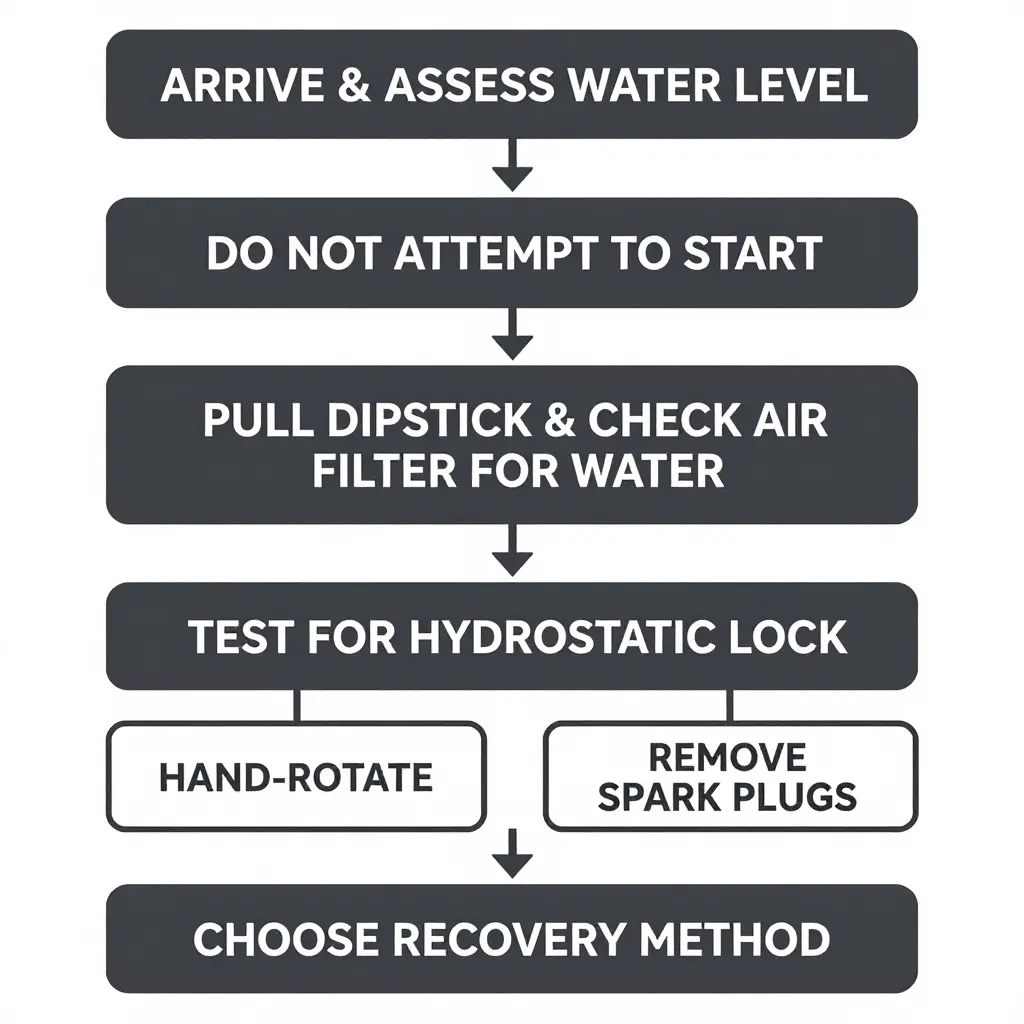
Figure 1. Pre-pull inspection sequence for a submerged or flood-damaged vehicle. Following these steps in order prevents a hydrostatic lock from turning into catastrophic engine damage during recovery.
The Pre-Pull Hydrostatic Lock Check: A Step-by-Step Procedure
Before a winch line goes taut on any flood recovery, the tow operator has to know whether the engine is hydraulically locked. If the cylinders are full of water, cranking or dragging the car can bend connecting rods, crack the block, or break a piston. Run this sequence every time.
Step-by-Step Pre-Pull Inspection
-
Park on firm, dry ground, level with the submerged car or uphill from it. Set the parking brake and chock the wheels so the truck cannot slide when the load comes onto the winch line.
-
Cut the battery ground (negative) cable first. With the ground broken, the starter cannot engage and a stray spark cannot light off fuel or debris. Taking the negative terminal first also keeps a wrench touching the body from shorting the electrical system.
-
Open the airbox and look for pooled water, silt, or a soaked element. If water reached the throttle body, it almost certainly reached the cylinders, and the engine is locked.
-
Pull the oil dipstick. Coolant or floodwater mixes with oil into a tan, frothy emulsion, and a reading above the full mark means liquid is in the crankcase. Either sign tells you to change how you pull.
-
Pull the spark plugs so compressed water has somewhere to go. With the plugs out, water pushed upward during rotation vents through the plug holes instead of stalling the piston. This is the step that turns a destructive lock into a recoverable one. For related roadside help, see our roadside assistance services.
-
Turn the crankshaft by hand, and only after the water paths are clear. Use a breaker bar on the crank bolt and go slowly. If it turns freely, the engine is not locked. If it binds, stop and treat it as hydraulically locked.
-
Photograph the dipstick, airbox, and plug wells, and log the odometer and the waterline height. Timestamped evidence shows the car was inspected before the pull, which protects the operator and the adjuster.
Why This Order Matters
Going straight to the winch is the most common and most expensive mistake in flood recovery. Each step depends on the one before it, so running the hydrostatic lock check in order protects the engine, the tow truck, and the paper trail the insurer will ask for.
Why Houston’s Terrain Makes Hydrostatic Lock Checks Non-Negotiable
Houston sits on a nearly flat coastal plain, which is the root of the flooding problem. With almost no slope to shed water, rain has nowhere to go but sideways and up. The clay-heavy soil stops absorbing once it is saturated, storm drains overwhelm within minutes, and surface water ponds, spreads, and climbs. Buffalo, Brays, and White Oak bayous and their tributaries form the primary drainage network, and in heavy rain they leave their banks and push water back into streets, parking lots, and garages.
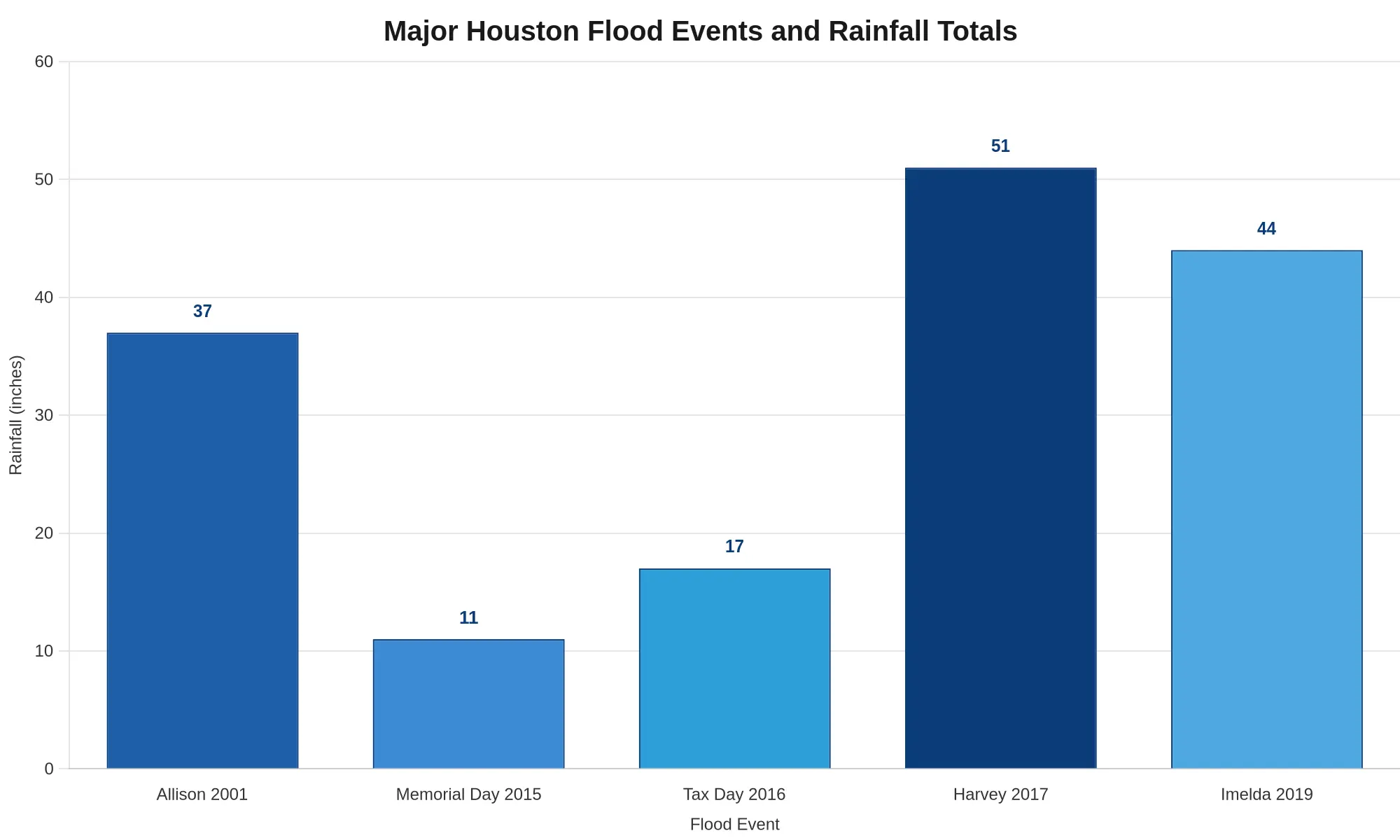
This is routine here, not a once-in-a-career event. Houston flood recovery happens on a repeating cycle. Tropical Storm Allison (2001), the Memorial Day flood (2015), the Tax Day flood (2016), Hurricane Harvey (2017), and Tropical Storm Imelda (2019) each dropped enough rain to submerge thousands of vehicles.
How Fast Standing Water Rises Around a Parked Vehicle
Because the ground can neither absorb nor shed the water, flooding around a parked car escalates quickly. Water can climb from the wheel wells to the door handles in well under an hour, and in a flash-flood corridor it can rise several inches a minute. A car that looked safe when the driver walked away can be past the dashboard before a crew arrives.
How Local Conditions Shape a Tow Company’s Recovery Decisions
That speed and repetition shape how a tow operator plans flooded vehicle recovery in Houston:
- Triage by water line, not call order – a car submerged to the roof gets handled differently from one with water only at the floor pan, because the recovery risk and the damage are not close.
- Approach and access – flooded underpasses, submerged garages, and soft shoulders mean confirming the surface can carry a loaded truck before committing.
- No start attempts – crews assume water reached the engine and drivetrain and secure the car without turning the key.
- Volume planning – because the storms return, established Houston firms keep extra flatbeds, winch capacity, and staging plans ready.
A local provider that treats this as routine is better positioned to move flood-damaged cars safely. See how a dedicated Houston tow service handles storm callouts.
Why a Submerged Vehicle Must Never Be Started
If floodwater entered the intake or exhaust, it can reach the combustion chambers. Water does not compress, so when the starter turns the engine, a piston rising against liquid cannot finish its stroke. Connecting rods bend, pistons crack, and the block or head can be ruined in a fraction of a second. Even an engine that escapes hydrostatic lock still has water and grit in the oil, transmission fluid, and electronics, and a start attempt can push current through wet wiring and cause a short or a fire. Disconnect the battery, tow the car out with the engine off, and let a technician drain, dry, and inspect it before anyone reaches for the key.
FAQ: Hydrostatic Lock and Flood Towing
What is hydrostatic lock and why does it matter after a flood?
It happens when a non-compressible fluid, usually water, gets into the combustion chamber through the air intake, the intake manifold, or a compromised cylinder head. A piston cannot compress liquid, so the crankshaft and connecting rods lock. On a flood-damaged vehicle that matters because any crank attempt drives the piston into an incompressible column of water, which can bend connecting rods, crack pistons, or deform the engine block inside one revolution.
Can a submerged car be started after being pulled out of water?
No. Do not start a submerged car until the intake, ignition, and fuel systems have been drained and verified dry. Water in the intake tract means a crank attempt pushes liquid straight into the cylinders and triggers hydrostatic lock. A qualified operator disconnects the battery, pulls the spark or glow plugs, and turns the engine over by hand to evacuate trapped fluid before anyone considers a restart.
How does a tow operator check for hydrostatic lock?
The operator looks for a visible water line, opens the air filter housing, and checks the intake tract for standing water. With the ignition disabled, they put a socket on the crank pulley bolt and try to rotate the crankshaft by hand. Resistance, or failing to complete two full revolutions, means hydrostatic lock. Milky oil on the dipstick or water in the spark plug wells points the same way.
Does water in the cylinders always destroy the engine?
No. If nobody cranked the engine while it was under water, the cylinders can often be cleared and the engine dried, flushed, and rebuilt. The damage comes from the energy of cranking against an incompressible column, not from the water sitting there. The real risks are bent rods, spun bearings, and cylinder walls that rust while internal moisture sits.
When should an insurance adjuster treat a flooded vehicle as a total loss?
Typically when floodwater reached the dashboard or higher, when the repair cost passes a set percentage of actual cash value (commonly 70 to 80 percent), or when electrical, drivetrain, and interior corrosion damage is beyond economical repair.
An experienced Houston towing company keeps recovery of flood-damaged vehicles organized, documented, and mechanically safe from the first pull to the final assessment.
The Bottom Line on Hydrostatic Lock
Before anyone pulls a submerged car out of standing water, a competent operator checks for hydrostatic lock. Water in the cylinders will not compress, so an extraction that spins the engine can bend connecting rods, crack pistons, and turn a recoverable vehicle into a total loss. That one check protects the engine from internal damage, keeps the crew clear of sudden load shifts and flying debris, and leaves the insurance claim defensible.
Key Takeaways by Role
- Tow operators: Confirm hydrostatic lock before applying load. It is standard practice in professional Houston flood recovery, not an optional step.
- Mechanics: Treat any water-ingested engine as locked until proven otherwise, and pull the spark plugs before you crank.
- Vehicle owners: Never try to start a flooded car yourself. Let a trained crew handle the recovery and let the shop assess the damage.
For more practical guidance, see Mike’s Towing resources, where operators share hands-on advice for safe, methodical flood recovery.