
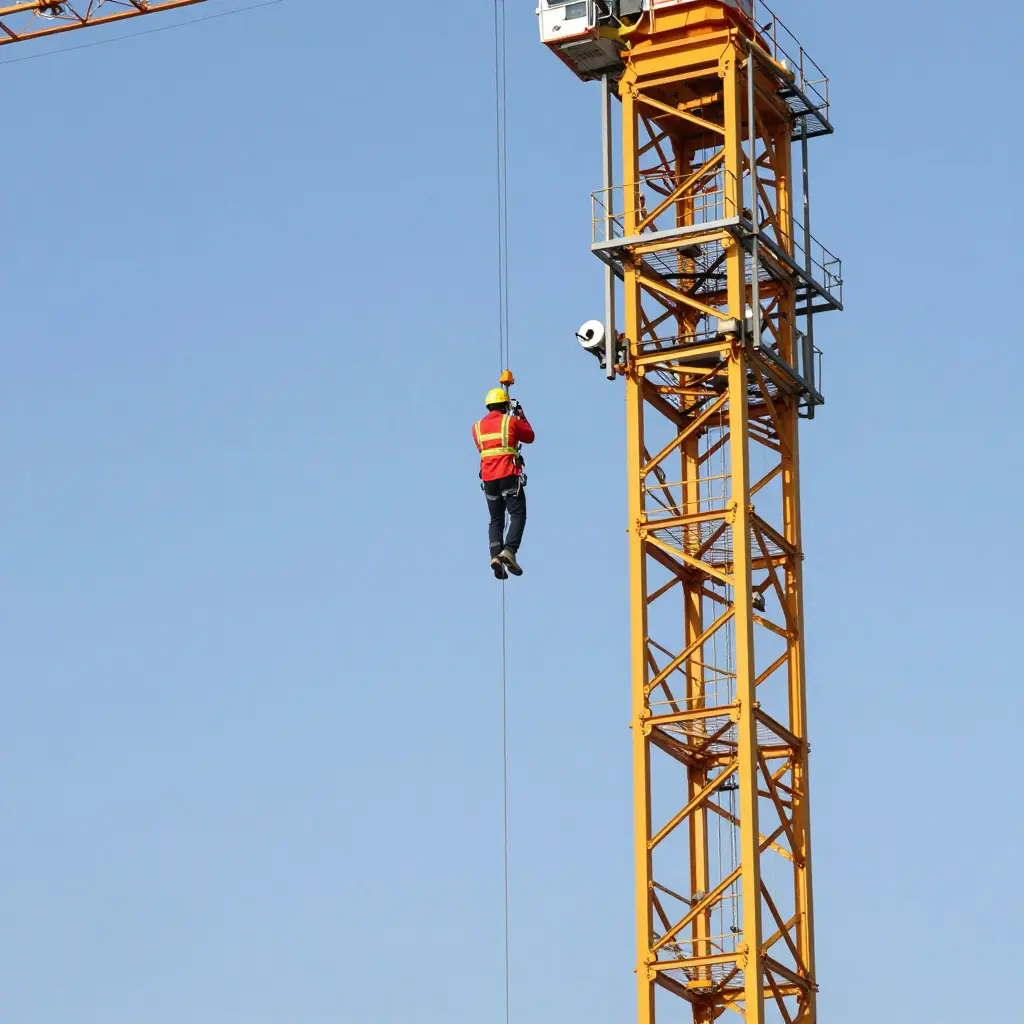
Should You Rotate a Worn Tower Crane Wire Rope or Replace It?
Tower crane wire rope is the steel cable on the hoist system that carries every load the crane picks. It runs under constant tension and bends over sheaves on each trip up and down, so it wears, and eventually the site team has to decide what to do about it: keep the rope in service, turn it around to move the wear, or replace it.
Rotation is sometimes a legitimate maintenance step and sometimes a way to postpone a replacement that is already due. The difference matters on a machine that lifts loads over people. This guide covers three things:
- Wire rope rotation – what end-for-ending does to the wear pattern, and the conditions under which it is acceptable.
- Discard criteria – the measurable limits inspectors apply: broken wires, diameter loss, corrosion, kinking, and changes in lay length.
- The decision itself – how to weigh rotation against replacement, document the finding, and meet the manufacturer’s and the applicable standard’s requirements.
By the end, you should be able to make the call, act on it, and record why.
Wire Rope Construction and Wear Mechanisms
A wire rope is not one solid cable. It is an assembly of small steel parts working together, and how they are put together explains why the rope wears the way it does.
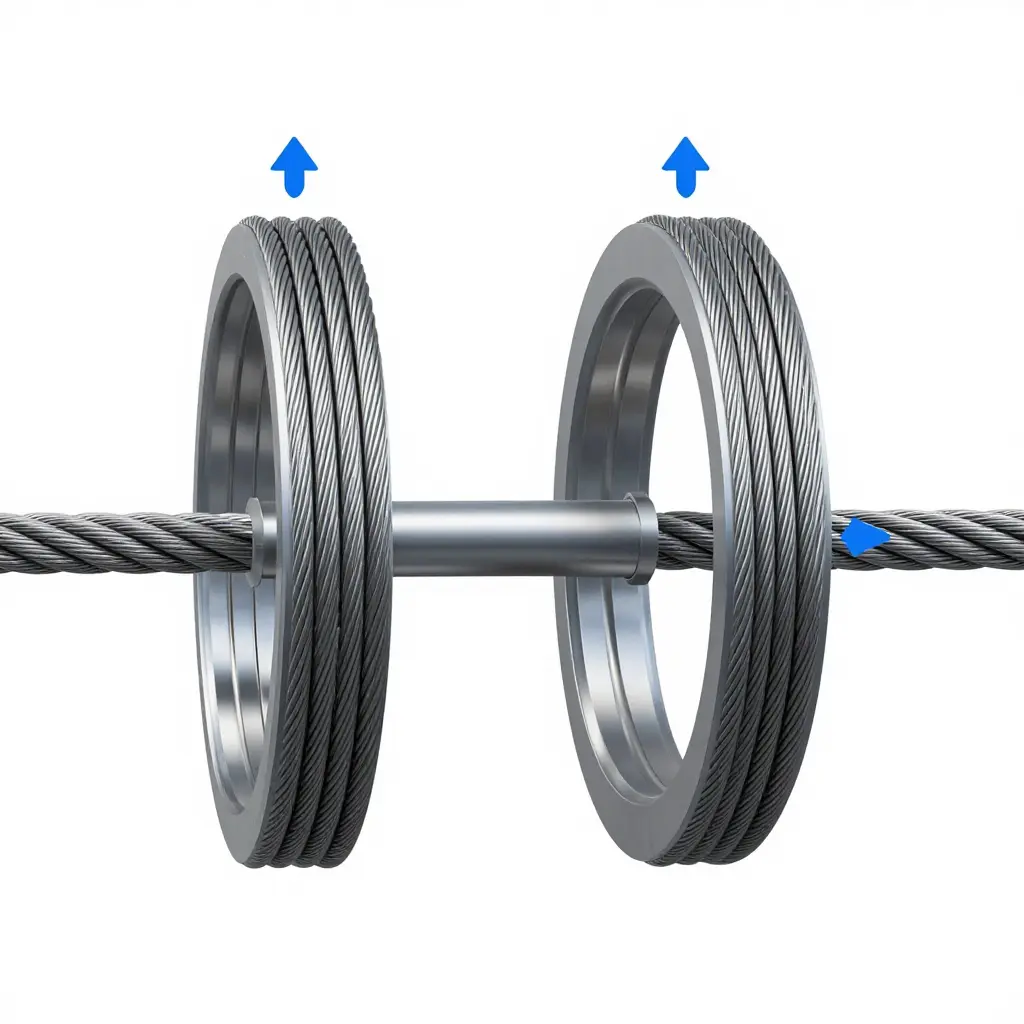
How a Tower Crane Wire Rope Is Built
Three components make up the rope:
- Wires. Individual steel wires are the smallest unit, drawn to tight diameter tolerances.
- Strands. Wires are twisted helically into strands, and those strands are then laid around a central core.
- Core. Steel, fiber, or a blend. It supports the strands and keeps them evenly spaced under load.
The way the strands twist matters. Lay direction (right-hand or left-hand) and lay type (regular or lang) determine how the rope bends, how it resists rotation, and how it seats on a drum. A mismatched lay can make a rope fight its own sheave groove.
How Wear Develops Over Lifting Cycles
Every lift puts the rope through the same cycle: tension as it takes the load, bending as it wraps each sheave, then straightening as the load lands. Repeat that thousands of times and internal friction, surface pressure, and weather start breaking the rope down from the inside.
The Five Wear Patterns to Watch
The damage tells you what the rope has endured, and how close it is to failure.
- Abrasion. Outer wires flatten and wear against sheaves, drums, and each other, reducing cross-section and strength.
- Fatigue. Repeated bending causes wire rope fatigue, forming fine internal cracks that grow with every cycle.
- Broken wires. Cracks and wear eventually snap individual wires. These broken wires are often the first visible failure signal.
- Corrosion. Moisture and contaminants pit the steel, robbing it of ductility and creating hidden weak points.
- Deformation. Kinking, bird-caging, or a flattened core show that the rope’s structure has started to collapse.
Why the Wear Type Drives the Rotate-or-Replace Decision
Abrasion concentrated on a short section – at a single sheave, say – may leave the rest of the rope sound enough to rotate. Fatigue is different. It affects the whole rope, and rotation cannot undo it. So inspection is not about counting flaws; it is about identifying which mechanism is at work and where it sits along the length. Rotate a rope with localized abrasion and you buy service life. Rotate one with advancing fatigue or clustered broken wires and you move a weakening section into a higher-stress position. Read the wear pattern first, then make the call.
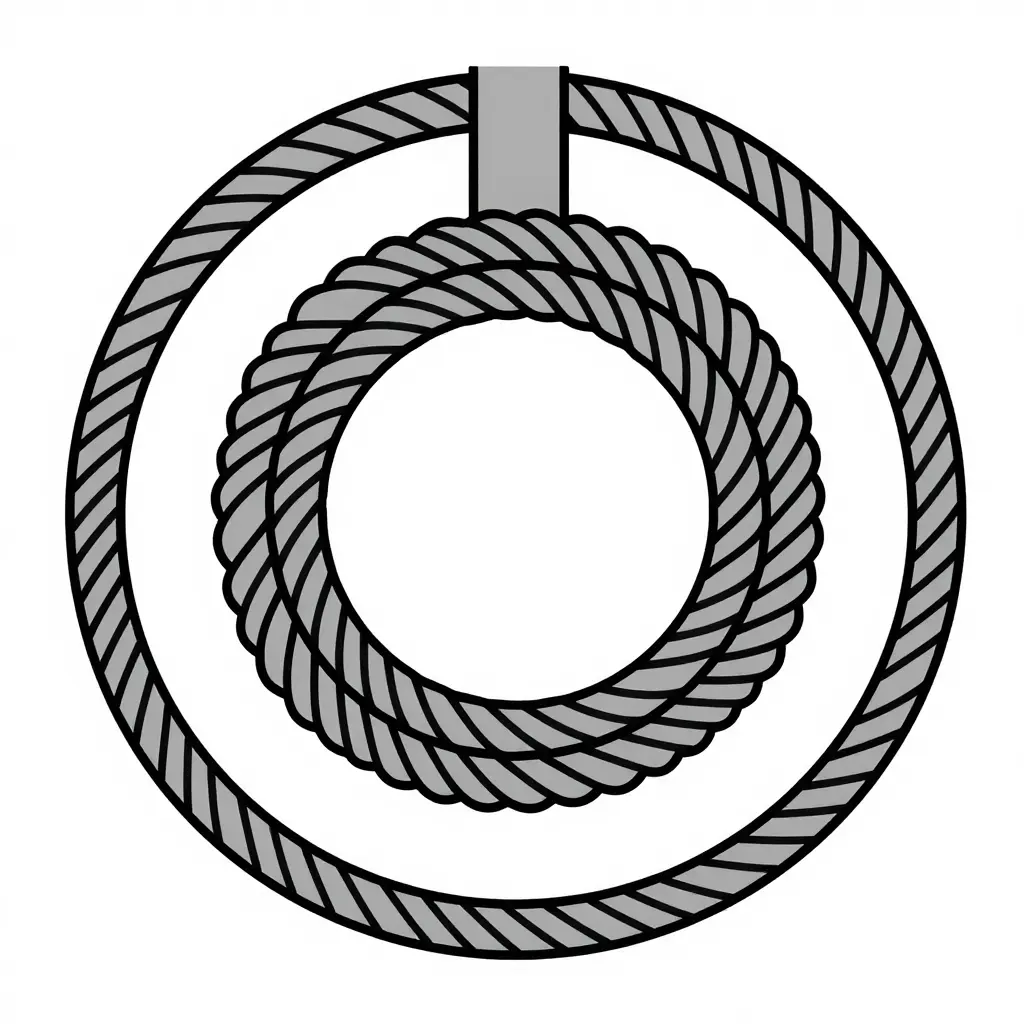
Schematic cross-section of a tower crane wire rope: the central core, the surrounding inner strands, and the outer strands that take the brunt of everyday abrasion.
How Wire Rope Rotation Works
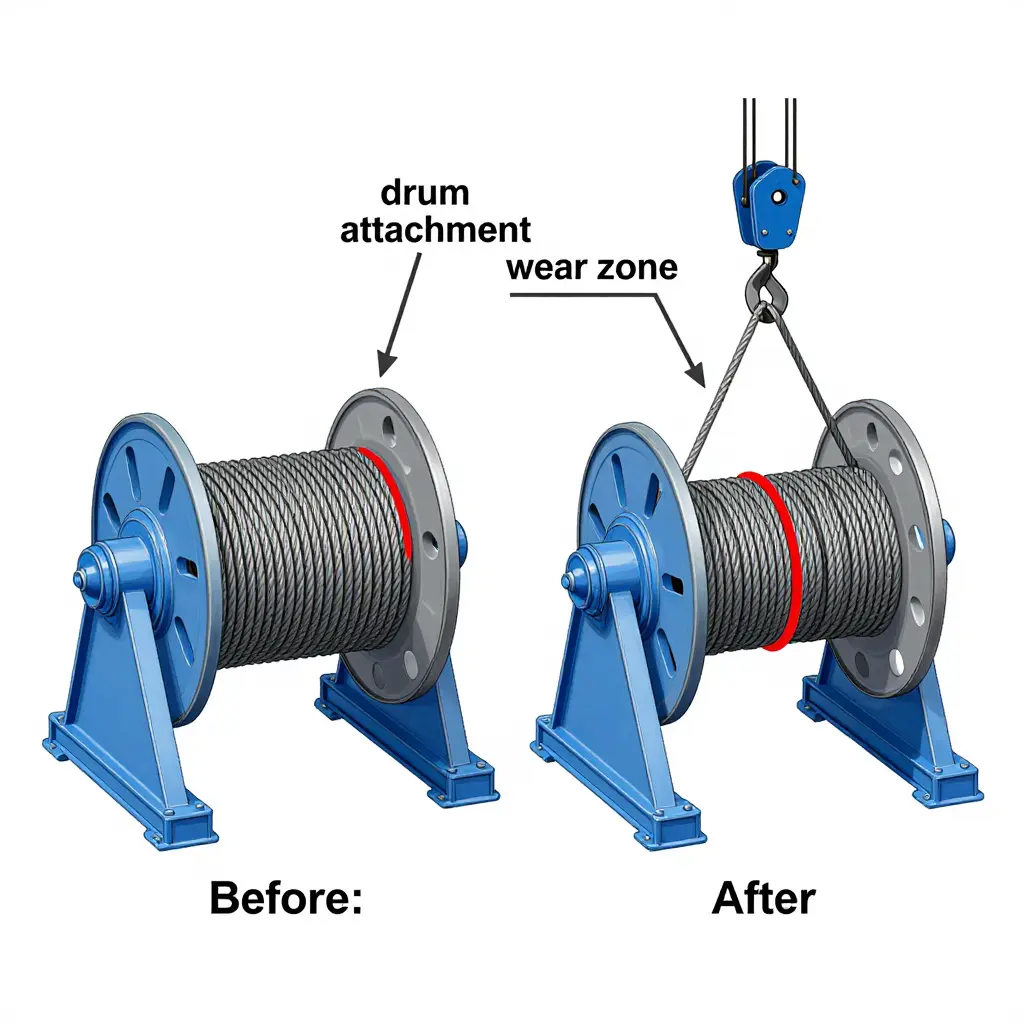
To rotate a wire rope is to reposition it end-for-end: the section that spooled onto the hoist drum becomes the working end at the hook, and the former hook end moves back toward the drum. On a tower crane, the drum attachment is the anchor where the rope is secured to the drum, so a true rotation means releasing that anchor, reversing the rope, and re-terminating both ends to specification.
The reason it can help is that rope rarely wears evenly. Bending stress concentrates at the drum attachment, friction peaks where the rope crosses sheaves, and repeated spooling pounds the same short length against itself. One localized zone can reach its discard limit while the rest of the rope is still serviceable. Redistributing those worn points across fresher rope spreads the damage and can extend service life instead of forcing a full replacement.
Rotation is a wear-management tactic, not a repair. It cannot reverse internal fatigue, corrosion, or broken wires, and it must never keep a rope in service past its removal criteria.
It tends to pay off only when all of the following hold:
- Wear is localized – damage clusters near the drum attachment or sheave contact points rather than spreading along the whole length.
- The rope is still within limits – broken-wire counts, diameter loss, and elongation remain inside the manufacturer’s discard criteria.
- No hidden damage exists – there is no corrosion, kinking, crushing, birdcaging, or heat damage anywhere in the length.
- Enough spare length is available – the rope is long enough to allow a clean, code-compliant re-termination at the drum attachment.
- Both ends can be re-made correctly – terminations can be re-fitted to the required standard once the rope is reversed.
- A qualified inspector signs off – a competent person confirms the remaining strength still supports the safe working load.
When every condition holds, rotation can buy real working hours. When wear is widespread or any structural damage is present, replace the rope.
Use this table to match inspection findings to an action, then confirm the result against the manufacturer’s wire rope discard criteria.
| Condition of Rope | Wear Location | Extent of Broken Wires | Corrosion Level | Cost Implication | Recommended Action |
|---|---|---|---|---|---|
| Light, even abrasion; no kinks or birdcaging | One short section, single drum layer | Fewer than 6 in one rope lay, none clustered | None to a faint surface film | Minimal – labor only | Rotate the wire rope |
| Moderate flattening on one face; ovality within limits | One side of the drum or one sheave track | Fewer than 6 in one lay and fewer than 3 in any one strand | Light surface rust that wipes away | Low – schedule re-inspection | Rotate and re-inspect soon |
| Localized diameter loss under 5% of nominal | One concentrated wear zone | Fewer than 6 in one lay, none clustered | Light | Low to moderate | Rotate the wire rope, monitor closely |
| Diameter loss of 5% or more of nominal | One or more wear zones | Any count, scattered or clustered | Moderate – pitting beginning | High | Replace – the rope has met the diameter discard limit |
| Birdcaging, kinking, or core protrusion | Any location | Any number | Any level | High | Replace immediately |
| Broken wires clustered in one strand or valley | One localized area | 3 or more in a single strand, or 2 or more valley breaks in one lay | Light to moderate | High | Replace immediately |
| Severe pitting; obvious diameter loss | Widespread | Numerous across several lays | Heavy pitting | High | Replace immediately |
| Heat damage, electrical arcing, or discoloration | Any location | Often brittle or fused | Any level | High | Replace immediately |
If any row lands in the replace column, replace the rope. Rotation only buys time when wear is light, even, and confined to a single zone.
Key Decision Factors: Rotate or Replace?
Whether you rotate a worn tower crane wire rope or pull it from service comes down to evidence, not gut feel. Work through these factors in order.
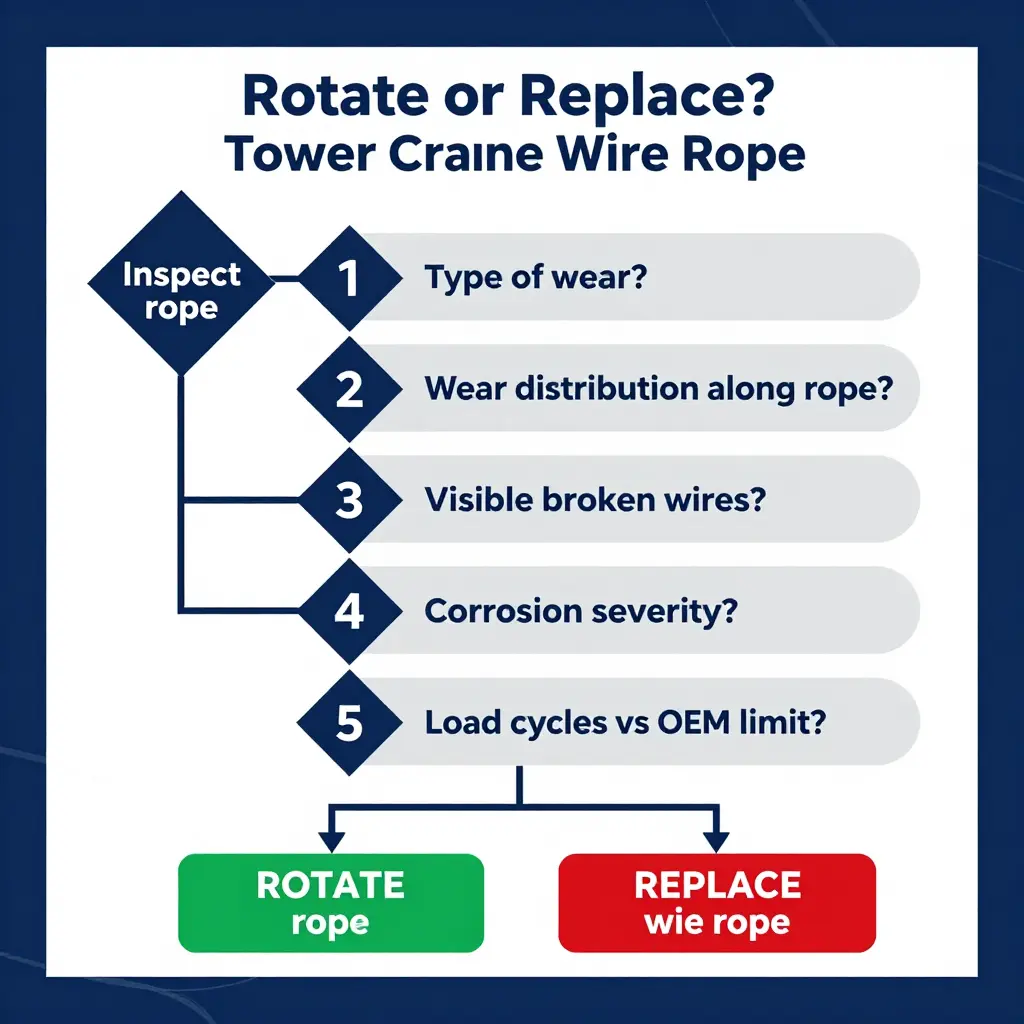
1. Type of Wear
Abrasion and flattening from sheave contact are often manageable. Fatigue cracking or a birdcage distortion is not. If the wear suggests the rope is failing from the inside out, rotation only spreads a hidden problem.
2. Distribution of Wear Along the Rope
Map where the damage sits. Worn spots bunched in one drum or sheave zone can sometimes be repositioned so fresh rope takes the punishment. Wear spread along the full length means there is no clean section left to rotate into service.
3. Number of Visible Broken Wires
Count broken wires within one rope lay, not across the whole rope. A handful in one concentrated area trips most thresholds fast. Scattered breaks that stay under the limit leave room to rotate.
4. Corrosion Severity
Light surface rust may clean up. Heavy pitting, reduced diameter, or internal corrosion means the rope has lost strength you cannot see, and the safer answer is to replace wire rope outright.
5. Load Cycles
High cycle counts accelerate fatigue. A rope near the end of its rated service life has little margin left, so rotation buys time you do not really have. Match cycle history against the manufacturer’s data before deciding.
6. OEM Thresholds
Weigh everything against the original equipment manufacturer’s limits. OEM rules on broken wires, diameter loss, and elongation are the ceiling, not a suggestion. A crane safety inspector should confirm the numbers and document the decision.
The Sequence in Practice
Type, distribution, broken wires, corrosion, cycles, then OEM limits. If any single factor crosses a hard threshold, stop and replace. If the wear is minor, localized, and inside every limit, rotation can extend service. When in doubt, treat rotation versus replacement as a safety question first and a cost question second.
Wire Rope Degradation Over Lifting Cycles
A single inspection is a snapshot, which makes it hard to tell when a rope crosses from “keep an eye on it” to “rotate or replace,” after which the trend shows where it is heading. To see how a rope gets there, watch how the wear indicators change as lifting cycles accumulate. The chart below is an illustrative model, not field data, but it shows the shape inspectors look for: broken wires per lay length and abrasion depth plotted across 5,000 representative lifting cycles. Both lines stay flat for a long time, then bend upward.
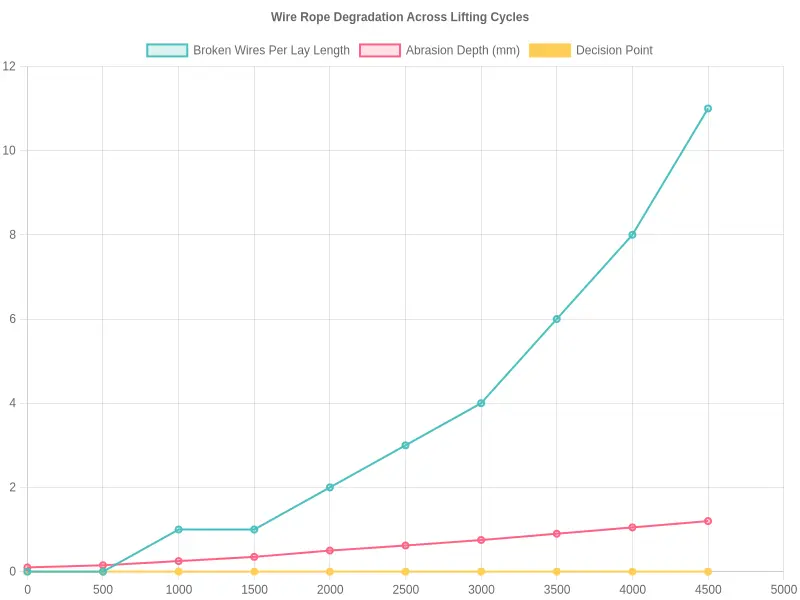
Reading the Curve
For the first 1,500 to 2,000 cycles, neither line moves much. A single broken wire here, a fraction of a millimeter of abrasion there – easy to dismiss. This is the deceptive part of rope wear: the surface still looks healthy, and the crane feels no different, while internal fatigue and friction work beneath the strands.
Somewhere between 2,500 and 3,500 cycles, the slope changes. The number of broken wires starts climbing faster than the cycle count, and abrasion depth accelerates right alongside it. By 4,000 cycles the trend is unmistakable, and by 5,000 both indicators are running away. This is the “knee” of the curve, where small amounts of additional use produce outsized losses in strength. It is why a rope can pass inspection on Monday and fail a more rigorous check a few weeks later.
The counts below are illustrative. The enforceable limits are the broken-wire and diameter criteria in the standard, not the abrasion figures in this model.
| Lifting Cycles | Broken Wires per Lay Length | Abrasion Depth (mm) | Status Guidance |
|---|---|---|---|
| 0 – 1,000 | 0 | 0.10 – 0.15 | Normal, log and monitor |
| 1,500 – 2,000 | 1 | 0.25 – 0.35 | Watch closely, re-inspect sooner |
| 2,500 – 3,000 | 2 – 3 | 0.50 – 0.62 | Plan rotation or replacement |
| 3,500 – 4,000 | 4 – 6 | 0.75 – 0.90 | Below the limit: rotate. At 6 or more: replace |
| 4,500 – 5,000 | 8 – 11 | 1.05 – 1.20 | Remove from service |
Why the Decision Point Sits Where It Does
The dashed marker near 3,800 cycles is not a rule pulled from a standard. It is the point in this model where several wear signals converge at once. Real discard criteria look at broken wires within a lay length, reduction in nominal diameter, corrosion, and distortion. When the accelerating part of the curve meets those thresholds, continuing to run the rope stops being a judgment call.
That is the value of tracking degradation over time. One inspection tells you where the rope is; the trend tells you where it is going. Log broken-wire counts and measure diameter or abrasion at consistent intervals, and you can see the knee coming and schedule a rotation or replacement during planned downtime rather than during a critical lift.
The Rotate-or-Replace Takeaway
- Early cycles: Low wear, low urgency – keep logging baseline readings.
- Mid-life: Watch the slope, not just the number. A rising rate matters more than a single reading.
- Past the knee: Accelerating wear means the margin shrinks fast. Rotate only if the rope is still below every limit; otherwise replace.
- Beyond thresholds: Once discard criteria are met, the rope leaves service – no exceptions for “one more job.”
When you know how the numbers trend, the rotate-or-replace question usually answers itself before the rope forces your hand.
For related field logistics and heavy-equipment support, see our Houston towing and roadside service options.
When Rotating a Tower Crane Wire Rope Is the Right Call
Rotating a wire rope, often called “end-for-ending”, can extend its service life, but only when the damage is early, localized, and non-structural. OEM manuals and inspection standards set the criteria a rope must meet to stay in service; none of them treats rotation as a repair. In the U.S., OSHA’s crane rule (29 CFR 1926.1413) and ISO 4309 define the discard limits, and ASME B30.3 covers tower cranes specifically. If a rope still holds plenty of usable strength, moving the worn section away from its most punishing contact zone can keep it working safely until the next planned change-out.
Rotate a wire rope only when all of the following are true:
- Wear is concentrated near the drum or a single contact zone. Abrasion, flattening, or diameter loss clustered at one drum wrap or sheave can be relocated to a less demanding position on the reeving.
- Broken wires stay below the discard threshold. Under OSHA’s rule, that means fewer than 6 randomly distributed broken wires in one rope lay and fewer than 3 in any one strand. Rotation-resistant ropes use a different count: 2 broken wires in six rope diameters, or 4 in thirty.
- There is no structural deformation. No kinks, birdcaging, core protrusion, heat damage, or severe corrosion pitting. Any of these is an automatic replacement, not a rotation.
- Diameters and elongation check out. Measured diameter loss must stay within 5% of nominal, and permanent stretch within the manufacturer’s allowable range.
- A documented wire rope inspection supports the call. A qualified inspector must record the condition, location, and severity of wear so the decision is traceable.
- The OEM permits it. Follow the crane manufacturer’s guidance for the specific rope construction and reeving before you act.
If even one condition fails, replace the rope. Rotation is a way to spread wear more evenly. It is never a way to mask damage that has already crossed a discard limit.
When Replacement Is Mandatory
Some decisions about a worn tower crane wire rope are a matter of judgment. Others are not. Once a rope crosses a published threshold, the conversation ends: you replace wire rope. There is no rotation schedule, no “run it one more shift,” and no field repair that makes an unsafe rope safe again. The point of wire rope discard criteria is to remove the guesswork before fatigue becomes a falling load.
Why This Is Not a Judgment Call
A rope degrades from the inside out. Broken wires hide in valleys between strands, corrosion eats the core before it shows on the surface, and shock loads leave damage you cannot see. That is why standards bodies publish objective limits instead of leaving the call to whoever stands closest to the drum. When any of the following conditions is present, the rope is done – regardless of how little time it has been in service.
Broken-Wire Limits
Every rope class has a maximum number of visible broken wires per rope lay and per strand. Cross those numbers, and the rope goes out of service. Pay special attention near end fittings, where fatigue concentrates. In many operations this is the first trigger that fires, and it is the one inspectors most often try to negotiate.
Severe Corrosion and Diameter Loss
The rope is condemned when corrosion is advanced enough to pit the wires, loosen the strands, or cause visible slack between them. Reduce the diameter by more than 5% from nominal and the rope has already sacrificed the strength reserve that makes it safe. Combined corrosion and diameter reduction is an automatic pass, not a maybe.
Core Protrusion, Heat Damage, and Deformation
A protruding core means the outer strands can no longer contain the load path. Heat damage from a torch, a short, or contact with hot material changes the metallurgy and leaves the rope brittle. And deformation matters just as much: kinking, birdcaging, crushing, and localized wear all signal that the rope has been overloaded or mishandled. None of these conditions improves with use.
Never Extend a Rope Past the Line
This is what separates a documented inspection program from wishful thinking. Inspectors and operators must never “extend” a rope that has already met a discard criterion – not for one more pick, not until the end of the shift, and not until the replacement arrives. If production pressure is pushing the decision, escalate it. A hoist rope that fails mid-lift takes the load, the crane, and everyone under it. A crane safety program that permits that risk is not a program.
Mandatory-Replacement Triggers at a Glance
- Broken wires exceeding the allowed count per lay length or per strand
- Severe corrosion, pitting, or visible strand looseness
- Diameter reduction beyond the permitted tolerance under load
- Core protrusion through the outer strands
- Heat damage, including brittleness or discoloration
- Kinking, birdcaging, crushing, or other deformation
- Any combination of the above – never offset one defect with another
When a rope reaches this list, the right move is replacement and a review of why it got there. Shops that handle heavy recovery and equipment support work this way – see how experienced heavy-equipment roadside support keeps damaged gear out of service until it is safe to move again. A discarded rope is not a failure of the maintenance program; running one past its limit is.
Cost and Lifecycle Analysis: Rotating vs. Replacing a Tower Crane Wire Rope
When a tower crane wire rope starts showing broken wires or a reduced diameter, the first instinct is usually financial: can we rotate a wire rope to a less critical position and defer the cost of a new one? Rotation looks like a bargain on the purchase order, but that short-term saving hides downtime, labor, and safety exposure that inflate the true lifecycle cost of the lifting equipment. The cheapest invoice today is rarely the cheapest decision over the life of the crane.
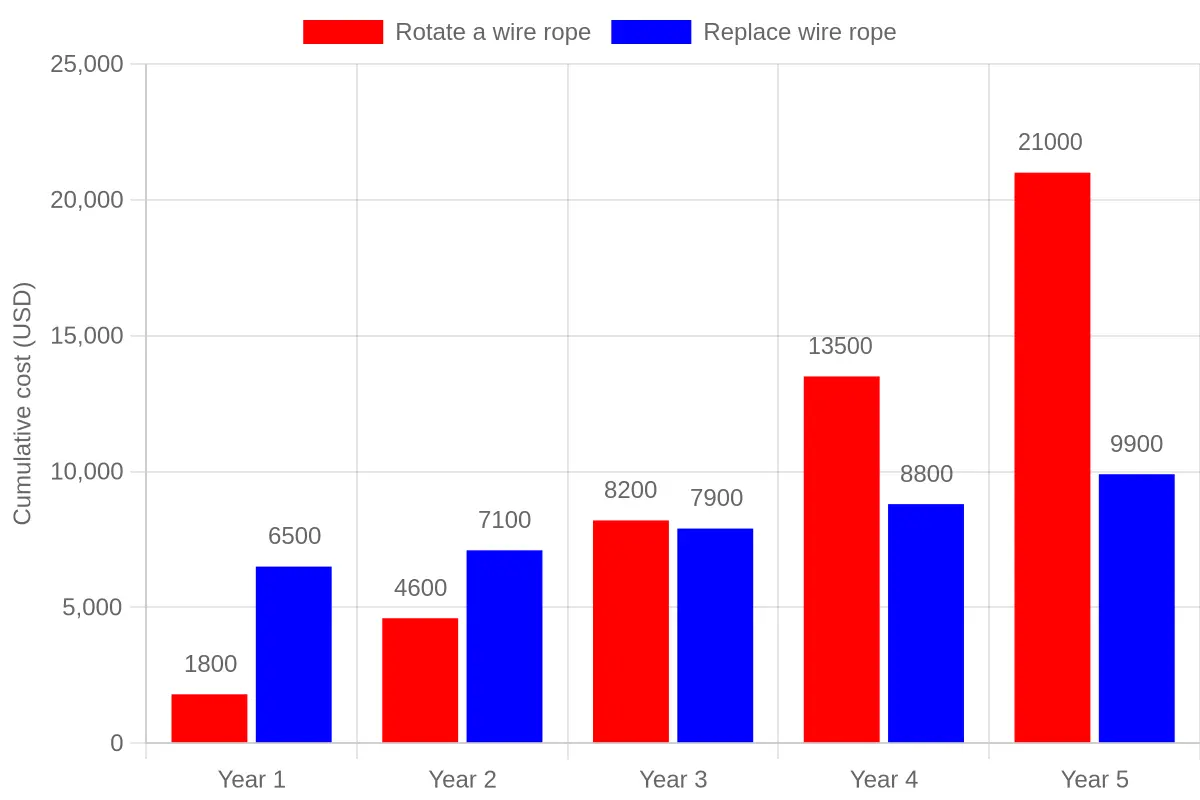
The chart above is an illustrative model of five years of total cost of ownership for the two strategies. In the model, rotation stays cheap for a year or two, then climbs as repeated inspections, relocations, and unplanned shutdowns pile up. Replacement carries a heavier first invoice but stays flat and predictable, finishing the period below rotation.
The cost factors most teams overlook
- Upfront material spend. Rotation avoids the price of a new rope today, but that money reappears later when you finally have to replace wire rope under pressure, often at premium rush pricing.
- Labor and rigging. Every rotation burns crew hours, crane downtime, and re-inspection time. Four rotations can easily cost more in labor than one clean replacement.
- Downtime risk. An unplanned rope failure can idle an entire site. When a crane goes down, you may need emergency heavy recovery and roadside service to keep operations moving – costs that never show up in a rope budget.
- Inspection burden. Rotated ropes demand more frequent NDT and visual checks, multiplying inspector hours across every cycle.
- Safety liability. A worn tower crane wire rope that fails can injure workers and trigger regulatory fines, litigation, and higher insurance premiums that dwarf any material saving.
Total cost of ownership at a glance
| Cost Factor | Rotate a Wire Rope | Replace Wire Rope |
|---|---|---|
| Year-1 cash outlay | Low | High |
| Inspection hours | Rising each cycle | Stable |
| Crane downtime risk | High, unpredictable | Low, scheduled |
| Safety / liability exposure | Compounds with wear | Reset to zero |
| 5-year total ownership | Highest | Lowest |
Why replacement lowers long-term cost
Replacement resets the clock: one scheduled outage, one clean inspection baseline, and a maintenance calendar you can plan around. Rotation spreads the risk across the whole timeline, deferring spend while steadily eroding reliability. Weighed honestly, replacing a worn tower crane wire rope on schedule is usually the cheaper – and far safer – choice.
Cost and Lifecycle Comparison: Rotate vs. Replace
The grouped bar chart below is illustrative, but it models the four factors that matter most on a job site: labor cost, downtime, part cost, and how long you can expect the rope to stay in service before the next decision point.
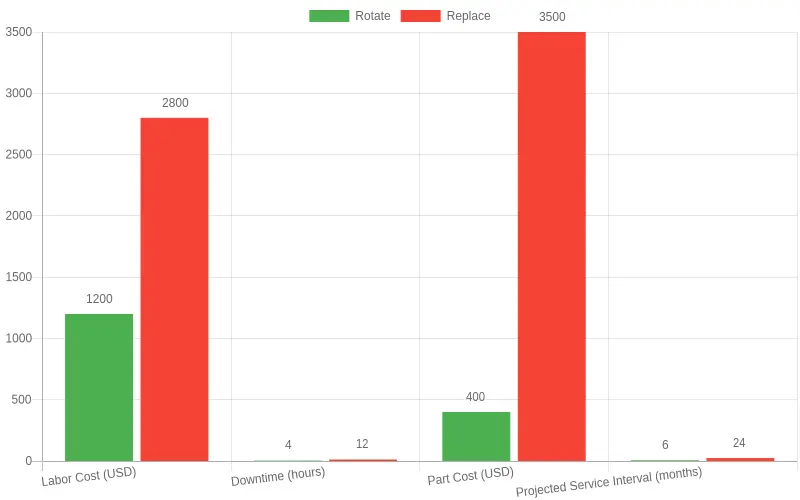
Three patterns stand out:
- Rotating is cheaper up front. You spend far less on labor and parts because you are shifting the rope end-for-end rather than buying a new assembly. That is the whole appeal.
- Replacing costs more today but buys time. The part cost is steep, but in the model the service interval is roughly four times longer, which pushes the next maintenance event further down the calendar.
- Downtime cuts both ways. A rotation is quick, but if you rotate too often, those short stops stack up. A replacement takes longer in one sitting but happens far less frequently.
What the Chart Does Not Show
Bars are easy to read and easy to over-trust. Rotating a worn rope does not remove damage; it redistributes wear along the length so the worn section lands in a lower-stress zone. That buys a service window, not a fresh start. Replacing resets the clock entirely, at full price and with a longer single outage.
The right call depends on how worn the rope is, how accessible the reeving is, and what a shutdown costs your project. A lightly worn rope may justify a quick rotation to stretch the interval until the next scheduled maintenance window. A rope that has reached the discard criteria should be replaced, full stop. No rotation schedule makes a spent rope safe again.
Rule of thumb: rotate to buy time, replace to buy certainty. Never rotate a rope that already fails inspection.
| Factor | Rotate | Replace |
|---|---|---|
| Labor cost | Lower | Higher |
| Downtime per event | Shorter | Longer |
| Part cost | Minimal | High |
| Projected service interval | Shorter | Much longer |
Use the chart as a starting point, then let a qualified inspector and the manufacturer’s guidelines make the final ruling for your crane.
OEM Guidance and Support: What Crane Manufacturers Require
Crane manufacturers publish rope specifications for each model: rated loads, bend ratios, sheave sizes, and the inspection intervals the rope must meet. Those numbers are calculated for a specific rope construction, so operators can tell when a rope has reached the end of its safe service life.
Most OEM manuals require the same basic practices: inspect before each shift, measure diameter loss against the manual’s limits, follow the lubrication and sheave-alignment schedule, and replace rather than rotate once broken wires, corrosion, or valley damage appear. When a rope’s condition falls outside the manual, the manufacturer – not the site team – is the authority on whether it can stay in service.
Because those rules come from the same engineering basis whether the crane stands on a downtown high-rise or in an industrial yard, the decision process is portable. Even routine logistics matter: reliable partners like this trusted towing and recovery company help keep project timelines intact when equipment has to be repositioned.
Best Practices Straight From the Manufacturer
- Inspect before every shift and log diameter reduction against the manufacturer’s limits.
- Watch for signs of hidden core damage or twist imbalance in the rope.
- Replace rather than rotate once broken wires, corrosion, or valley damage appear.
- Follow the OEM’s lubrication and sheave-alignment schedule exactly.
- Escalate any uncertainty to the manufacturer’s hotline before the rope returns to service.
Putting these habits into practice is the fastest route to dependable crane safety across a fleet. When a crane is grounded and repairs stall, 24/7 roadside assistance and prompt heavy-duty tow trucks keep recovery and transport moving, while emergency tow service can step in during the tightest turnarounds. The rule is simple: lean on the manufacturer’s guidance, and never let a worn rope set your safety margins.
FAQ: Rotating vs. Replacing a Worn Tower Crane Wire Rope
Can you rotate a wire rope more than once?
Yes, but only within safe wear limits. Rotation shifts where the rope bends and wears, exposing fresher sections such as the dead-end area or the opposite face of the drum. Each cycle spreads abrasion across more of the rope and can extend its working life. Once a tower crane wire rope shows broken wires, diameter loss, or heavy corrosion that meets the discard criteria, further rotation adds risk instead of value, and you should replace the rope at that point.
How many broken wires require replacement?
Thresholds depend on the rope and on the governing standard. For cranes in U.S. construction, OSHA 29 CFR 1926.1413 requires removal of a running rope at 6 randomly distributed broken wires in one rope lay, or 3 broken wires in one strand in one lay. Rotation-resistant ropes are counted differently: 2 randomly distributed broken wires in six rope diameters, or 4 in thirty. The 12-in-one-lay and 4-in-one-strand figures that circulate widely come from ASME B30.2, which applies to overhead and gantry cranes, not tower cranes. Always follow the manufacturer’s and your site’s inspection standard.
Does rotation affect wire rope load capacity?
Rotation itself does not change a rope’s rated load capacity. Improper handling does: twisting, kinking, or shock loading during rotation can reduce breaking strength, in severe cases by 20% or more in a heavily twisted rope. A correctly rotated rope keeps its cataloged capacity. Capacity is set by diameter and construction, so any loss of diameter from wear is the real threat to load limits.
How often should a tower crane wire rope be inspected?
Wire rope inspection happens on three levels. Operators perform a visual check before every shift, watching for broken wires, kinks, and corrosion. A documented thorough inspection is typically done monthly. A comprehensive inspection, including internal condition and end fittings, is performed at least annually and after any shock load, overload, or significant event. Harsh environments require more frequent checks.
Can a worn rope be repaired instead of replaced?
Wire rope cannot be repaired the way a chain link or fitting can. Broken wires, corrosion pitting, and fatigue cannot be restored, so a worn rope is replaced, not patched. You may re-terminate an end fitting or shorten a rope when the damage is isolated and the remaining length still meets criteria. Once wear affects the working section, always replace wire rope rather than trying to save it.
What about heavy lifting equipment and support services?
Keeping lifting operations safe often relies on dependable heavy equipment and towing support for moving gear and disabled machinery on and around the job site. Pairing proper rope maintenance with reliable transport keeps projects moving without cutting corners on safety.
Conclusion: Decide with Data, Not Deadline Pressure
The question is narrow: is the remaining wear still inside the manufacturer’s and OSHA’s limits? If it clearly is, you may rotate the rope to spread wear across a less-stressed section, after a documented inspection confirms it. If it is not, or you are unsure, replace the rope immediately. Do not let a schedule, a budget, or a supervisor’s urgency turn replacement into a delay you are afraid to trigger. A failed hoist rope costs more than money. Measure, compare to the limits, document, then act: rotate within limits, replace beyond them, and treat replacement as routine maintenance rather than a setback.
Final Takeaways
- Inspect before you decide. Use calipers and visual checks to record diameter loss, broken wires, corrosion, and distortion against the rope’s discard criteria.
- Rotate only within limits. A tower crane wire rope can be rotated for even wear only when it still passes every inspection threshold.
- Never call replacement a delay. The moment wear, damage, or doubt exceeds limits, replace wire rope – a schedule is never a reason to wait.
- Document everything. Keep inspection logs, rotation dates, and replacement records so operators and inspectors work from one source of truth.
- Escalate doubt upward. If you are uncertain, stop the lift – an inspector’s sign-off always beats a guess.
- Make safety non-negotiable. Replacement is not lost time; it is the cost of doing the job right.