
Introduction
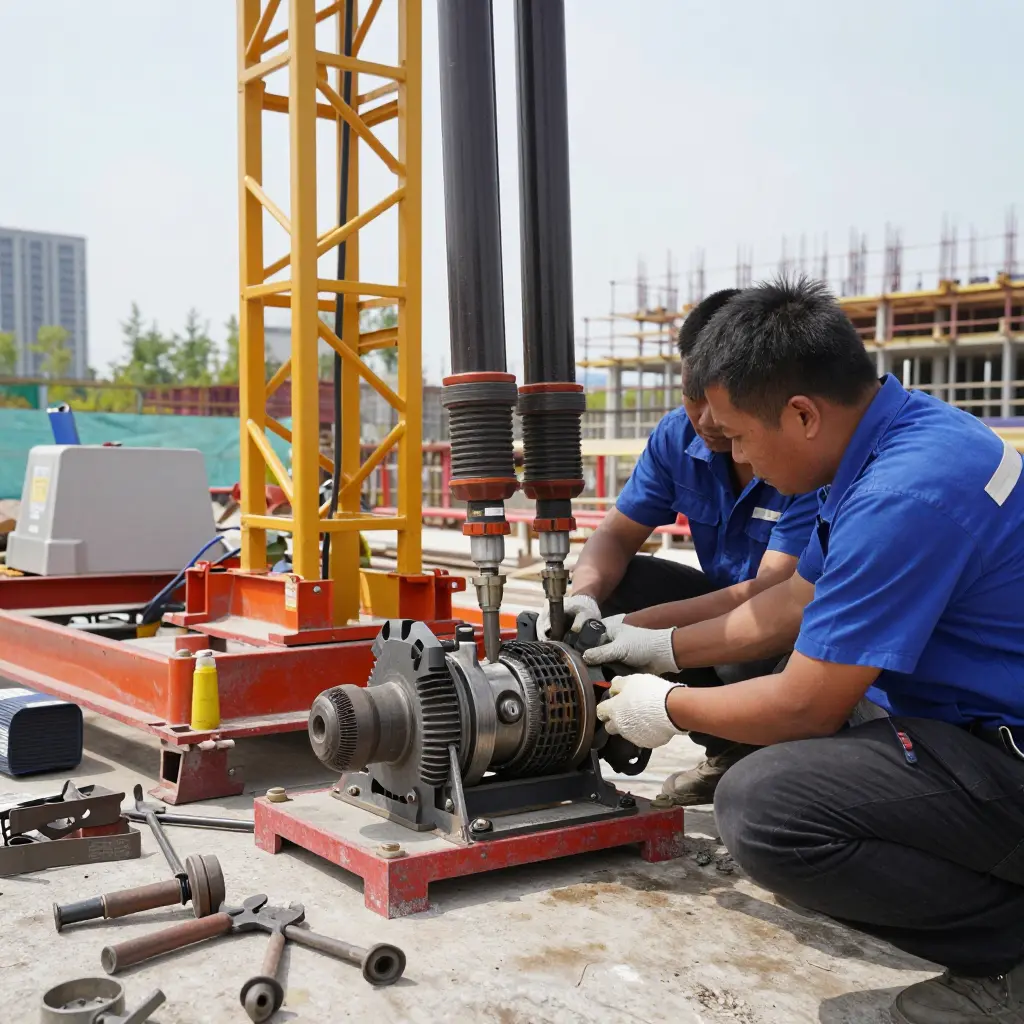
When a tower crane’s hydraulic oil runs hot, most crews drain the reservoir and refill it. That reflex is expensive. The oil is usually carrying heat away from a problem, not causing it, and on cranes that overheat again and again the source is typically internal wear in the hydraulic pump. A fresh fill buys a shift or two; it does not repair the pump. Check the pump for wear before you spend money on oil.
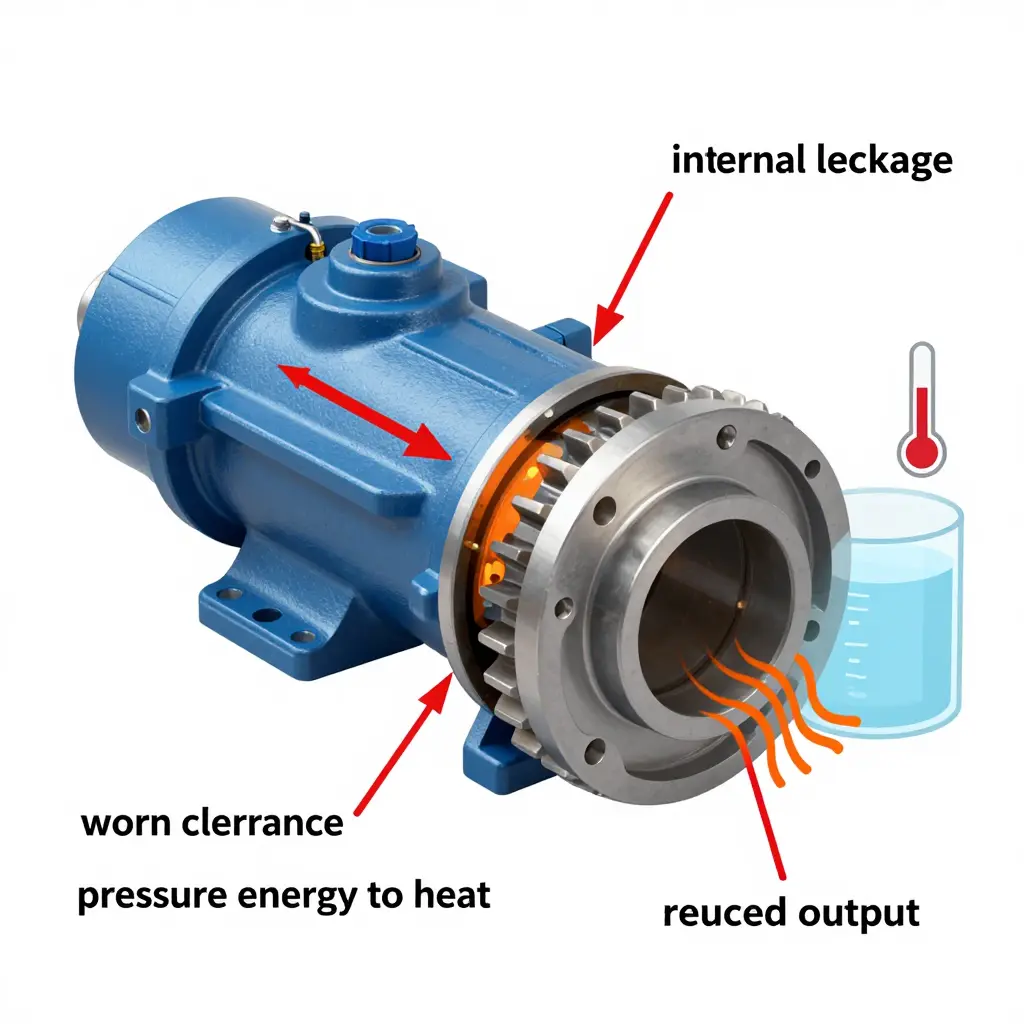
Pump wear shows up first as lost volumetric efficiency. Gaps between the gears, vanes, or pistons and the surfaces they run against widen, and more high-pressure fluid slips back to the low-pressure side instead of doing work. That leakage turns pressure energy into heat. Clean oil can absorb some of it, but it cannot close a worn clearance. On a cool morning the gauge may drop for a shift or two, which is why the wrong diagnosis sticks: the improvement disappears as soon as the crane works hard.
By the end, you should be able to:
- Trace overheating to its source, whether that is internal leakage, aeration, or a fault in the cooler, reservoir, or relief valve.
- Test pump wear with pressure, flow, and case-drain measurements before committing to an oil change.
- Decide between repairing the existing pump and replacing it outright, based on measured wear and total cost.
If a crane or support vehicle is stuck on site, operators, technicians, and fleet managers can learn more about heavy equipment breakdown support.
How Pump Wear Turns Hydraulic Fluid Into a Heat Source
When a tower crane runs hot, the fluid is rarely the problem. If you drain the reservoir, refill with clean oil, and the temperature climbs right back up within a shift or two, you have hidden a fault rather than fixed one. Hydraulic pump wear is driving the heat. Fresh fluid cannot reverse worn metal or close a clearance that has already opened up.
Worn clearances open the door to internal leakage
A pump works because its internal clearances are tiny: gears, vanes, or pistons sweep past the housing with almost no gap. Wear widens those gaps, and high-pressure fluid slips past the worn points back to the low-pressure side instead of pushing the load.
That is internal leakage, and it moves nothing. The fluid just circulates, cycle after cycle.
Leaked pressure energy becomes heat
Energy does not disappear when fluid leaks; it changes form. Every drop escaping through a worn clearance carries pressure energy that is no longer lifting anything, and that energy becomes heat in the oil.
One small leak barely registers. Over thousands of pump cycles, though, reservoir temperature keeps climbing, and that steady rise is the usual signature of tower crane hydraulic overheating.
Lower efficiency forces the system to work harder
As leakage grows, volumetric efficiency falls. Less fluid reaches the actuators, so the pump runs longer and builds more pressure to move the same load. Relief valves open more often, hot fluid circulates faster, and friction adds heat of its own. The cycle feeds itself: more wear, more leakage, more heat.
Why fresh oil cannot fix worn metal
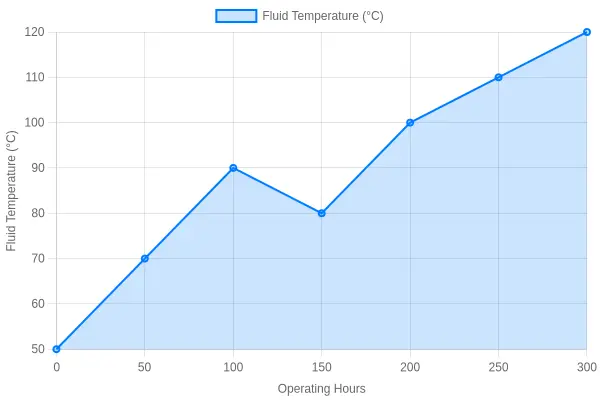
A fresh fill lowers the starting temperature and flushes out some contamination, so the gauge can look healthy for a shift or two. The worn clearances are still there, still leaking, still making heat, and within hours the temperature is back where it started.
Flow-test and pressure-test the pump, confirm the wear, then rebuild or replace it. The hot oil is a result, not the cause. If a failing pump leaves the machine stranded on site, towing and recovery support can move it without throwing off your schedule.
What the Curves Tell You
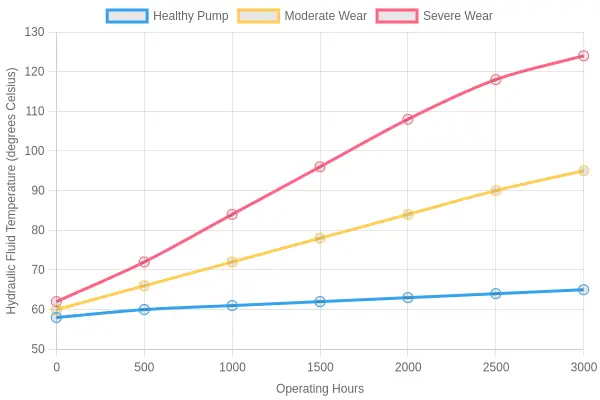
At zero hours all three pumps sit in a tight band, roughly 58 to 62 degrees Celsius. The band comes apart as hours accumulate. The healthy pump holds a nearly flat line, drifting from about 58 to 65 degrees across 3,000 hours. The moderately worn pump climbs steadily to roughly 95 degrees, and the severely worn pump passes 124 degrees and keeps rising. Wear does not add a fixed number of degrees; it compounds, which is how a pump that ran cool when new ends up being the reason the crane overheats.
Warning Signs That Point to Pump Wear, Not Oil Quality
When a tower crane starts running hot, the oil is the first suspect and often the wrong one. Catching pump wear early saves you from buying fresh hydraulic fluid that will overheat just as fast. These are the signs to watch:
- Rising fluid temperature under normal load: the reservoir runs hotter than it used to, even when the crane is lifting its usual working weight.
- Slower hydraulic function response: commands feel laggy, and functions take noticeably longer to build pressure or reach full speed.
- Erratic slewing or hoisting: the crane jerks, drifts, or hesitates instead of moving smoothly through a lift.
- Increased noise from the pump: whining, groaning, or a grinding tone that grows louder as the machine warms up.
- Fluid discoloration: oil turns dark, milky, or burnt-smelling well before its scheduled change interval.
- Metal particles in the filter: fine shavings or glitter in the filter housing are a strong sign of internal wear.
- Pressure fluctuations: gauge readings bounce or refuse to hold steady during a constant load.
- Shortened oil service life: you are draining and replacing fluid far more often than the manual recommends.
- Reduced load-holding ability: the boom or suspended load slowly creeps down on its own.
- Vibration or shuddering: the entire system shudders under load, especially at higher pressures.
One of these signs is worth a pump inspection; several together make it urgent. Do that before you commit to a fluid change. If the crane is already down and you need heavy equipment moved or recovered, professional roadside support can keep your schedule on track while the diagnostics run.
Assuming the fluid is the problem is the fastest way to waste money on a hot-running crane. The table below sets the two common troubleshooting paths side by side.
| Diagnostic Action | Time Required | Cost Implication | Effect on Overheating | Long-Term Reliability |
|---|---|---|---|---|
| Oil-first: Drain and refill the full hydraulic reservoir | 4-6 hours | $800-$1,500 in fluid alone | Temperature may drop 5-10 C, then climbs right back | Low – the root cause is still there |
| Pump-first: Pressure-test the pump and measure case drain flow | 1-2 hours | $150-$300 inspection fee | Pinpoints the actual heat source | High – diagnosis drives the repair |
| Oil-first: Flush lines and swap filters | 2-3 hours | $300-$600 | Hides debris for a while, heat returns within days | Low |
| Pump-first: Check clearances and internal bypass wear | 2 hours | $200-$400 | Reveals the internal leakage that generates heat | High |
| Oil-first: Repeat the oil change once overheating comes back | 4+ hours again | Doubles your fluid spend in a single week | No lasting change on the gauge | Very low |
| Pump-first: Rebuild or replace the worn pump | 6-8 hours (planned) | $2,000-$5,000, but it fixes the fault | Eliminates bypass-generated heat | High |
| Oil-first: Send fluid for lab analysis after the fact | Extra 3-5 days of downtime | Lab fees stacked on top of the wasted oil | Confirms contamination too late to help | Medium |
| Pump-first: Schedule the repair before a failure | Controlled planned downtime | Avoids secondary damage to valves and seals | Prevents heat cascading through the system | Very high |
The oil-first route leaves you with a clean reservoir and a lighter wallet. The pump-first route leaves you with an answer. Two hours of inspection up front usually costs less than the fluid it saves, and if the crane needs a heavy haul to a repair bay, dependable heavy equipment transport and recovery keeps the job moving.
Step-by-Step Hydraulic Pump Wear Inspection for Tower Cranes
Before you drain a gallon of oil, confirm that the pump is the source of the heat. Rising oil temperature, sluggish slewing, weak hoisting under load, and pressure that bleeds away all point to hydraulic pump wear. An oil change can mask those symptoms for a week while the internal damage gets worse. The sequence below lets a technician put a number on pump wear before signing off on new fluid.
-
Isolate and depressurize the system. Engage lockout/tagout, shut down the power unit, and bleed residual pressure from accumulators, cylinders, and lines. Confirm zero pressure with a calibrated gauge before cracking a fitting. A live hydraulic circuit on a tower crane stores enough energy to cause serious injury.
-
Record baseline fluid temperature and pressure. With the crane at its normal operating temperature, log reservoir temperature and system pressure at idle and at full load. Those numbers define what “hot” means for this machine and become the reference for every test that follows.
-
Extract a fluid sample for particle analysis. Draw a mid-reservoir sample into a clean bottle and send it for ISO cleanliness counts and wear-metal testing. High iron, copper, or bronze points to internal wear rather than a fluid-chemistry problem.
-
Measure pump case drain flow. Route case drain leakage into a calibrated container for a timed interval, then compare the flow with the manufacturer’s maximum allowable leakage. Excess case drain flow is the most reliable single indicator that internal clearances have opened up.
-
Check clearances against manufacturer tolerances. With feeler gauges or a dial indicator, measure the critical internal clearances – gear tip, side, and end clearance, or piston and barrel clearance, depending on pump type – and compare each against the range in the service manual.
-
Inspect the suction strainer and filters. Remove and examine the suction strainer and return filters for metal flakes, sludge, or collapsed mesh. A clogged strainer starves the pump and speeds up wear, while metallic debris confirms that wear is already underway.
-
Compare measured volumetric efficiency to specifications. Calculate volumetric efficiency from the case-drain and flow data, then compare it with the factory specification. Below the acceptable threshold, no fluid change will rescue the pump.
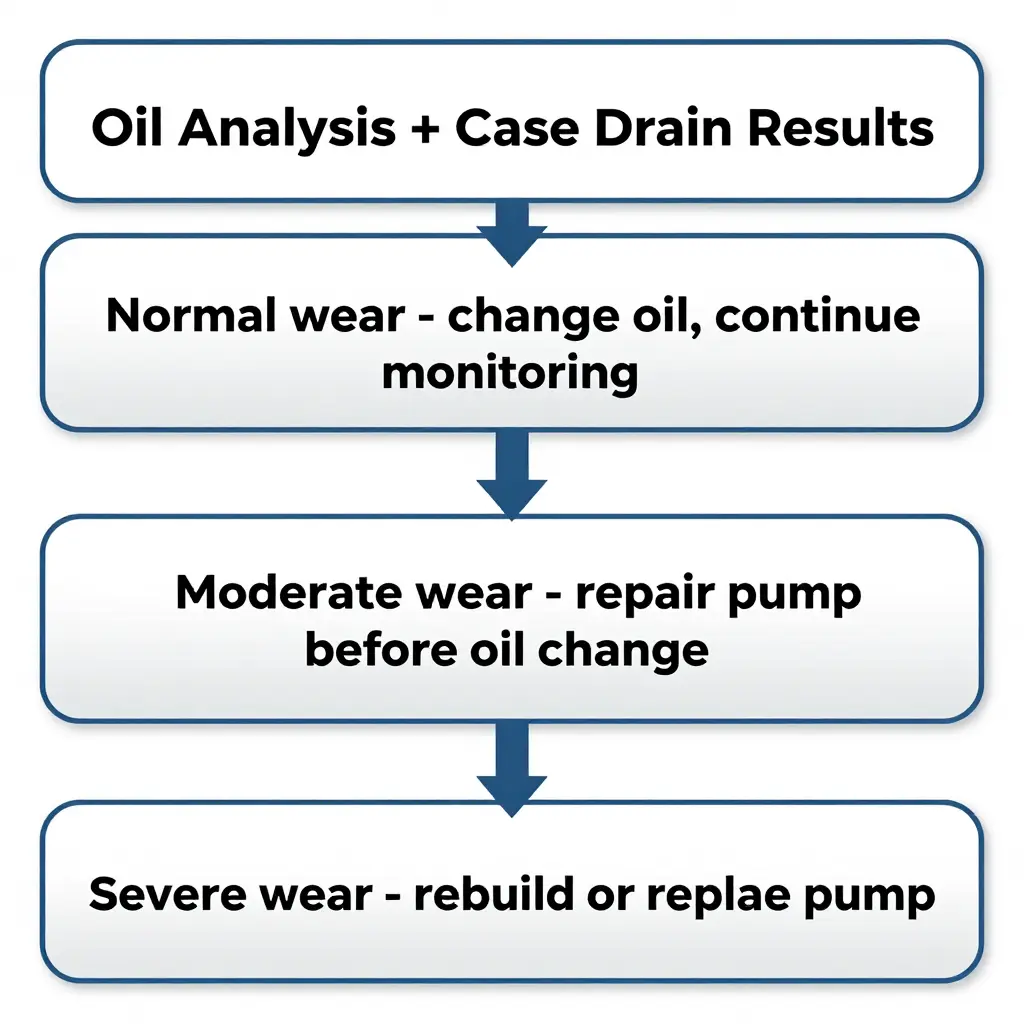
Read the results together. If case drain flow and wear metals are within limits, flush the circuit and change the oil. If clearances and volumetric efficiency are outside specification, schedule a pump replacement as part of the tower crane maintenance plan before the next lift.

The diagram traces that logic: one overheating complaint branches into three checks and converges on three repairs. If a rig still ends up stuck on site, understanding what a road crew can handle helps you plan the next move.
Interpreting Fluid Analysis and Wear Measurement Results
A single reading from a pump inspection means little. What matters is how particle counts, ferrous metal content, viscosity, and case drain flow move together. Read as a group, they show how far internal wear has progressed – and whether an oil change will fix your tower crane hydraulic overheating or just hide a pump that is already failing.
Particle Counts: The First Red Flag
ISO cleanliness codes track how many abrasive particles are circulating in the fluid. In a stable system the code stays flat between services. When it climbs two or more codes in a short interval, contamination is getting past the filters and scuffing internal surfaces – active wear, not normal operation.
Ferrous Metal Content
Spectrometric oil analysis reports iron and other wear metals in parts per million. A low, steady iron level is normal during break-in. The trend and the particle size are what signal trouble: sharp spikes plus visible ferrous flakes mean gears, pistons, or cylinder walls are shedding metal, the usual fingerprint of hydraulic pump wear.
Viscosity Changes
Viscosity outside its specified range weakens the oil film and starves components of lubrication. Thickening usually means oxidation from heat; thinning points to fuel, water, or shear breakdown. Either way, friction and temperature rise, which speeds up the wear you are trying to measure.
Case Drain Flow
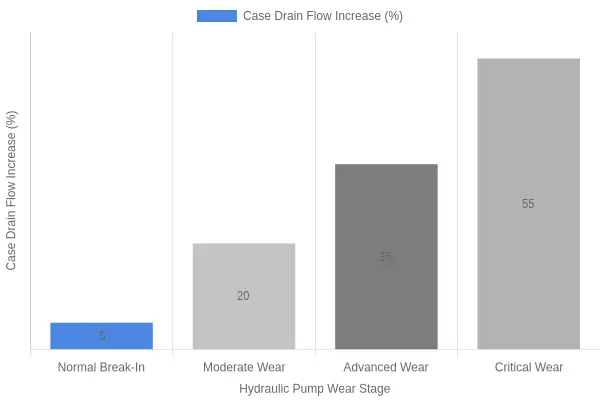
Case drain flow is the clearest single indicator of internal leakage. A healthy pump returns a small, steady trickle; as clearances open, that flow rises sharply. The chart below maps the increase against wear stage and marks the point where repair becomes the cheaper option.
Normal Break-In Wear vs. Accelerated Wear
Break-in produces low, slowly rising iron and stable particle counts that level off after the first service. Accelerated wear looks different: the numbers climb between every sample, ferrous flakes show up, and case drain flow keeps rising. One high reading is a flag; three climbing readings are a verdict.
| Indicator | Normal Break-In | Moderate Wear | Severe / Accelerated Wear |
|---|---|---|---|
| ISO particle count | Stable, within target | +1 code | +2 codes or more |
| Ferrous metal (ppm) | Low and steady | Slowly rising | Sharp spikes, visible flakes |
| Viscosity | Within spec | Slightly out of range | Well outside spec |
| Case drain flow | Under +10% baseline | +10% to +25% | Above +25% |
Turning Wear Severity Into a Repair Decision
Match the evidence to one of three actions, and do it before an oil change so a failing pump does not contaminate the new fluid.
- Repair when wear is moderate: isolated internal leakage, contaminants still controllable, pump otherwise sound.
- Rebuild when wear is advanced but the housing and shaft are serviceable – new seals, bearings, and rotating group restore performance.
- Replace when case drain flow has spiked, metal flaking is heavy, and housing damage makes rebuilding uneconomical.
Act once the call is clear. Changing oil over a worn pump just runs new fluid through damaged internals, and the overheating returns within weeks. If wear has already caused a breakdown on site, arranging prompt roadside service can get the unit moving again while you plan the repair. Read the data first; change the oil second.
What the Inspection Data Actually Shows
When tower crane hydraulic systems come in hot, the first instinct is often to dump the oil and refill. Inspection records tell a different story. The chart below shows how a batch of tower crane hydraulic inspections broke down by pump wear category.
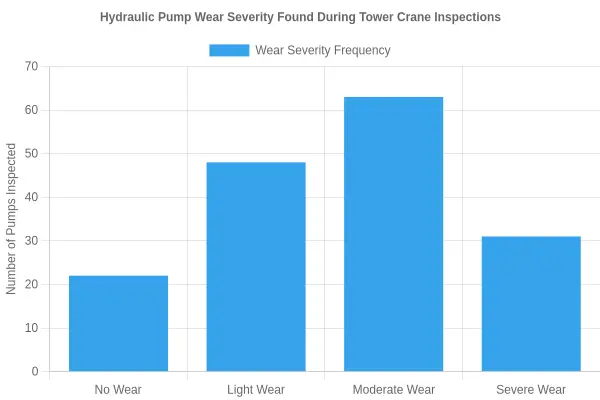
Because moderate and severe pump wear together account for well over half of all findings, technicians should verify pump condition before spending time and fresh oil on a routine change.
Reading the Chart
The chart uses two axes:
- X-axis (horizontal): the wear severity categories – No Wear, Light Wear, Moderate Wear, Severe Wear.
- Y-axis (vertical): the number of pumps inspected that fell into each category.
| Wear Category | Pumps Inspected |
|---|---|
| No Wear | 22 |
| Light Wear | 48 |
| Moderate Wear | 63 |
| Severe Wear | 31 |
No Wear was the smallest group and Moderate Wear the largest. Moderate and severe together account for 94 of the 164 pumps – roughly 57 percent – with enough internal damage to raise oil temperatures on their own. Clean fluid through worn bores and tired bearings will not cool that down. Check the pump before deciding the oil is the problem.
Frequently Asked Questions About Tower Crane Hydraulic Overheating
How can I tell whether overheating is caused by pump wear or oil degradation?
Oil degradation shows up chemically: discoloration, a burnt smell, lost viscosity. Pump wear shows up mechanically: whining, erratic pressure, metal particles suspended in the fluid. A fluid sample plus a pressure test at operating temperature will separate the two quickly. If temperature stays high after fresh fluid goes in, the fault is mechanical rather than chemical.
How often should hydraulic pumps be inspected?
A full pump inspection is commonly scheduled every 500 to 1,000 operating hours, or quarterly on heavily used units. Oil analysis should come more often, roughly every 250 hours, because it gives the earliest warning of developing trouble. A complete inspection covers filter debris, pump case temperature, and system pressure at the relief valve.
Can a fresh oil change temporarily reduce overheating?
Yes. Clean fluid transfers heat and holds viscosity better than degraded oil, so the gauge drops. That relief is what masks underlying hydraulic pump wear, which is why the pump should be diagnosed before you conclude the oil was the whole fault. If temperature is back up within a few shifts, the cause is mechanical.
What signs indicate that the pump needs immediate replacement?
Sudden loss of lifting pressure, loud metallic knocking, fluid leaking around the pump seal, and metal shavings in the reservoir all point to a pump that has failed or is about to. So does a case-drain flow test that exceeds the manufacturer’s limit. When these show up alongside tower crane hydraulic overheating, stop operating the crane until the pump is replaced.
How do coolant or cooling system faults relate to hydraulic overheating?
Clogged or leaking coolers, a failed cooling fan, and low coolant levels all cut the system’s ability to shed heat, so fluid temperature rises even with a healthy pump. Hydraulic and cooling circuits often share airflow or a heat exchanger, and a fault in one can quickly overheat the other. Check coolant condition and cooler airflow before you condemn the pump; it is a fast, low-cost step.
Should I change the oil before or after checking the pump?
Check the pump first. New oil in a worn pump wastes money and hides the symptom for only a short time, and a failing pump can contaminate that oil within hours. Diagnosing the pump first is what makes an oil change the fix instead of a patch.
Preventive Maintenance Best Practices That Protect Your Tower Crane Hydraulics
Hydraulic overheating rarely appears out of nowhere. Routine, preventive tower crane maintenance is what separates a pump that runs for a decade from one that fails mid-pour. The habits below are cheap and quick, and they cut the risk of wear and heat buildup inside the system.
Test the Fluid on a Fixed Schedule
Pull a hydraulic oil sample every 250 operating hours or quarterly, whichever comes first. Lab analysis tracks viscosity, water content, and particle counts, so contamination shows up long before it scores a pump bore. Log each result next to the hour-meter reading, because a trend says more than a single snapshot. When a bad sample means the crane has to come down for bench work, line up a reliable towing company in Houston early so the haul does not stall your schedule.
Replace Filters on Interval, Not on Instinct
Filters are the cheapest protection in the system. Change the return and pressure elements on the schedule below, and replace them right after any repair that opened the circuit.
| Component | Typical Interval | Replace Early If… |
|---|---|---|
| Return filter | 250-500 hours | Pressure drop climbs |
| Pressure filter | 500 hours | Metal fines appear |
| Breather | 500 hours / annually | Moisture in the bowl |
Verify the Cooling System Before Each Shift
Walk the cooler during the pre-shift check. Clean the fins, check fan and belt tension, verify coolant level and flow, and look for the heat plume that signals a blocked exchanger. A cooler running a few degrees hot makes the pump work harder all day. If the exchanger fails on a hot afternoon, a fast roadside service team keeps the delay short.
Choose the Correct Hydraulic Oil
Match the grade and viscosity index printed in your crane manual, and never top off with a mismatched or generic fluid. Getting the specification right is the same discipline as checking pump wear before you change the oil: diagnose correctly and the wrong fluid never enters the system.
Keep Operators Watching the Gauges
Operators are the system’s first sensor. Train them to note rising oil temperature, sluggish boom response, or an unusual whine from the pump, and to report it the same shift. When a failure gets past that warning and sidelines the unit, having a nearby towing service on speed dial keeps recovery fast and predictable.
Conclusion: Diagnose the Pump Before You Drain the Oil
When a tower crane shows signs of tower crane hydraulic overheating, the first step is not a fresh drum of oil. It is a structured inspection of the hydraulic pump. Replacing fluid treats a symptom; measuring hydraulic pump wear finds the actual source of the heat. Oil runs hot because an aging pump can no longer hold pressure, and it will keep running hot even after a full flush, which is why reactive oil changes lead to repeat failures and avoidable downtime on site.
Pressure and flow testing show how internal leakage makes the pump work harder and turns mechanical energy into heat. Oil analysis catches wear metals and rising particle counts long before contamination is visible. The diagnostic sequence, the inspection list, the comparison table, and the trend charts all point the same way: confirm pump condition first, then decide whether the oil genuinely needs replacing.
Final Recommendations
- Operators: log hydraulic temperatures daily, note sluggish response or erratic boom movement early, and report symptoms before they escalate.
- Maintenance teams: run pressure, flow, and vibration checks before authorizing any oil change, and replace or rebuild worn pumps as the priority repair.
- Supervisors: schedule preventive pump inspections at fixed intervals rather than waiting for a breakdown call. When a crane is immobilized, coordinating prompt recovery support such as roadside assistance for heavy equipment keeps the diagnostic plan on track.
Tower crane manufacturers such as Zoomlion publish the clearance tolerances and service intervals this sequence depends on; staying inside them is what keeps a pump healthy. Treat pump diagnostics as the first move rather than the last resort, and overheating stops being a recurring problem.