
Understanding Hybrid Towing Fundamentals
A hybrid that has lost power and will not start needs different handling from a conventional car. The engine may be off, but the high-voltage components are still energized, and in most hybrids the driven wheels stay mechanically tied to the electric motor-generators. That is why an operator cannot simply drag a dead hybrid the way they would an unpowered sedan: if the driven wheels roll, they back-drive parts that are not being lubricated or cooled. The safe answer is to get the driven wheels off the ground, and on an all-wheel-drive hybrid that means all four.
A dead hybrid is not one problem with one fix, because the layout differs by model. In a front-wheel-drive hybrid, the front wheels are geared to the motor-generators and the rear wheels are not. In an all-wheel-drive hybrid, a second motor or a driveshaft ties in the rear axle as well. Rolling a driven wheel turns a motor-generator, and a spinning motor-generator makes current. With the hybrid shut down, nothing is managing that current, so it can damage the motor-generators or the high-voltage battery.
Three terms come up repeatedly. A hybrid drivetrain pairs a gasoline engine with one or more electric motor-generators and a high-voltage battery, so the wheels can be driven by either source. Flatbed towing sets the whole vehicle on a tilting deck, leaving no wheel on the road. A towing service for a dead hybrid is a provider equipped to move a non-running hybrid without letting its driven wheels turn.
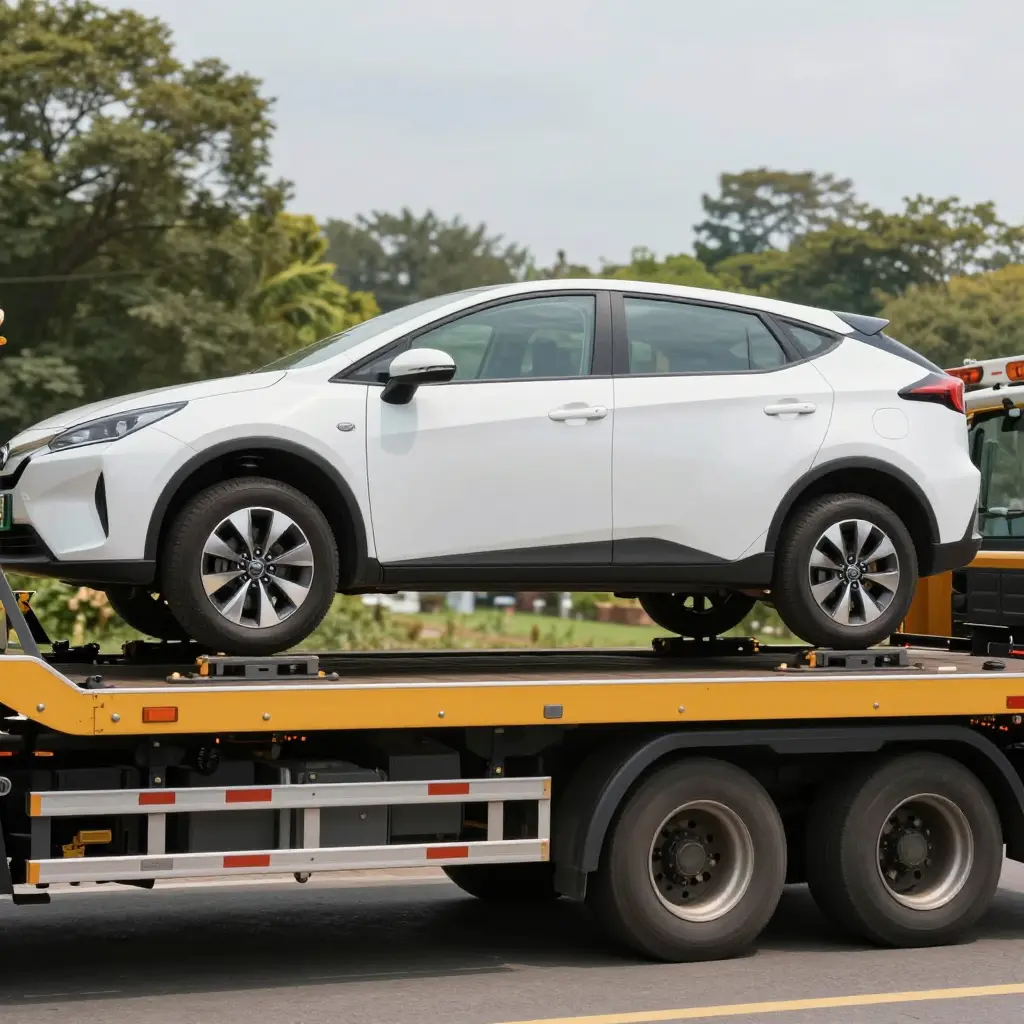
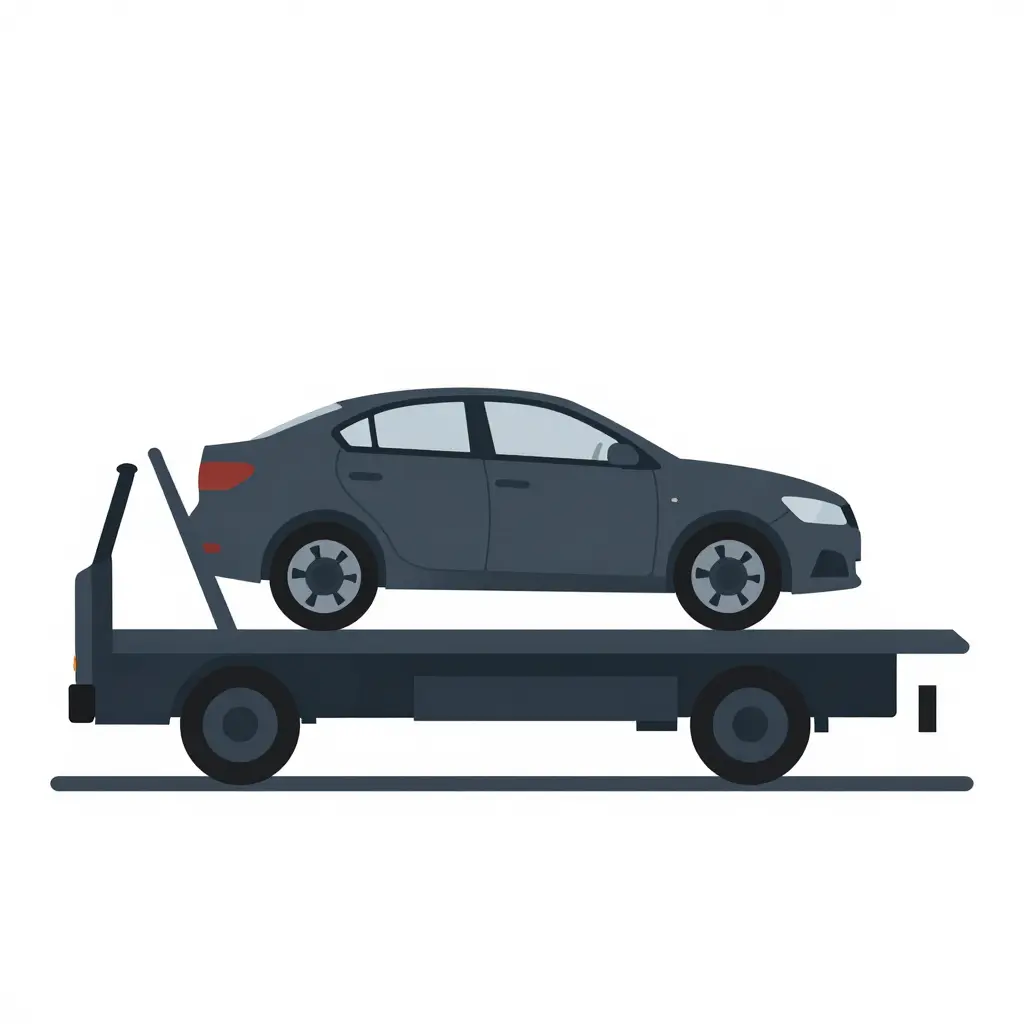
Given that layout, a flatbed is the most widely recommended method: the whole vehicle rides on the deck, all four wheels are secured, and nothing rotates. Before the platform tilts, the operator straps the vehicle down, releases the parking brake, and sets the transmission the way the manufacturer specifies. For owners and roadside crews alike, using an established provider such as Mike’s Towing takes the guesswork out of equipment and procedure.
Why the Driven Wheels Must Come Off the Ground
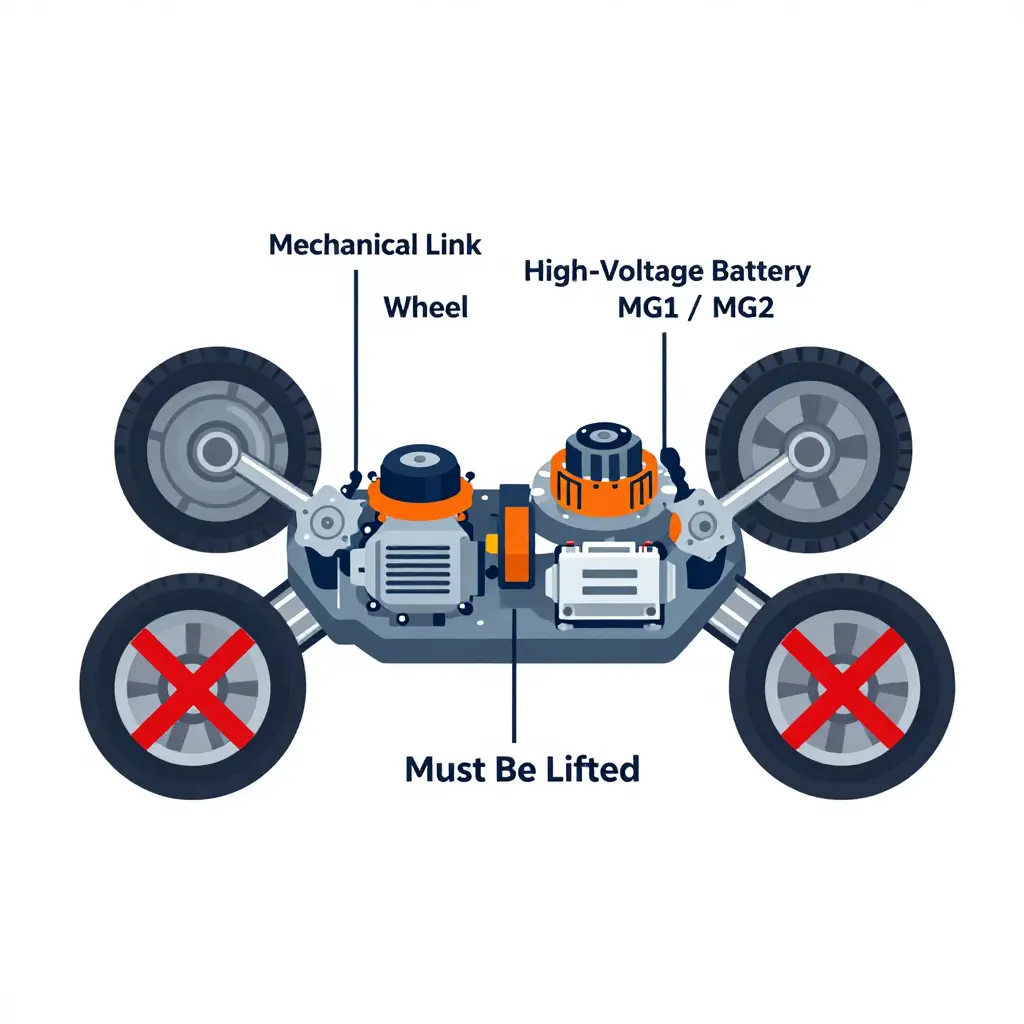
A dead hybrid is not a dead conventional car. Cutting the high-voltage system does not uncouple the wheels from the electric drive; the mechanical link stays exactly where it was. The wheels that move the car are still geared to the motor-generators, which is why those wheels must never roll during a tow. On an all-wheel-drive hybrid every wheel is a driven wheel, so all four have to come off the ground.
The Drivetrain Never Truly Disconnects
In a hybrid, the motor-generators live inside the transaxle. They are not belt-driven accessories bolted to the side of the engine, and no clutch opens when the engine quits. They sit on the same shafts that turn the driven wheels, permanently. Spin a driven wheel and the motor-generator spins with it, whether the car is on or off.
What Happens When the Wheels Turn
When a hybrid is towed with a driven wheel rolling, the road becomes the power source. The rotating wheel back-drives the motor-generator, and a spinning electric motor behaves as a generator whether you want it to or not.
That creates two problems:
- Uncontrolled voltage generation. A back-driven motor-generator produces voltage that the disabled high-voltage system is not managing. It can energize circuits that are not designed to be live during a tow.
- No lubrication or cooling. The transaxle oil pump and the cooling circuits run off the engine or the hybrid system. With the hybrid shut down, oil is not circulating and heat is not being carried away.
Without an oil film, bearings, bushings, and gear surfaces run metal against metal. Without coolant flow, windings and inverter components soak in heat they cannot shed.
Rolling Wheels Cause Real Hybrid Towing Damage
Damage from a rolling tow builds quietly. A car can reach the shop with scored gears, overheated bearings, or a failed motor-generator and give no warning on the way. None of it is cheap to fix, and all of it is avoidable.
There is a safety angle too. A back-driven motor-generator can put unexpected voltage where an operator is working, which is one more reason not to let a driven wheel turn.
The Correct Procedure
The hard rule is that no driven wheel may turn. A flatbed or a full four-wheel lift satisfies that on any hybrid. On a front-wheel-drive hybrid, a wheel lift or dolly that raises the front axle also keeps the motor-generators still, though a flatbed remains the safer default. If the driven wheels cannot be lifted, the vehicle should not be moved.
Treat a discharged hybrid as a vehicle that is still mechanically and electrically connected to the road. Getting the driven wheels off the ground breaks that connection, protects the motor-generators, and keeps the high-voltage system from being back-fed. Operators who want dependable equipment and crews trained in hybrid recovery can call our roadside service team.
Hybrid Drivetrain: Why the Wheels and Electric Components Share a Link
In a typical hybrid, the engine, the battery pack, and the motor-generator are not independent. A mechanical drivetrain ties them together and runs out to the wheels.
- The engine supplies mechanical power to the drivetrain.
- The electric motor-generator sits inline with the drivetrain and can both drive the wheels (as a motor) and produce electricity (as a generator).
- The battery pack stores and releases the electrical energy that flows to and from the motor-generator.
- The driven wheels connect through the drivetrain in a way that keeps them mechanically linked to the electric components.
The last point is what matters for towing. Because the driven wheels are physically tied to the motor-generator, rolling them back-drives the electric components. With the car powered down, nothing manages the current or the heat that follows, and sensitive electronics can be damaged.
That is why the driven wheels have to be off the ground before the car moves. For owners who need this handled carefully, professional roadside assistance for hybrid vehicles should protect the drivetrain from the moment the vehicle is loaded.
A dead hybrid dragged with its driven wheels rolling feeds mechanical and electrical energy back into systems that were never meant to run unpowered. The damage is usually permanent and costs far more than a flatbed tow would have. The parts most at risk:
- Electric motor-generator – With the inverter inactive, the spinning motor can act as an unintended generator, subjecting its windings and bearings to uncontrolled voltage and heat.
- Power inverter – This unit manages high-voltage conversion between the battery and motor; without coolant circulation and active control logic, oversupplied current can overheat and destroy its switching electronics.
- Transmission (including the planetary gear set / transaxle) – Internal clutches and gears depend on pumped lubricant that the transaxle only circulates while the vehicle is running, so a stationary-engine tow starves them and accelerates wear.
- Differential and final drive – These gears turn whenever the wheels rotate, but they run without pumped lubricant when the drivetrain is not actively powered.
- Battery cooling system – The high-voltage pack’s coolant pump and fans only operate when the vehicle is on, so a rolling tow can let the battery and inverter overheat with no thermal management.
This is why operators lift the driven wheels, or all four on an all-wheel-drive hybrid, whenever a hybrid will not start. If you need a trusted roadside service that understands these risks, a team trained in hybrid recovery keeps a simple breakdown from turning into a major repair.
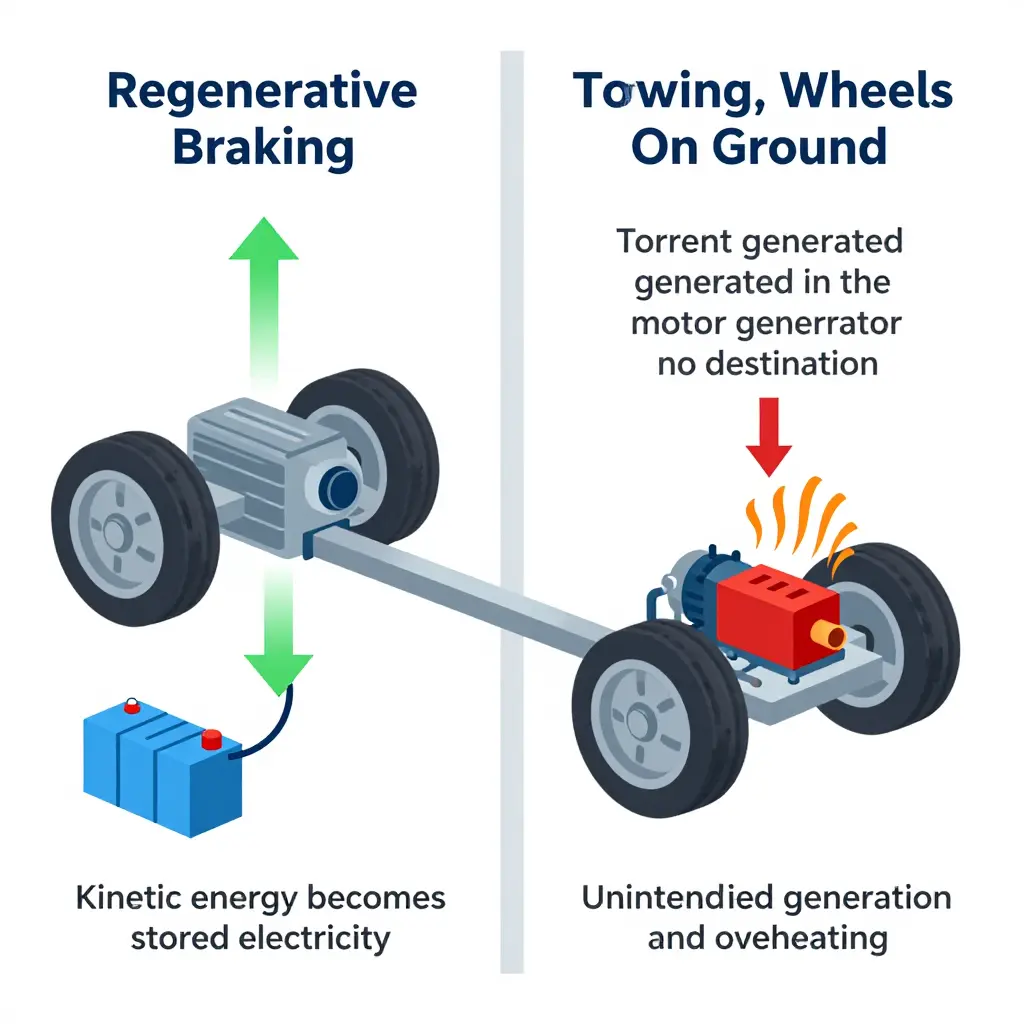
Regenerative braking is how a hybrid recovers energy when the driver slows or coasts. Instead of relying only on friction brake pads, it runs the electric motor in reverse. The turning driven wheels spin that motor, the motor generates electricity, and the current charges the high-voltage battery. The resistance created by the conversion is what actually slows the car, which is why the process is called regenerative braking – the energy is regenerated rather than lost as heat.
The Towing Problem: Unintended Generation
The same mechanism turns against you when a hybrid is towed with its driven wheels rolling. Those wheels keep turning the motor-generator whether the car is switched on or not, so the vehicle keeps producing electricity even though nobody asked it to.
Normally the battery and the hybrid control system manage that current. When the battery is dead, disconnected, or already full, the electricity has nowhere to go. It is converted into heat inside the motor-generator, the inverter, and the high-voltage cables – the same path regenerative braking uses to move energy.
With no engine-driven cooling airflow and no active management, those parts can overheat quickly. Sustained overheating can damage the inverter, melt wiring, and in rare cases start a fire. That is exactly why a rolling tow is discouraged and why a flatbed, or a wheel lift that raises the driven axle, is the safe choice.
When the vehicle has to move without its driven wheels turning, a trained provider such as Mike’s roadside service can lift it clear and keep unintended current out of the system.
The four common methods differ in one decisive way: how many wheels are left on the road, and whether any of them are driven.
| Towing Method | Wheels on the Ground | Suitability for a Dead Hybrid | Risk Level |
|---|---|---|---|
| Flatbed Towing | None – all four wheels secured on the deck | Best choice; safe for any hybrid drivetrain | Low |
| Full Wheel Lift / All-Wheel Lift | None – all four wheels raised clear of the road | Good alternative when a flatbed is unavailable | Low-Medium |
| Wheel-Lift Towing | Two non-driven wheels, on a front-wheel-drive hybrid | Raises the driven axle, so it can work for a front-wheel-drive hybrid; unsafe on an all-wheel-drive hybrid, where driven wheels keep rolling | Medium-High |
| Tow Dolly Towing | Two non-driven wheels, on a front-wheel-drive hybrid | Same limit as a wheel lift – it must raise the driven axle, and most manufacturers do not approve it for regular use | Medium-High |
What counts is not the number of wheels on the road by itself but whether any of them are driven. If the rolling wheels are not connected to the hybrid drive, they turn harmlessly; if they are, they feed the motor-generators. A flatbed or full lift removes the question entirely. To get this right the first time, it pays to work with an experienced Houston towing service that understands hybrid hardware.
How Towing Methods Stack Up on Safety
Not every tow truck handles a dead hybrid the same way. What counts is whether the driven wheels are allowed to roll. The chart below scores the four common methods on that basis, where a higher score means less risk to the vehicle.
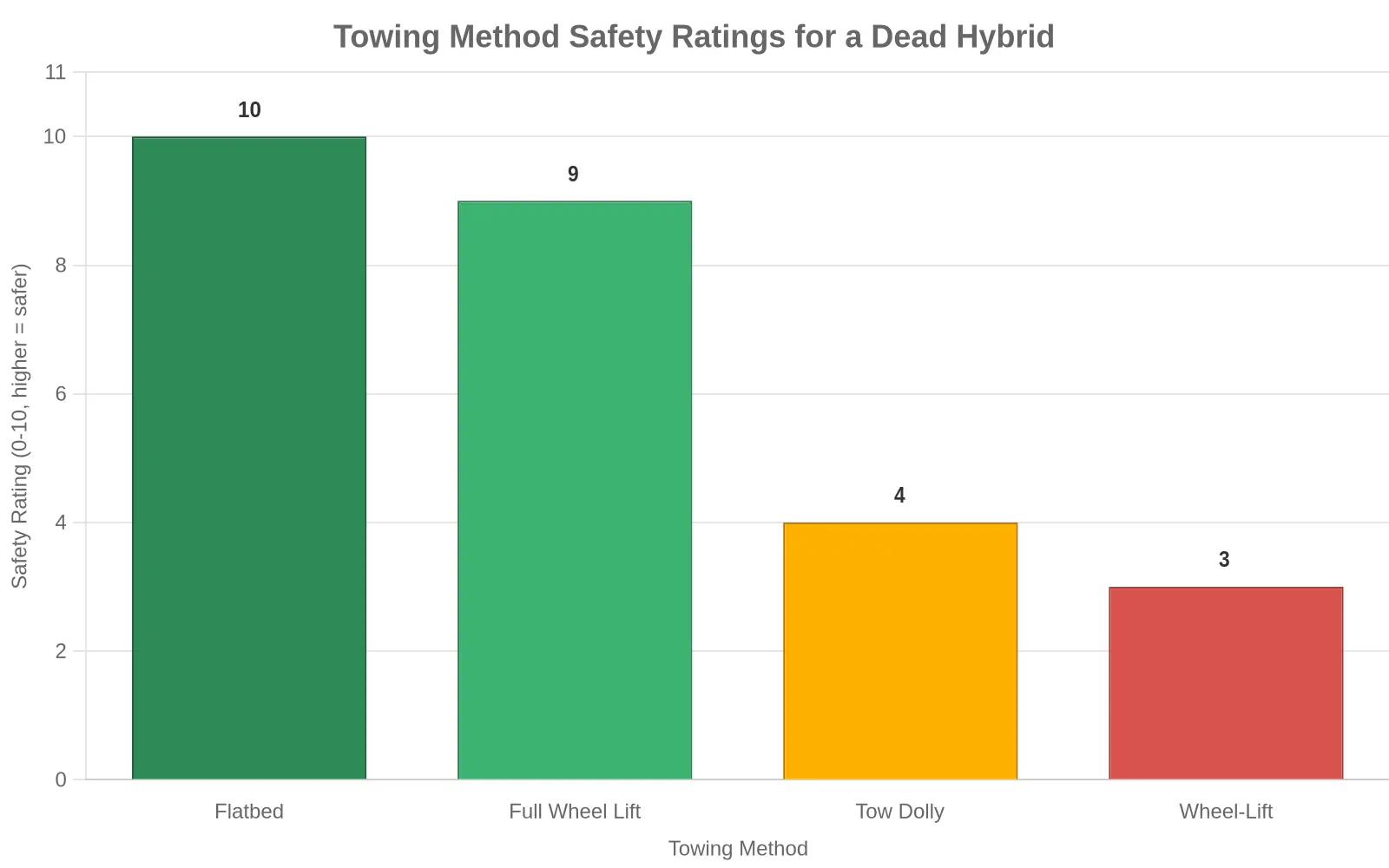
Flatbed and full wheel lift sit at the top because no wheel turns at all. A tow dolly and a standard wheel lift leave one axle on the pavement, so they score lower – appropriate for a front-wheel-drive hybrid only if the axle left rolling is the non-driven one, and not appropriate for all-wheel drive. To arrange a tow that keeps your hybrid fully suspended, you can request expert towing service from a team that knows hybrid-specific procedures.
What the Ratings Tell You
| Towing Method | Safety Rating (0-10) | Wheels Off the Ground | Risk Level |
|---|---|---|---|
| Flatbed | 10 | All four | Very Low |
| Full Wheel Lift | 9 | All four | Low |
| Tow Dolly | 4 | Two (one axle) | High |
| Wheel-Lift | 3 | Two (one axle) | High |
Methods that keep all four wheels off the ground are the safest choice for a dead hybrid. They eliminate the rolling that can overheat the electric motor-generators or wear the transmission. Anything that leaves a driven wheel touching the road should be treated as a last resort.
Manufacturer Guidelines and Industry Standards
The rules for moving a hybrid come from the manufacturer, not the tow operator, and they generally point to the same answer: use a flatbed, or lift the driven wheels clear of the road.
What the Owner’s Manual Actually Says
Open the manual for almost any hybrid and you will find a warning about towing with the drive wheels rolling on the pavement. That spins the electric motor-generators and produces current with nowhere to send it. The result can be overheating, damaged inverter components, or a ruined transmission.
Manufacturers usually name the safe option instead: a flatbed, or a lift that raises and supports the driven axle. All-wheel-drive hybrids leave no safe “rolling” option at all. Front-wheel-drive hybrids have more room to maneuver, but only if the front axle is the one in the air.
Industry Best Practices for the Pros
Roadside crews and repair shops work from the same list. Before a hookup, a trained operator checks the owner’s manual, confirms which wheels are driven, and notes whether the vehicle should be in Park or in “Tow” mode. Get it wrong and you can fry components that cost thousands to replace.
The standing advice is simple: when in doubt, lift all four wheels. It protects the drivetrain, keeps the operator clear of liability trouble, and gets the vehicle to the shop without a second round of damage. For owners near the Gulf Coast, a dedicated towing service in Houston, TX follows these manufacturer rules on every hybrid call. The same discipline applies with the Jacksonville towing professionals who handle hybrids along the East Coast.
Your owner’s manual is the authority. A flatbed is the easiest way to follow it.
Frequently Asked Questions About Hybrid Towing
Can a hybrid be towed with two wheels down?
Generally no, at least not with the driven wheels down. Hybrid motors, generators, and transmissions rely on fluid circulation and cooling that only happen while the vehicle is running, and rolling them dry causes friction, heat, and mechanical damage. That is why manufacturers and professional operators usually insist on a flatbed. On a front-wheel-drive hybrid, a lift that raises the front axle leaves only the non-driven rear wheels turning, which is why some manuals allow it for short, low-speed moves. On an all-wheel-drive hybrid, two wheels down is never safe.
Is a tow dolly safe for a hybrid?
A tow dolly is only appropriate when the wheels left on the ground are the non-drive wheels, and even then most builders do not endorse it. On a front-wheel-drive hybrid, a dolly that lifts the front wheels can sometimes work for very short, low-speed moves, but it is not a manufacturer-approved solution for regular use. On an all-wheel-drive hybrid, a dolly is unsafe because it leaves two drive wheels rolling and can damage the electric drivetrain. When in doubt, request a professional towing service for a dead hybrid that uses a flatbed.
How far can a hybrid be towed?
Distance depends entirely on the method. With a flatbed tow truck, a hybrid can be transported any practical distance because no wheels touch the road and no drivetrain components spin. When a hybrid is moved with wheels on the ground, safe towing distance drops dramatically, and many manufacturers specify that such movement should be avoided altogether. If a roadside situation forces a short roll, it should be treated as an emergency measure, never a routine one.
What happens if a hybrid is towed incorrectly?
Incorrect towing can destroy the electric motor, damage the reduction gear or transmission, and interfere with the regenerative braking system. Because these parts are expensive and often sealed, repairs can cost thousands of dollars and may void portions of the warranty. Overheating and fluid starvation are the biggest risks, and damage often goes unnoticed until the vehicle is started again. Understanding hybrid towing rules ahead of time is what keeps these failures from happening.
Key Takeaway
The driven wheels come off the ground for one reason: it is the only method that protects the hybrid drivetrain while moving a vehicle that cannot run under its own power. On an all-wheel-drive hybrid, that means all four. Choose a provider who knows the difference, and the tow stays safe.
Conclusion: Protecting Your Hybrid Starts With the Right Tow
The short version: when a hybrid loses power, the driven wheels must come off the ground. The electric drivetrain stays mechanically linked even when the vehicle is “dead,” so any setup that lets a driven wheel roll – a two-wheel tow, a dolly in the wrong place, flat-towing – can spin the motor-generators and generate damaging heat. Lifting the driven wheels removes that risk; on an all-wheel-drive hybrid, that means all four.
Keep these takeaways in mind:
- Treat a disabled hybrid differently from a conventional car; the drivetrain does not simply disengage when the engine stops.
- Insist on a flatbed or a full four-wheel lift, or at least a lift that raises the driven axle.
- Confirm the operator understands hybrid procedures before the vehicle is loaded.
- Document the vehicle’s condition and towing method for your records.
When in doubt, do not improvise. The safest path is to request a towing service for a dead hybrid that is properly equipped and experienced with these drivetrains. If you want a team that understands the correct lifting method, you can reach out to a trusted Houston towing company for professional assistance. Getting the procedure right protects your hybrid’s drivetrain and your warranty, and it costs far less than a rushed tow that was done the wrong way.