
For business owners, the efficiency of towing services can significantly impact operational continuity. Understanding tow truck response times is crucial for managing roadside emergencies. Factors like location, traffic, and the nature of the towing job play vital roles in determining how long a tow truck will take to arrive and complete its task. This article will explore the variability in tow truck response times across different locations, delve into factors that influence towing durations, and assess how modern technologies are optimizing these operations for businesses and individuals alike.
Tow Time Unveiled: What Really Determines the Speed of a Tow Across Cities and Countryside

When someone asks how long a tow will take, the answer is not a single number but a range shaped by location, conditions, and the specific service. Urban calls tend to be faster due to nearby fleets and higher driver density, often yielding an ETA of 15 to 30 minutes from dispatch. In rural areas, even with a ready operator, travel distances and limited equipment can stretch that window to 45 minutes, an hour, or more. Weather, traffic, and road work can further extend the timeline or create delays between arrival and starting the recovery. A simple tire change can be quick if the tow truck has the right tools on hand; a more complex recovery or vehicle extraction from difficult terrain may require additional time and sometimes a staged plan.
Dispatch practices also matter. Clear location details, vehicle type, and observed hazards help the dispatcher place the right truck with the right tools, which can shave minutes off the wait. If possible, ask for an ETA and a live update link, and be prepared to confirm access routes or gate codes. Across the board, the core message remains: proximity and availability set the ceiling, while the task’s complexity and the environment set the floor.
Tow Time Unveiled: What Really Determines How Fast a Tow Truck Arrives and Finishes the Job
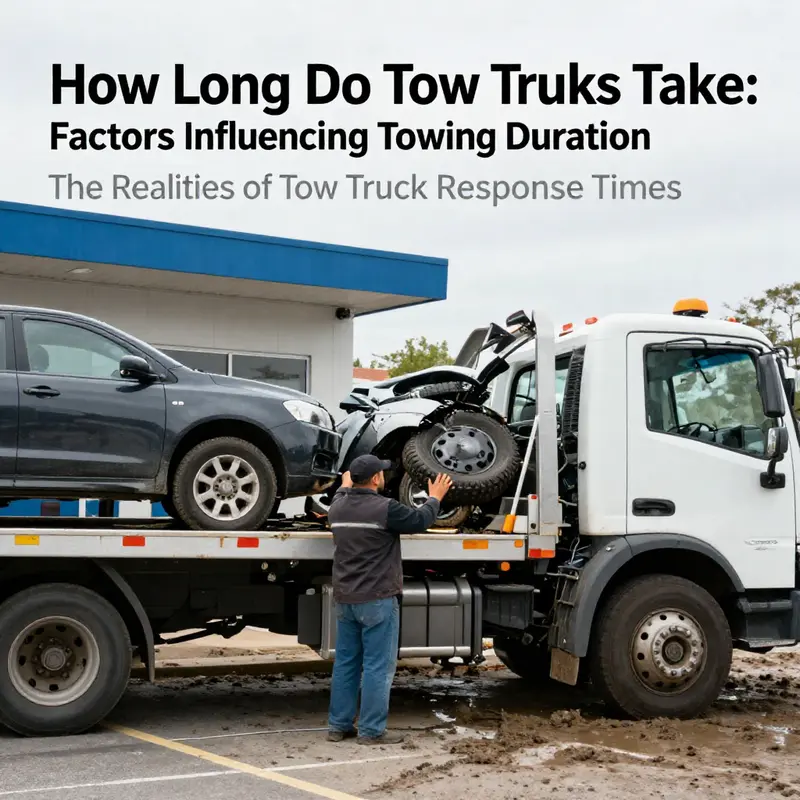
When people ask how long a tow truck will take, the answer isn’t a single number. Time metrics shift with geography, demand, weather, and the specifics of the incident. In practice, you can think of tow time as a two-part story: the wait for a unit to arrive, and the work that follows once it’s on scene. Together they define the overall duration, and together they reveal why two tows in the same city on the same night can feel radically different. The most immediate factor is proximity. In dense urban areas where a lot of units operate in a small footprint, a tow truck can reach a caller in roughly 15 to 30 minutes. The same service, in a rural lane or a remote stretch, might require well over an hour simply because the nearest available unit sits farther away. This isn’t a matter of will or pace alone; it’s a logistics problem solved by coverage density, dispatch discipline, and the geography of the road network. If you picture the service area as a map of dots, the closer the dots line up to your location, the quicker the arrival. When visibility is poor or weather is unsettled, those travel times can creep upward as crews adjust routes to avoid hazards and to maintain safety margins for drivers and equipment. In fair conditions, the clock moves more predictably. In storms, snow, or flooding, even a familiar route can become a detour, and the overall response time stretches as crews navigate slick surfaces, reduced visibility, and higher on-scene caution. The second phase—the on-site process—depends on what’s happening with the vehicle and where it’s headed afterward. A straightforward breakdown, such as a flat tire or a jump-start, usually resolves in a compact window. The driver might secure the vehicle, perform a quick roadside fix, and transport only if necessary. In many cases, the job ends with the vehicle remaining roadside, or the driver leaves after a simple assist, reducing the total time you experience. More complex operations, however, unfold like a mini-recovery operation. If a vehicle is involved in an accident, or if it’s trapped in mud, snow, or off-road terrain, the crew must manage scene safety, police coordination, and sometimes multiple pieces of equipment. Lifting onto a flatbed, winching from a ditch, or reconfiguring gear to handle a large or luxury vehicle can add minutes or hours to the timeline. And if more than one vehicle is involved, or if the location complicates the move, the operation can extend into longer windows. The kind of vehicle and the destination matter too. Large commercial trucks, heavy machinery, or high-end cars require specialized flatbeds and careful handling. The distance to the repair shop, impound lot, or storage facility can stretch the clock, especially if the route options are constrained by traffic or road restrictions. All these factors ride on top of the everyday rhythms of the day: peak travel times, weekends, and events that draw extra demand. Modern dispatch systems, equipped with GPS tracking and real-time routing, help teams coordinate more tightly. Instead of guessing, the dispatcher can forecast a more reliable ETA by watching unit location, traffic data, and weather feeds, and they can update the customer as conditions change. For a local option with transparent dispatch, consider checking a nearby service page such as Mike’s Roadside Service Page. It’s a practical reminder that accessibility and clarity in communication often matter as much as the mechanical act of towing itself. When you’re figuring out how long a tow will take, it helps to ask for a realistic ETA that includes arrival and basic on-site time. A typical breakdown in town might land in the 30 to 60-minute range from the moment the call is placed, assuming no unusual delays. A longer or more complex scene, especially in challenging weather or at a remote site, can push that window out by a few hours. If you need a precise estimate, contact the local service directly; they can tailor it to the current conditions and the specific vehicle involved. Digital platforms that provide on-demand dispatch and live updates are transforming expectations, reducing uncertainty, and helping drivers and customers align on a practical timeline. For readers seeking deeper context on how these factors coalesce across the industry, a detailed external resource offers insights into the standards, types, and performance drivers behind modern tow operations: https://www.roadside.com/what-affects-towing-times/.
Smart Positioning, Faster Replies: Optimizing Tow Truck Operations for Modern Timelines
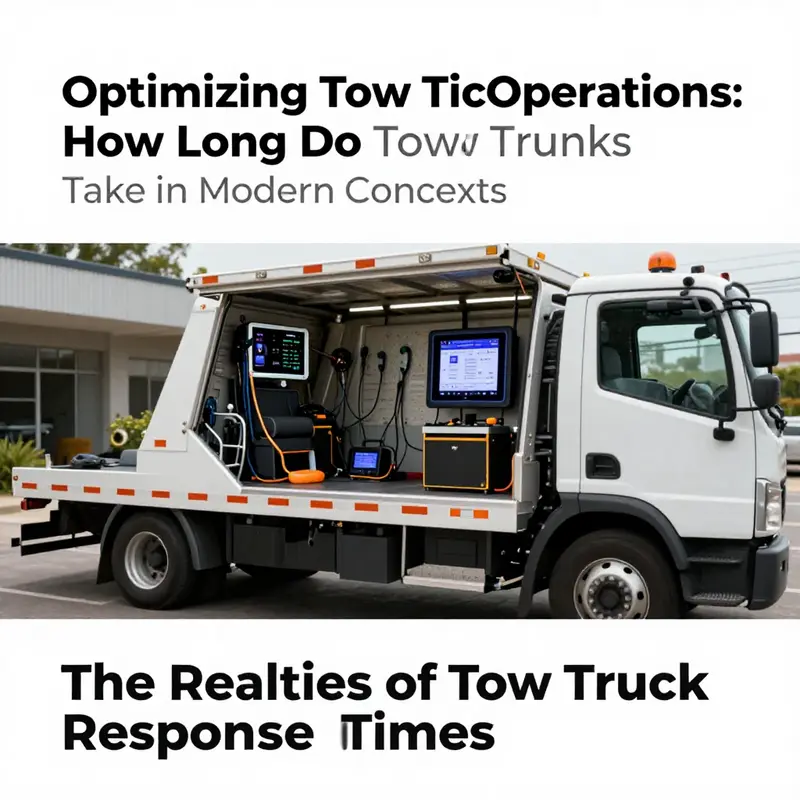
When we examine how long tow trucks take, the answer becomes a story about coordination as much as distance. Real-world response times vary with call origin, traffic, and the kind of help requested. In dense urban centers, the standard expectation—an arrival within 15 to 30 minutes—often holds, but the real driver of user experience is what happens after the call lands. A simple jump-start or tire change may require only a brief intervention and a quick departure, while a complex recovery from mud, a rollover, or a multi-vehicle incident can stretch into hours. The chapter aims to explain how operators use data and smart positioning to shave minutes off the clock, even when road conditions and demand shift in real time. In this light, modern tow operations resemble a carefully choreographed relay, where timing and routing ripple outward to affect every leg of the journey from roadside to shop.
The heart of optimization rests on data-driven positioning. By analyzing historical accident data and its locations, service providers can forecast where demand will spike and how many units are needed at regional and sub-regional levels. The approach relies on extracting geographic coordinates from large datasets and applying clustering techniques such as k-Means and k-Medoids to identify high-demand pockets. The goal is to pre-position fleets so that a truck is closer to the likely site of trouble when a call lands. This method accepts the imperfect nature of real life—accidents can happen anywhere—but it builds a scaffold that reduces average wait times by turning a best-guess deployment into a calculated, evidence-based one. The practical payoff appears when dispatch decisions align with the predicted patterns of demand, allowing trucks to be closer to where they will be needed next rather than where they happened to finish their prior assignment.
The tools and technologies backing this shift are as important as the math behind it. Researchers describe workflows that use platforms like OSMNX to compute realistic road distances from cluster points to major corridors, ensuring that routing models reflect real travel paths rather than idealized maps. One representative study processed a sizable dataset (161,420 accident records) by combining Oracle SQL, Python, and KNIME to refine deployment strategies. The emphasis is not on fancy software for its own sake but on translating complex spatial data into actionable dispatch rules. The result is a deployment doctrine that can adapt to dynamic factors: fluctuating traffic, weather conditions, and the day’s changing landscape of incidents. In practice, fleets in well-structured systems can push response times toward the lower end of the spectrum, with a meaningful share of calls reaching on-scene arrival well under 30 minutes. For a more tangible image of how such optimization plays out in large metro areas, consider how regional fleets are evolving toward similar data-led layouts and adaptive routing. In this context, a real-world example near dense networks and rapid dispatch echoes the same optimization logic described here.
Yet optimization does not erase distance or traffic. It reshapes the odds by placing resources where they matter most and by enabling faster decision-making when conditions change. In cities with advanced systems, real-time data feeds and predictive analytics support more adaptive routing, dynamic reallocation of units, and better coordination with traffic management signals or incident scenes. The path from call to clearance thus becomes a sequence of calibrated actions rather than a single, static event. Conversely, in rural or underserved regions, there are still geographic and logistical limits that keep response times above an hour for a notable portion of requests. The contrast is instructive: the same core principles—data-driven placement, realistic distance calculation, and real-time dispatching—must be scaled to account for different density patterns and travel impediments. The overarching aim is to maximize coverage while minimizing downtime, so that stranded motorists spend less time waiting and more time returning to the road.
Ultimately, modern tow operations hinge on a learning system. The convergence of data science, geographic analysis, and nimble dispatching shapes a future where the average wait is shorter, the chance of a lengthy recovery is mitigated, and the roadway returns to normal more quickly after disruption. For a deeper dive into these optimization strategies, see the latest research article that links predictive deployment to tangible reductions in wait times. External resource: https://doi.org/10.1109/ubmk63289.2024.10773565
Final thoughts
For business owners, understanding tow truck response times is vital in ensuring operational continuity and safety. Factors such as location and the type of service significantly influence how quickly help arrives. Furthermore, advancements in technology are increasingly optimizing these response times, making it easier for companies to manage roadside emergencies effectively. Proper knowledge and planning can enhance the customer experience and reduce downtime during vehicle issues.