
Understanding your truck’s towing capacity is essential for business owners who rely on their vehicles to transport goods or equipment. Whether you need to tow a trailer, an RV, or heavy machinery, knowing how much your truck can tow ensures efficiency and safety. In this guide, we will explore the critical factors influencing your truck’s maximum towing capacity and introduce you to the RV Tow Check app, a powerful tool designed to provide precise towing limits tailored to your specific vehicle. By the end of this article, you’ll equip yourself with the knowledge to make informed towing decisions, protecting both your investment and your operational capabilities.
Tow Capacity Decoded: Reading Your Truck’s Maximum Towing Limit and Tow Safely
When you ask, “How much will my truck tow?” you’re really asking about a set of intertwined limits that guard your vehicle and everyone on the road. The answer isn’t a single number on a sticker or a horsepower figure alone. It’s a careful read of several specifications that work together: the truck’s maximum towing capacity defined by the manufacturer, the weight of the truck itself, the weight of the trailer, and how all of that gear is distributed and carried. This is why the conversation around towing capacity often begins with the basics: your make and model, the engine type, whether the drivetrain is 2WD or 4WD, and even the trim level, which can subtly affect the components that support towing. It’s not merely about raw power; it’s about whether the frame, suspension, brakes, and transmission were designed to handle the combined mass you plan to move. Understanding this helps you stay within the lines that keep you safe and preserve your truck’s warranty over time.
The most reliable starting point is the numbers the manufacturer provides. Those figures are not arbitrary; they reflect testing, engineering limits, and safety margins built into the design. The official ratings you’ll find in the owner’s manual or on the placard mounted on the driver’s side door jamb summarize what the vehicle was engineered to handle in real-world towing scenarios. For many readers, the placard is the quickest reference, presenting the bumper-to-bumper reality of what the truck can safely haul and tow under typical conditions. Nevertheless, it’s also essential to recognize that these numbers assume well-maintained equipment, proper hitching, and sensible loading. If you’re planning to tow an RV, a large trailer, or a heavy load that pushes near the edge of those limits, you want to verify every component aligns with the manufacturer’s safeguards.
Within this framework, a critical concept to grasp is the maximum payload capacity. Payload isn’t just passengers and groceries; in the towing context, it includes everything the truck carries that contributes to the overall weight the chassis must support. The method described in the materials is straightforward: identify your truck’s curb weight, then subtract that from the Gross Combined Weight Rating, or GCWR. The resulting figure represents the maximum payload capacity. This payload capacity explicitly encompasses the trailer’s weight, the occupants, cargo in the bed or cab, and any accessories you’ve added. It’s a reminder that towing isn’t simply a matter of “how big a trailer can you pull,” but also how much weight you can legally and safely carry in the truck while it tows.
To translate those numbers into practical decisions, you’ll want to differentiate between the RV or trailer weight and the weight the truck is literally carrying in its bed and cabin. The fundamentals are simple in theory but can be complex in practice: GCWR is the upper bound for the combined weight of the truck and the trailer when you’re in a towing configuration. GVWR and curb weight further refine how much of that GCWR is tied up in the truck’s own mass. The curb weight is what the truck weighs on its own, without passengers, cargo, or a trailer. The GVWR represents the maximum weight the truck is rated to carry, including passengers, fuel, cargo, and any installed equipment. The interplay of GCWR and GVWR, along with the curb weight, determines how much you can tow without confronting safety hazards or warranty concerns.
In practice, you’ll often hear about a few practical steps to determine the actual towing limit for a given trip. Start by locating your GCWR and curb weight from the placard or the manual. Subtract the curb weight from the GCWR to obtain the maximum payload capacity. This is the ceiling that includes everything you put in the truck and everything you tow. If your trailer has a substantial weight, you’ll need to ensure that the trailer’s weight plus any payload inside the truck does not exceed that calculated payload. This approach helps prevent overloading the drivetrain and braking systems, which are calibrated to perform with a safety margin in mind. It’s worth noting that the numbers you see aren’t just about moving a load; they’re about ensuring that the entire vehicle-trailer combination remains controllable and predictable under highway conditions, in corners, and during braking events.
A common pitfall is to focus only on the trailer’s weight while neglecting the weight you’re carrying inside the truck. People often overlook passengers or a cargo-filled bed, which can tip the balance and push you beyond the limit. That’s why the rule of thumb—treat the GCWR as the total cap for everything you’re moving, and verify the truck’s own weight and payload allowances—offers a safer, more reliable approach than focusing on a lone number. The end goal is not to chase the highest possible rating but to stay within a margin where a trailer’s weight, plus a reasonable payload, can be managed with confidence.
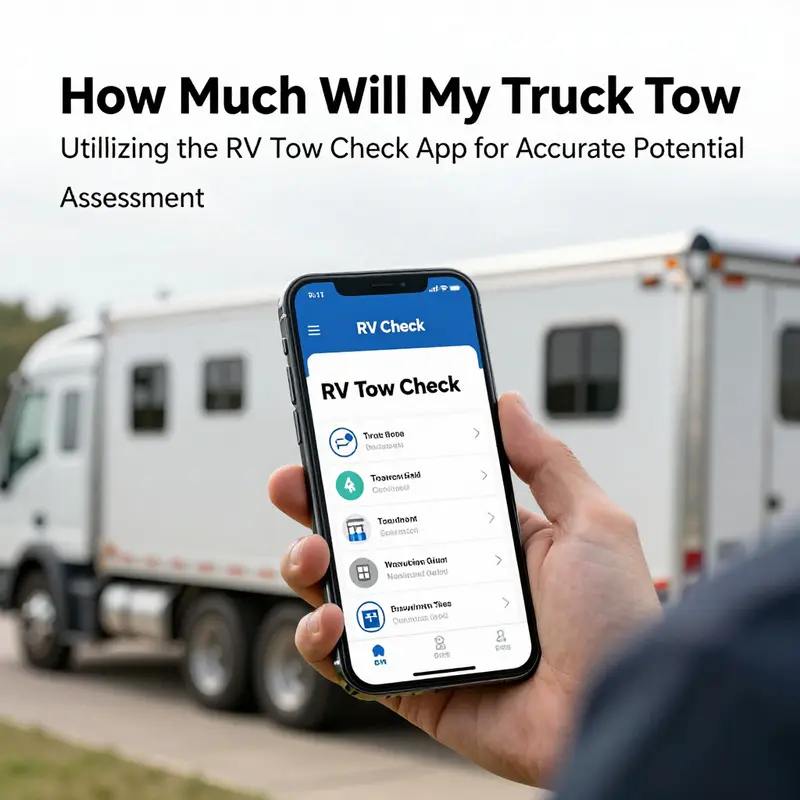
For readers who prefer a structured, tool-assisted approach, there are dedicated capacity calculators designed with towing safety in mind. The RV Tow Check app is highlighted in the material as a practical, vehicle-specific resource. It is described as a specialized calculator that matches your truck’s make, model, and year to manufacturer safety guidelines and warranty considerations. This tool is designed to be accessible for beginners yet robust enough for more experienced users who want a quick, accurate read without hunting through manuals. In beginner mode, the app walks you through the steps with guided instructions, while expert mode presents a streamlined, single-page calculator that emphasizes speed and precision for those who already know the basics. The app is available in the Apple App Store for iPhone users, making it easy to carry a personalized towing reference in your pocket. The emphasis here is clear: use the official figures, respect safety margins, and avoid exceeding the truck’s maximum capacity.
As you translate the numbers into a real-world plan, you’ll also need to consider how the trailer’s weight is distributed. The weight distribution between the hitch and the trailer tongue, the braking load, and the wind sensitivity of a tall or long trailer all influence how much can be safely towed. While the research focuses on the numerical side—GCWR, GVWR, curb weight, and payload—an experienced driver knows that a precise, safe joint capacity depends on the trailer’s geometry as well as the vehicle’s supporting systems. A trailer brighter in profile may demand more careful speed control, careful lane positioning, and more conservative braking compared to a shorter, lower-profile unit. This is not merely a technical exercise; it’s about maintaining control, avoiding tire overload, ensuring the brakes on both the truck and trailer engage smoothly, and keeping the overall platform within predictable limits.
In practical terms, calculating your towing capacity comes down to a few concrete actions. First, consult the owner’s manual or the placard for GCWR, GVWR, and curb weight. Second, perform the subtraction to estimate payload capacity, understanding that payload includes the trailer weight, passengers, cargo, and accessories. Third, cross-check these calculations with the towing package features your vehicle may have, including suspension tuning, brake assistance, and transmission cooling capabilities that are often part of higher trim levels or factory-titted configurations. A four-wheel-drive setup can alter weight distribution and, in some cases, impact exact ratings due to drivetrain losses and added equipment. Even when the numbers align, you should visually confirm the hitch is properly rated for the load and that you’ve selected a trailer with compatible brakes, lights, and weight ratings to match the vehicle’s specifications.
To bring this into a more accessible frame, consider a scenario common to many travelers and weekend warriors. Suppose your GCWR is 14,000 pounds and your truck’s curb weight is 6,000 pounds. The payload capacity would be 8,000 pounds, according to this framework. This 8,000 pounds comprises whatever you and your family add in the cab and bed, plus the trailer weight you hope to pull. If the trailer itself weighs 7,000 pounds, you’d still have room for a few hundred pounds of passengers and gear—assuming the hitch, trailer, and vehicle are all equipped to handle the combined load. In scenarios like this, the margin is slim. It’s precisely the kind of situation where a robust, user-friendly tool can help you confirm your plan before you hit the road.
For those who want a succinct, experience-based way to connect the numbers with real-world practice, there’s value in talking with a towing professional or a seasoned practitioner who understands how weight interacts with vehicle dynamics in daily usage. If you want a practical, local perspective, consider exploring services from a reputable towing professional, such as Mikes Towing, to gain insight into how weight, weight distribution, and equipment installations influence towing on the ground. Learn more about how a local towing operation approaches these factors by visiting Mikes Towing.
Ultimately, the purpose of all these steps is simple: keep the trailer within the safe limits defined by the manufacturer while respecting the total payload you can carry. The maximum towing capacity is a ceiling, not a target. It’s there to prevent overloading, maintain braking efficiency, preserve tire integrity, and keep the warranty valid. When you combine the manufacturer’s ratings with a careful assessment of the trailer’s weight and your payload, you’re not just avoiding risk—you’re ensuring the towing experience is predictable, controllable, and enjoyable rather than fraught with surprises. If you ever doubt your calculation, you can turn to the RV Tow Check app for a tailored read that aligns with the latest guidelines and safety standards. External resources from trusted towing safety platforms can also provide a broader perspective on how mass, momentum, and load distribution affect handling in the real world. For a quick reference to these official safety resources, visit the RV Tow Check site.
External resource: https://www.rvtowcheck.com
null
null
Final thoughts
In summary, understanding your truck’s towing capacity is vital not just for fulfilling business needs but also for ensuring safety and vehicle longevity. Utilizing resources such as manufacturer specifications and the RV Tow Check app can significantly streamline this process. By approaching towing with informed awareness, you not only protect your assets but also improve operational efficacy. Equip yourself with the knowledge and tools to tow efficiently and responsibly, safeguarding your business pursuits.