
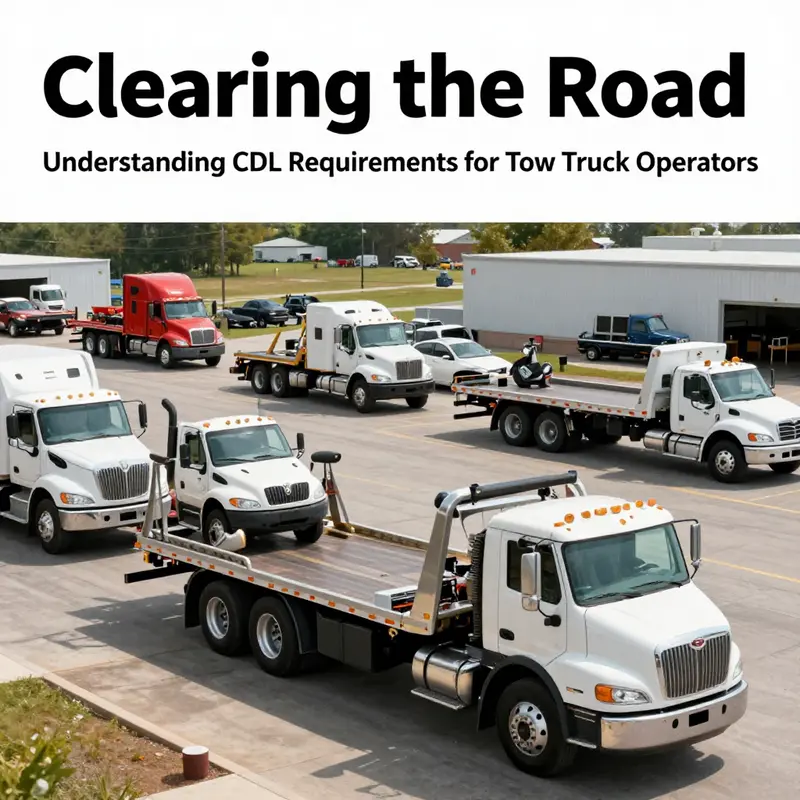
As the demand for towing services rises, understanding the licensing requirements for tow truck operators becomes essential for business owners. Specifically, many may wonder whether a Commercial Driver’s License (CDL) is needed to operate a tow truck. This guide highlights the weight-based rules and regulations governing CDL requirements, as well as special equipment considerations to ensure your towing business operates legally and efficiently. By clarifying these aspects, you can avoid potential penalties and provide safe services to your clients.
Weight, Warnings, and Wreckers: How CDL Rules Shape Tow Truck Operations
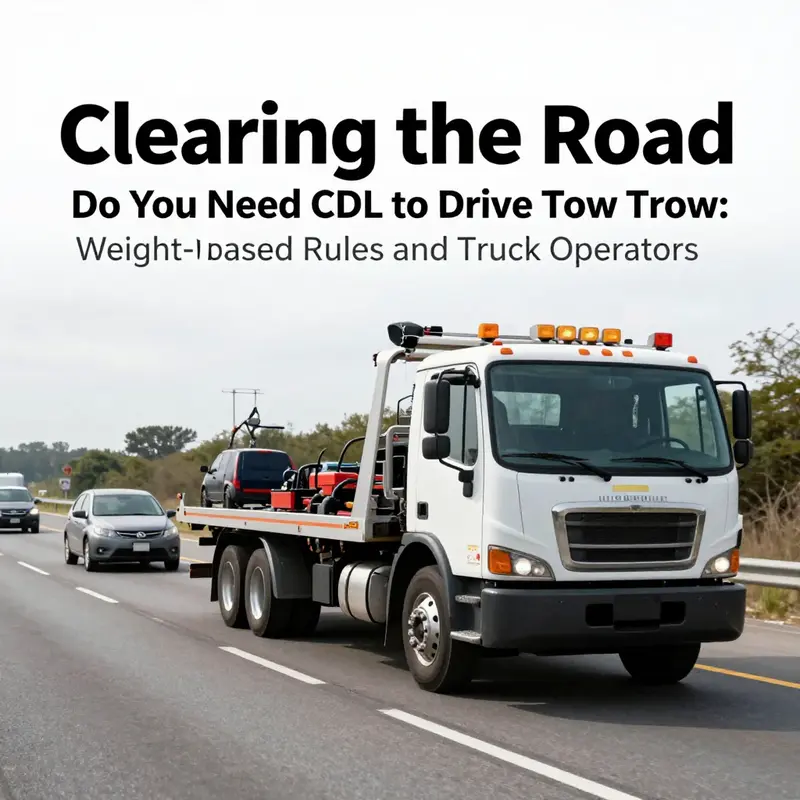
Behind the wheel of a tow truck, the line between rapid response and safety is drawn in weight plates and training records. A call comes in, a vehicle is disabled, and the driver moves through traffic with the heavy responsibility of not only reaching the scene quickly but also securing a crew, bystanders, and the vehicle that has broken down. In the towing industry, licensing isn’t just a bureaucratic hurdle; it is a practical framework designed to ensure that the operator can handle the kind of vehicle that is moving and the unpredictable situations that come with roadside recovery. The question of whether you need a CDL to drive a tow truck is not simply binary. It hinges on where the truck sits on the scale of heavy machinery and what it does at the edge of the road. The federal rules set a baseline, but state regulations can adjust the boundary lines, adding layers of local requirements that can surprise even seasoned operators.
The core principle is weight. The federal standard uses gross vehicle weight rating, or GVWR, as the starting point. When the tow truck itself has a GVWR of 26,001 pounds or more, the obligation to hold a CDL becomes clear. This threshold is designed around the practical realities of manipulating a vehicle that could exceed tens of thousands of pounds, with power that can surprise a casual observer. The operator who wants to deploy a heavy-duty wrecker into rush-hour traffic or onto a freeway shoulder must prove through testing that they can handle the machine safely, perform basic maneuvering with precision, and manage the dynamic loads that occur during towing, winching, and recovery operations. In many fleets, the heavier a tow truck is, the more likely it is that CDL requirements will apply, not only for the operator but also for the company that employs them, given the safety and insurance considerations tied to heavy commercial work.
Yet the story doesn’t stop at the tow truck’s own weight. A vehicle that a tow truck is actively towing can push the combined weight beyond the CDL threshold. If the towed vehicle carries a GVWR over 26,000 pounds, or if the combined weight of the tow truck and the load surpasses 26,001 pounds, a CDL may be required. This nuance is where many discussions about licensing drift from theory into real-world practice. A light-duty wrecker that looks compact in the shop can become a high-stakes vehicle on the street when it is attached to a heavy trailer or a heavy, disabled vehicle. The rules are not simply about what sits on the chassis; they are about what the entire system looks like when it comes together on the road.
This is where a mental model of the work helps. The operator must consider not only the vehicle’s weight but how that weight is distributed, how braking systems respond under load, and how momentum shifts when a heavy vehicle is being winched or loaded onto a flatbed or rollback. When your crew is dealing with uneven terrain, slick highways, or nighttime visibility, the margin for error narrows. The regulatory framework is designed to reduce those margins by ensuring the operator has the necessary training, knowledge of constraints, and ability to perform the job with a consistent emphasis on safety. The emphasis on weight-based rules is not arbitrary; it reflects the straightforward physics of moving and stopping a heavy machine that can generate dangerous forces if mishandled.
People sometimes ask whether a CDL is still needed when a tow truck appears less imposing than a big highway tractor. The answer rests on two pillars: the vehicle’s own GVWR and the nature of the operation. If the tow truck itself sits under the CDL threshold but is routinely used to carry or tow loads that bring the total over the limit, the licensing requirement shifts accordingly. A practical way to view this is to imagine the tow truck as a platform that, when loaded with another large vehicle, transforms into a different vehicle category for regulatory purposes. The margin for error in this scenario is effectively reduced because the operator is accountable for more complex handling, longer stopping distances, and the potential for higher consequences in the event of an incident.
State laws add another layer. While the federal framework provides the baseline, each state can set its own rules, refine the edge cases, and determine how endorsements or specific operating contexts influence CDL applicability. Some jurisdictions might require a CDL for certain towing operations even when the combined weight remains near the threshold, or they might mandate additional certifications for hazardous materials involvement or specialized recovery techniques. The inescapable takeaway is that the concept of what you can/cannot drive with a standard license is not fixed in a single place. It is a moving target shaped by vehicle weight, the nature of the towing task, and the regulatory environment where the work occurs.
For someone considering a career or a side hustle in towing, the decision to pursue a CDL should be anchored in careful weight accounting and an honest assessment of typical jobs. If you anticipate working primarily with light duty equipment in a small-town setting, you might operate under different constraints than a tow operator in a dense urban corridor with frequent heavy loads. The practical route is to map the equipment you intend to use, the likely towed loads, and the types of recoveries you expect to perform. Then you compare that map against the state DMV guidance and the FMCSA framework to identify where licensing is mandatory and where it is prudent. This process becomes especially important for those who plan to run a small fleet, where the regulatory frame not only governs personal licensing but also bears on fleet insurance, driver qualification files, and compliance protocols that keep teams operating smoothly and safely in the long run.
As you read these rules, a broader picture emerges: CDL requirements are less about arms-length formality and more about practical capability. They are designed to ensure that operators can manage heavy hardware, respond to emergencies, and keep themselves and others safe on busy roadways. The weight thresholds let regulators focus attention on the operations most capable of producing unsafe outcomes, while allowing more flexible arrangements for lighter, low-risk movements. This balance—between ensuring safety and maintaining operational efficiency—reflects a mature approach to commercial driving in an industry where the line between a routine roadside incident and a high-impact accident can be thin.
For those who want a clearer anchor in a familiar landscape, a practical resource exists that examines how this plays out in a specific market. It helps to see real-world considerations—the types of calls, the typical crew configurations, and the way companies navigate licensing when they expand their fleets. If you are curious about how these dynamics unfold in a particular city, you can consult local perspectives and examples through resources like this one on tow services in Houston:
Ultimately, the message is clear: whether you are starting a career in towing, expanding a fleet, or simply trying to understand whether your current license is sufficient, weight is the central criterion. The GVWR of the tow truck and the potential GVWR of the load being hauled set the boundary lines. If you are ever unsure, the safest and most reliable course is to verify with your state DMV, because state rules can twist the edge cases in ways that are easy to overlook from a general overview. The FMCSA site offers authoritative guidance, framing the federal expectations while you navigate the specifics of your state. This cross-check is not merely a bureaucratic formality; it is a practical step toward ensuring that every tow operation you undertake is compliant, predictable, and safe for the operators, the equipment, and the public. For authoritative guidance, refer to the FMCSA’s official site: https://www.fmcsa.dot.gov.
null
null
Final thoughts
Navigating the complexities of CDL requirements for tow truck operations is crucial for business owners. By understanding the weight-based rules and special equipment considerations laid out in this guide, you can ensure compliance with regulations while optimizing your service offerings. Safeguarding your business against potential legal issues will not only enhance your operational efficiency but also build trust with your clients, thereby supporting the long-term success of your towing business.