
In the multilingual world of business, effective communication is essential, especially in industries like towing. Understanding how to convey specific terms such as ‘tow truck’ in Spanish can vastly enhance customer interactions and broaden market reach. This article delves into the accurate translation of ‘tow truck’ and explores regional variations, providing business owners with valuable insights to engage Spanish-speaking clients effectively. Each chapter aims to enrich your comprehension, equipping you with the necessary terminology for seamless interactions.
De Camión de Remolque a Grúa: Una Exploración Práctica de Cómo Decir Tow Truck en Español
Cuando te detenes al margen de la carretera, no basta con un vehiculo; hace falta lenguaje claro. En español, el concepto de tow truck se expresa con varias palabras, cada una con matices y usos distintos. Las tres mas comunes son camión de remolque, grúa y vehiculo de recuperacion. A continuacion se explica su significado, uso y diferencias segun la region.\n\nCamión de remolque: se refiere literalmente a un camión cuyo proposito es remolcar otros vehiculos. Es la traduccion neutral, amplia y aceptada en contextos formales, manuales y prensa. La forma enfatiza el equipo como objeto y funcion.\n\nGrúa: termino mas coloquial y cotidiano en Espana y muchos paises de America Latina. Proviene de la palabra grúa crane. Se usa para referirse tanto al servicio como al camión que presta la asistencia; es inmediato y flexible en conversaciones de emergencia.\n\nVehículo de recuperacion: registro técnico y formal. Se usa en documentos oficiales, seguros o procedimientos de gestion de incidentes, cuando se quiere enfatizar la operacion de recuperacion de forma organizada.\n\nOtros terminos: camión de rescate, tractor de remolque, y otras variantes existen pero son menos comunes fuera de nichos técnicos. En la practica, algunos dialectos mezclan terminos, como la frase la grua llego para remolcar el coche o el camion de remolque ha llegado.\n\nQué usar en la vida real: cuando estés describiendo el incidente a un despacho, di necesito un camión de remolque para retirar mi coche. Si hablas con un conductor o un transeúnte, una grúa vendrá a remolcar el coche funciona bien. Para informes o documentacion, se requiere un vehiculo de recuperacion para retirar el vehiculo averiado.\n\nConsejos prácticos: aprende a ajustar tu termino al interlocutor y al contexto. Si hay formalidad o requisitos legales, prefiere vehiculo de recuperacion; para conversacion cotidiana, grúa; como termino neutro y ampliamente entendido, camión de remolque. En caso de duda, camión de remolque suele ser la opcion mas segura y comprensible.\n\nRecursos de aprendizaje: practica con frases de muestra, guias regionales y diccionarios tecnicos para familiarizarte con la jerga local. Cuando viajes, observa que palabras usa la gente en tu destino y adapta tu lenguaje en consecuencia.
Naming the Roadside Helper: Regional Voices and Contexts for Saying ‘Tow Truck’ in Spanish
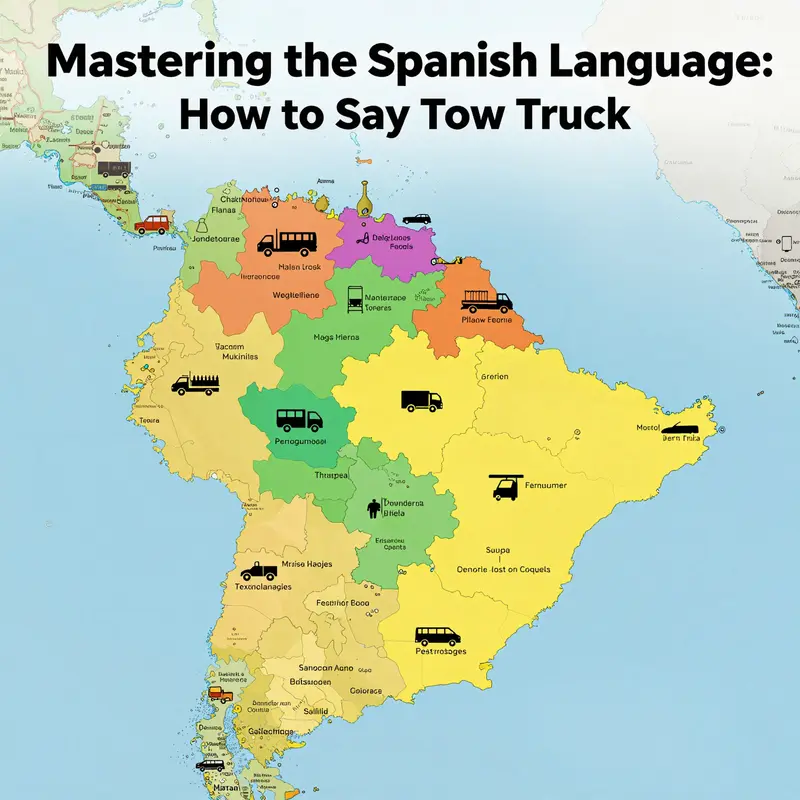
When a car stalls on a busy highway or a slick morning coats the shoulder with rain, the language you choose to describe the vehicle that will rescue you matters as much as the rescue itself. The phrase you use acts as a social cue, a clue about what kind of service you expect, and even a marker of regional culture. In the world of roadside assistance, the basic idea is constant: a specialized vehicle is summoned to tow, recover, or repair a disabled automobile. Yet the words that people actually use to name that vehicle shift with geography, with the formality of the moment, and with the particular kind of service a driver expects to receive. That is why studying how to say tow truck in Spanish becomes more than a simple translation exercise. It becomes a passport to effective communication when you are on the road, whether you are driving through Madrid, Mexico City, Buenos Aires, Bogotá, or a rural Chilean road. The right term carries practical consequences. It helps you ask for the right service, it aligns expectations with the capabilities of the vehicle, and it reduces the chances of confusion under pressure when you most need help.\n\nIn Spain, the most common and formal label for the vehicle that tows or lifts away a broken car is camión grúa. The word grúa by itself is deeply embedded in everyday speech and can cover a range of heavy-duty lifting and pulling tasks. The combination camión grúa emphasizes the vehicle’s crane-like, lifting capability, which is a helpful mental image when you are describing a tow across a road or in an official report. In official contexts, roadside-service brochures, and general conversation, camión grúa is standard. Yet you will also hear camión de remolque—the literal translation, “removal truck.” This variant puts a sharper focus on the towing device—the remolque—that connects to and drags the disabled car. Both forms communicate the same function, but the choice between them signals slightly different registers: camión grúa leans toward the machine’s lifting and hoisting capacity, while camión de remolque foregrounds the towing operation itself. The example sentence, El camión grúa llegó para retirar el coche averiado de la carretera, captures the formal, almost procedural tone that you often encounter in Spain. It reads like a report of action, precise and straightforward, which aligns with how many Spaniards approach road-related communications, especially in written or semi-formal forms.\n\nAcross the Atlantic, the everyday speech of many Latin American countries tends to be more economical and somewhat more flexible. In Mexico, for instance, grúa is the workhorse term. It is both short and widely understood, a shorthand that comes up in conversations among drivers, insurance agents, and emergency responders alike. The phrase Llámame si tienes problemas, te mando una grúa—“Call me if you have problems, I’ll send a tow truck”—illustrates the casual, action-oriented language that typically governs roadside exchanges. In Mexico, a service might be advertised as un servicio de grúas or simply grúas, reflecting the broader ecosystem of mobile assistance, emergency response, and vehicle recovery. The versatility of grúa makes it a practical choice in hurried or unfamiliar situations, when speed and clarity trump ceremonial formality.\n\nArgentina presents a similar mix of usage, with camión de remolque and grúa both in play, though remolque on its own can feel a touch more technical or mechanical. Some Argentinians will use remolque to refer to the towing device itself, while others will refer to the vehicle that incorporates it as camión de remolque. In everyday talk, grúa remains a strong, familiar term that travelers may hear on the street, at impromptu roadside stops, or in casual conversations with tow-truck operators. The register here can tilt toward regional nuance rather than strict formalism, so a caller describing a roadside incident might choose the shorter grúa for speed and ease, especially when language is a matter of improvisation under stress.\n\nIn Colombia, grúa dominates casual speech as well, mirroring the pattern seen in Mexico. When a driver says, voy a llamar a la grúa, the listener immediately understands the situation: someone is going to summon a tow vehicle and arrange help. The term functions smoothly in everyday life, from street corners to insurance claims, and it appears with reassuring simplicity in roadside signage and service descriptions. Chile follows a similar pattern, but with a preference in many contexts for camión de remolque as the standard for both formal and informal settings. The dual usage—grúa for informal talk and camión de remolque for more formal or comprehensive references—reflects a broader principle: regional speech often preserves multiple lexical options for the same tool, letting people navigate different social and professional landscapes with flexibility.\n\nPeru rounds out the broad regional picture with a notably pragmatic approach. Grúa is widely understood, and this term travels easily across masses of drivers who share the same roads, language, and sense of emergency. Some speakers in Peru, however, may opt for camión de rescate or taller móvil when the tow truck offers on-site repairs or rapid stabilization services. These phrases broaden the scope of what a tow vehicle can do, hinting at a more expansive service profile beyond mere recovery. They also reflect a common strategy in many countries: to reserve certain terms for situations that require more than simple towing—recovery with on-site assessment, minor repairs, or emergency rescue.\n\nThe thread tying these regional patterns together is practical communicative behavior. In many Latin American contexts, the phrase llamar a la grúa is universal, even when the precise term for the vehicle shifts with region, service type, or context. A roadside service provider may advertise su servicio de grúas, a catch-all phrase that signals a fleet capable of multiple tasks—towing, transport, accident recovery, and on-site assistance. For travelers and locals alike, the choice between grúa and camión grúa or camión de remolque is less about a rigid dictionary rule and more about what the moment demands. If you want to be unmistakably precise in written notes or official documentation, camión grúa or vehículo de remolque can serve as a precise, formal designation. If speed and shared understanding matter most, grúa is a perfectly adequate and widely understood stand-in.\n\nLanguage and technology also shape how people think about the vehicle on the road. In many regions, a tow truck is more than a mere vehicle; it is part of a service ecosystem that includes roadside assistance, insurance networks, and mobile repair capabilities. The terms themselves sometimes appear in marketing materials as a shorthand for broader offerings: servicio de grúas, ayuda en carretera, or asistencia en carretera. This expansion is not just a marketing flourish; it reflects the practical reality that the vehicle is part of a wider set of options that a stranded driver might need, from towing to minor repairs to jump-starts and on-site diagnostics. The choice of term thus becomes a small engagement with the service’s scope and the user’s expectations.\n\nFor someone learning how to say tow truck in Spanish, a general rule of thumb emerges: grúa is widely understood and comfortable in everyday talk across most of the Spanish-speaking world. Camión grúa is a more formal or technical label that many people use in Spain and in official communications, while camión de remolque emphasizes the towing function more explicitly and can be useful in contexts where the mechanical feature is central to the conversation. When in doubt, default to grúa and add context—like the need for immediate towing versus on-site assistance—to guide the listener toward the right service. If you are painting a precise picture for a report, signage, or documentation, pairing grúa with a qualifying descriptor—camión grúa or camión de remolque—helps avoid ambiguity and communicates competence and clarity.\n\nThis chapter would not be complete without a nod to the practical reality of the road. In intercity or interstate travel, especially in multilingual areas or near international borders, hearing a native speaker use a term you recognize helps you accelerate the resolution of a problem. In the end, the core idea remains not the exact phrase you utter but the shared understanding you achieve with the person who comes to help. To see a concrete example of how a tow-truck service describes its vehicle in a real-world setting, you can explore the Houston area’s own resource on a dedicated tow-truck page. The link below leads to a local service page that demonstrates how terms like tow truck can be contextualized within a broader local vocabulary, service range, and customer expectations: Houston tow truck.\n\nAs you prepare for travel through Spanish-speaking regions, keep in mind that the linguistic map of tow-truck terminology is a map of practical communication rather than a fixed atlas. You will encounter camión grúa, camión de remolque, grúa, and even remolque-like constructions depending on where you are and whom you are speaking to. The important thing is to listen for the cues from the conversation, to ask clarifying questions when the situation feels uncertain, and to bring your own expectations into alignment with the service you are about to receive. If you speak with a driver or dispatcher, a simple, polite inquiry can bridge language gaps: ¿Puede enviar un camión grúa o una grúa para remolcar mi coche? If the other party chooses grúa, you have a common ground; if camión grúa is the chosen term, you will be aligned with the formal register. Either way, you are communicating a shared request: assistance with your immobilized vehicle, delivered by a trusted, specialized vehicle that has the power to lift, pull, stabilize, or transport your car to a safe location.\n\nIn this sense, the variations in terminology do more than reflect regional dialects. They reveal a broader pattern in how people perceive and articulate emergency assistance in their own cultural and linguistic frames. The vocabulary you use can shape the expectations of both the service provider and the person needing aid. It can influence the speed and type of service, the perceived professionalism of the provider, and even the emotional weight of the exchange. The next chapter will deepen this exploration by turning from regional labels to the everyday phrases people employ in different settings—the roadside, the repair shop, the insurance program, and the online portal—so you can navigate any scenario with confidence. But for now, when you hear the words grúa, camión grúa, camión de remolque, or camión de rescate, you will know you are listening to a regional voice that carries with it a distinct approach to how a tow vehicle becomes part of the story of getting back on the road.\n\nExternal resource: https://dictionary.cambridge.org/dictionary/english-spanish/tow-truck
Final thoughts
Understanding the term ‘tow truck’ in Spanish, alongside its regional variants, is not just a linguistic exercise; it’s a strategic advantage for business owners. By incorporating these translations and variations into your communications, you can connect more effectively with Spanish-speaking clients, ensuring clarity and building trust. As you cater to diverse customers, every term you learn enhances your service quality and expands your business horizons.