
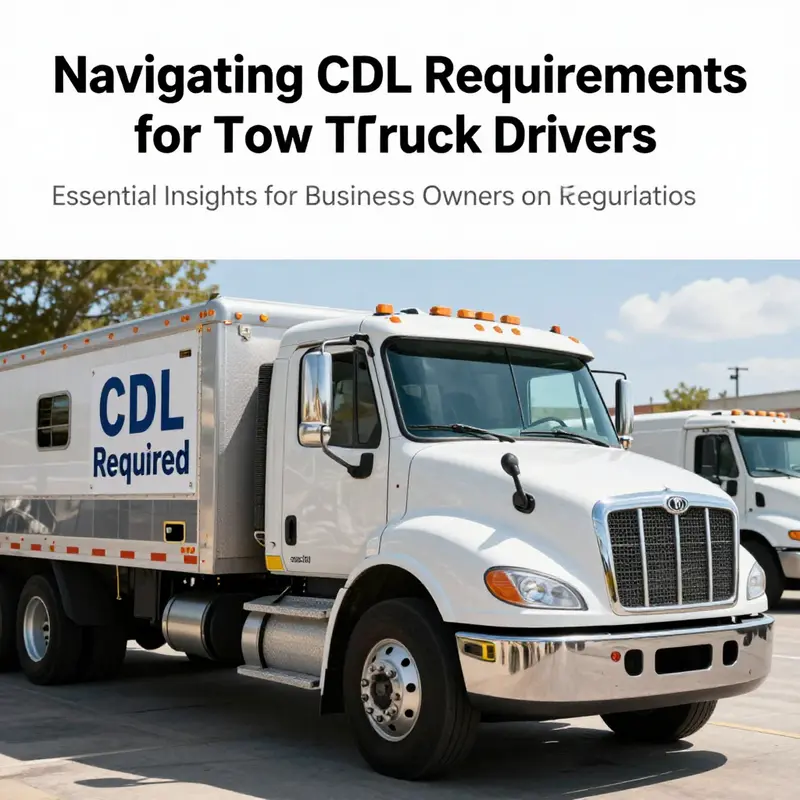
Understanding the nuances of Commercial Driver’s License (CDL) requirements for tow truck operations is vital for business owners in the towing industry. The need for a CDL can significantly impact your hiring practices, vehicle acquisitions, and overall operational compliance. This guide outlines critical weight requirements, varying state regulations, and the importance of licensing to ensure your towing business operates smoothly while adhering to legal standards. Each chapter will detail specific aspects that contribute profoundly to your operational success.
Weight Thresholds That Determine a CDL for Tow Trucks
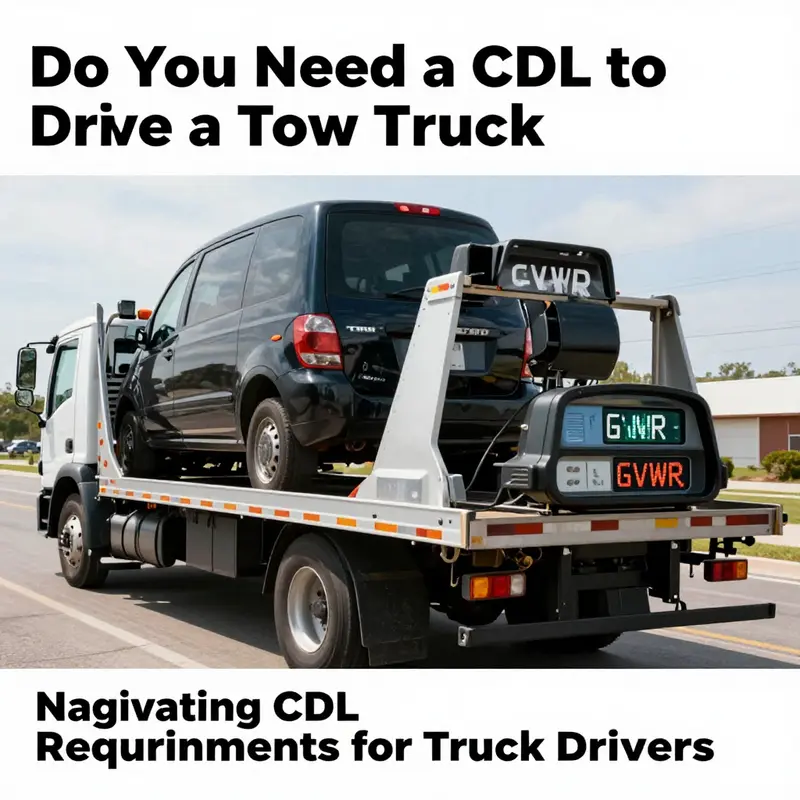
Tow trucks are not simply bigger versions of everyday trucks; they operate under a precise set of rules that hinge on weight. The core logic uses the tow vehicle’s GVWR and the combination GCWR when the towed load is included. In practice, the licensing question is about whether the weights push the job into the commercial driver territory. In most cases a CDL is required when the tow truck itself has a GVWR of 26,001 pounds or more. If the tow truck stays under that threshold but is towing a vehicle heavier than 26,000 pounds, the overall combination can still cross the CDL line. The math is straightforward, but the implications are substantial: more weight means more responsibility and more training and oversight.
State rules vary. For example in New York, if the towed vehicle has a GVWR over 10,000 pounds and the gross combination weight rating of the tow setup exceeds 26,000 pounds, a CDL is required. This shows that even a lighter tow vehicle can require a CDL if the load is heavy enough. Because states differ in how they apply these thresholds and in how they define the license class, the prudent step is to check the local DMV and the state driver’s manual for exact figures. They spell out not only weight limits but also endorsements and medical card requirements that accompany different license categories.
For operators, weights drive daily decisions about which drivers can perform certain calls, which routes a truck can take, and what kind of insurance and safety practices a company must maintain. In practice, a truck with a heavy GVWR will almost always require a CDL for most jobs, while scenarios that involve lighter towed weights may still fall under non-CDL guidelines, provided the combined weight stays below the threshold. The configuration matters too: the same vehicle can demand different licenses depending on whether it is hauling a heavy towed load or performing smaller, lighter recoveries.
Understanding the numbers is key. The GVWR tells you the maximum safe weight of the tow vehicle itself, while the GCWR indicates the limit when the tow vehicle and any payload or towed load are considered together. If those numbers cross the critical thresholds, plan to pursue the appropriate CDL path and to secure any required endorsements, along with the medical card and knowledge testing that accompany CDL preparation. In practice, many tow operators operate under CDL prerequisites because the weight profiles they handle commonly sit in the CDL zone. The administrative steps include proof of medical fitness, knowledge testing, and practical driving tests that align driver capability with road safety and with insurers and fleets.
The licensing landscape also shapes career prospects. A driver who holds a CDL is typically more versatile across jurisdictions and better prepared to tackle a broad range of towing tasks. It signals a level of training and readiness to clients and dispatchers that a noncommercial license cannot convey. This matters in dense urban environments and on busy highways where weight, speed, and maneuverability intersect with risk management. For readers trying to gauge how these rules affect real-world jobs, consider a local example of a towing service to see how weight, equipment, and regulation converge in practice. External resources can help deepen your understanding. For a broader regulatory framework, consult the official driver’s manual from your state. External resource: NY DMV Driver’s Manual: https://www.dmv.ny.gov/pubs/brochures/m13.pdf
Tow Truck CDL Rules: Decoding State Thresholds and When a License Is Required
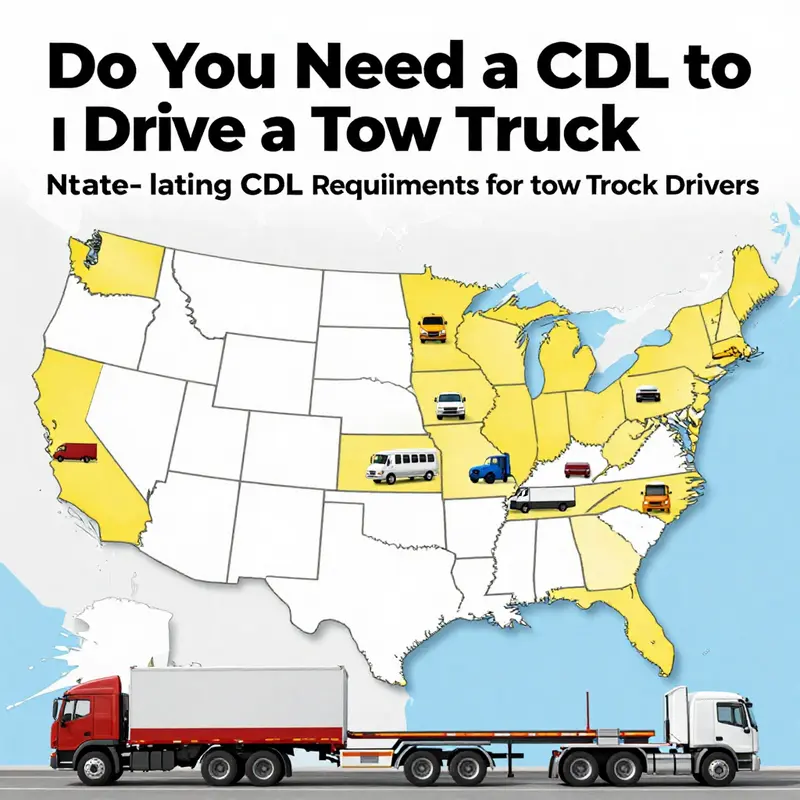
Licensing a tow truck operation is not a mere formality; it sits at the core of safety, liability, and daily planning. The question do you need a CDL to drive a tow truck isn’t answered with a single universal rule. Instead, weight thresholds, vehicle configuration, and state lines determine licensing needs. Federally, the FMCSA sets the baseline standards for CDLs, but states fill in the gaps with their own rules and enforcement practices. In practical terms, a CDL is usually required when the vehicle being towed has a GVWR over 10,000 pounds, or when the combined weight of the tow truck and its load exceeds 26,000 pounds. Crossing either threshold moves a routine tow into the realm of commercial licensing.
That framework becomes more nuanced once you look at state practice. Some states treat the tow truck itself as the trigger—if its GVWR tops 26,000 pounds, a CDL is in order regardless of the towed vehicle. Others focus on the total combination, recognizing that a relatively light tow truck could still produce a heavy combination if the vehicle being towed is large. Because states implement the rule in ways that reflect local road use, insurance markets, and enforcement priorities, the exact requirements can vary. This is why the DMV in your state is the source of truth on what you can legally drive and what training you must undertake. A couple of concrete snapshots illustrate the range: in California, the threshold often cited is a tow truck GVWR over 10,000 pounds or operations involving more than eight passengers; in Texas, the same overarching limits apply but with emphasis on the 26,000-pound marks for GVWR and combined weight; and in New York, the focus includes the heavier GVWR bar and additional considerations when hazardous materials are involved. These variations underscore a vital point: even if two nearby fleets perform the same job, their licensing obligations can be different simply because they operate in different states.
There are also exemptions worth noting. Non-commercial uses—like moving your own vehicle or assisting a family member without compensation—can sometimes avoid a CDL. Yet even in non-commercial scenarios, the vehicle must meet safety, registration, and insurance obligations. The line between personal and commercial work can be subtle, and being on the wrong side of that line can expose owners and drivers to penalties, insurance gaps, and disallowed operations. Because of this, many professionals err on the side of caution: when in doubt, pursue the appropriate CDL and endorsements, and document the reasons for your choice. The alternative is a patchwork of risk that makes dispatch decisions harder, increases costs, and adds uncertainty for customers.
Once you have the weight picture, the next piece is understanding which CDL class applies. The materials you provided indicate that the relevant classifications tend to be Class B or Class C, depending on the exact weight and setup of the tow equipment and the towed loads. In some operations, and depending on state rules, a Class A may come into play if a combination vehicle exceeds the weight limits. Insurance, driver qualification files, and maintenance standards all hinge on getting this classification right. Training requirements, road tests, and endorsements—such as air brakes or hazardous materials—often accompany the state’s CDL syllabus. The practical takeaway is simple: map out your fleet, confirm the state’s rules, and plan your driver training accordingly before taking a tow assignment from the first client.
To close the loop of practical guidance, remember that the rules apply not only to the driver but to the vehicle, the load, and the route. Check your local DMV for the precise numbers, keep a current record of vehicle weights, and stay aligned with any changes in the law. For a real-world sense of how the rules show up in a busy market, consider how operators in Houston handle licensing as part of their day-to-day planning, and you can explore an example here on tow trucks in Houston. For a deeper dive into California’s stance, see the state–level resource linked in the external note below; it lays out the specific thresholds and exemptions that govern tow truck CDL requirements.
External resource: https://www.dmv.ca.gov/portal/dmv/detail/vh/towtruckcdl_requirements
Tow Truck Licensing Demystified: Weighing the CDL, Weight Rules, and Roadside Safety
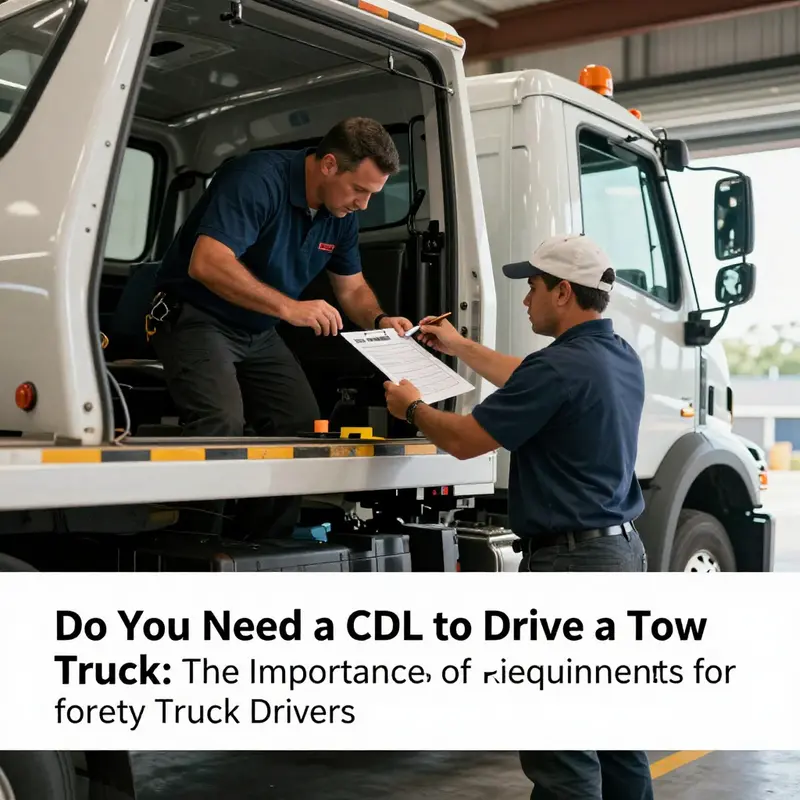
When a tow truck rolls into the lane, it carries more than a bulky machine and a vehicle in need of rescue. It carries a responsibility to operate within the law and to manage risks that come with heavy weights, complex configurations, and crowded roadways. The licensing question, at its core, asks not only what you can drive, but how securely you can move another vehicle while preserving the safety of you, your crew, and everyone sharing the road. Most scenarios wind back to one simple threshold: weight. The federal and state frameworks use the Gross Vehicle Weight Rating (GVWR) to determine who should hold a Commercial Driver’s License (CDL) and what class that license must be. In practical terms, if the tow truck itself weighs 26,001 pounds or more, a CDL is usually required. If the tow truck is lighter than that, but it is towing a vehicle that pushes the combined weight above 26,000 pounds, a CDL may still be necessary because the total operation crosses the limit that governs non-commercial licensing. This isn’t just a formality in a manual; it translates directly into the kind of training a driver must have, the safety procedures that must be followed, and the liability considerations that come into play if something goes wrong on the road.
Beyond the screen of GVWR numbers, equipment specifics can shape licensing needs in surprising ways. A tow truck equipped with a powerful winch or other heavy lifting gear can trigger CDL requirements even when the weight on the scales appears modest. States may interpret these configurations with nuance, and some place emphasis on the vehicle’s intended use and the presence of lifting apparatus as a factor in licensing. Because regulations vary from state to state, the most reliable path is to consult the local Department of Motor Vehicles or its equivalent. In the field, this means planning for the possibility that a routine roadside call could require a CDL class that matches the truck’s weight and its mission, whether that mission is simple towing, recovery, or heavy-duty winching on high-speed highways. The practical upshot is clear: licensing decisions are not abstractions. They determine what you can drive, what you can tow, and how you must operate to keep the roadway safe.
The safety imperative behind CDL requirements runs deeper than compliance. A CDL is not merely a credential; it is a compact between the operator, the public, and the employer that is reinforced by training in vehicle control, weight management, braking dynamics, and emergency procedures. Heavier tow configurations demand skillful handling of momentum and stopping power, precise load securement, and the ability to manage stress in fast-changing traffic conditions. Operators learn to assess weight distribution, tire load, braking demand, and the risks posed by wind, hills, and sudden maneuvers. The training embedded in a CDL program also covers critical safety fundamentals such as securing towed vehicles properly, using wheel lifts and tie-downs correctly, and understanding the limits of the equipment. The consequence of neglecting these aspects is not only a ticket or a court summons; it is the heightened risk of a serious accident where a heavy, maneuvering vehicle can become uncontrollable or fail to respond as expected when abrupt decisions are needed on a crowded roadway.
Given the high stakes, the recommendation to anyone contemplating tow work is to verify licensing requirements with the state DMV and to anticipate how those requirements translate into daily operations. The path to compliance often starts with a careful assessment of weight: what is the GVWR of the tow truck, what is the GVWR of typical towed vehicles, and what is the combined weight during common towing scenarios? If the figures surpass the 26,001-pound threshold for the truck, or if the combination would exceed that limit, a CDL—typically Class B or Class C, depending on the exact configuration—becomes the sensible and lawful choice. In many jurisdictions, additional endorsements may be needed for vehicles that incorporate air brakes or other specialized systems, further shaping the driver’s qualifications. These details, though technical, translate into real-world readiness: the ability to bring a rescued vehicle to safety without compromising the safety of other road users.
The operational landscape also features practical considerations about how licensing aligns with service expectations. For instance, in busy urban areas, a tow operation’s reputation for reliability rests on consistent, safe performance under pressure. A licensed operator with proper CDL training is better prepared to respond to complex scenes—accidents, disabled vehicles, and obstructed lanes—without compromising passenger and bystander safety. This is not merely about meeting legal minimums; it’s about establishing a standard of care that reduces liability and enhances public trust. For many small and mid-sized tow outfits, the licensing decision can shape staffing, vehicle acquisition, and the kinds of services offered. A company that adheres to clear CDL guidelines can market a safer, more professional image, while also lowering the risk of regulatory penalties. If you want a concrete example of how licensing anchors day-to-day operations in a real market, you can explore local service narratives and how they describe their fleet configurations and driver qualifications through the lens of city dispatch requirements.
For readers seeking a practical, location-based reference, consider exploring how licensing considerations are addressed in real-world operations—such as the Houston area’s tow services. The balance between weight thresholds and the availability of qualified CDL drivers is often reflected in how fleets plan their equipment purchases and training cycles. If you’re curious about a local perspective on tow-truck configurations and licensing, you can visit: tow-truck-houston.
Ultimately, the CDL decision for tow trucks hinges on weight and use. It is a decision that affects not only the legality of operation but the safety, reliability, and trust a towing business builds with clients and with other road users. The goal is straightforward: operate within the law, maintain rigorous safety practices, and invest in the training that ensures every tow is conducted with control, precision, and care. As regulations evolve and as fleets adopt heavier equipment or more specialized setups, double-checking with the state DMV remains essential guidance. For those seeking official, state-level direction beyond local practice, the California DMV page offers a detailed framework for understanding these requirements in a broader regulatory context: https://dmv.ca.gov/.
Final thoughts
In navigating the complexities of CDL requirements for tow truck drivers, business owners must prioritize understanding the weight classifications, state regulations, and the critical nature of proper licensing. As these elements directly impact operations and safety standards, being well-informed will enhance your business’s credibility and success. Ultimately, ensuring compliance with CDL requirements will not only safeguard your business but also enhance the safety of your drivers and the public.