
For businesses reliant on vehicles, understanding tow truck timelines is crucial. This article explores three key aspects: the differences in response times between urban and rural areas, the varying durations of towing processes, and how external factors impact these timelines. By comprehensively covering these elements, business owners can better prepare and respond to unexpected vehicle breakdowns, ensuring smoother operations and reduced downtime.
Timing the Tow: How Urban Density and Rural Distance Shape Tow Truck Arrival Times
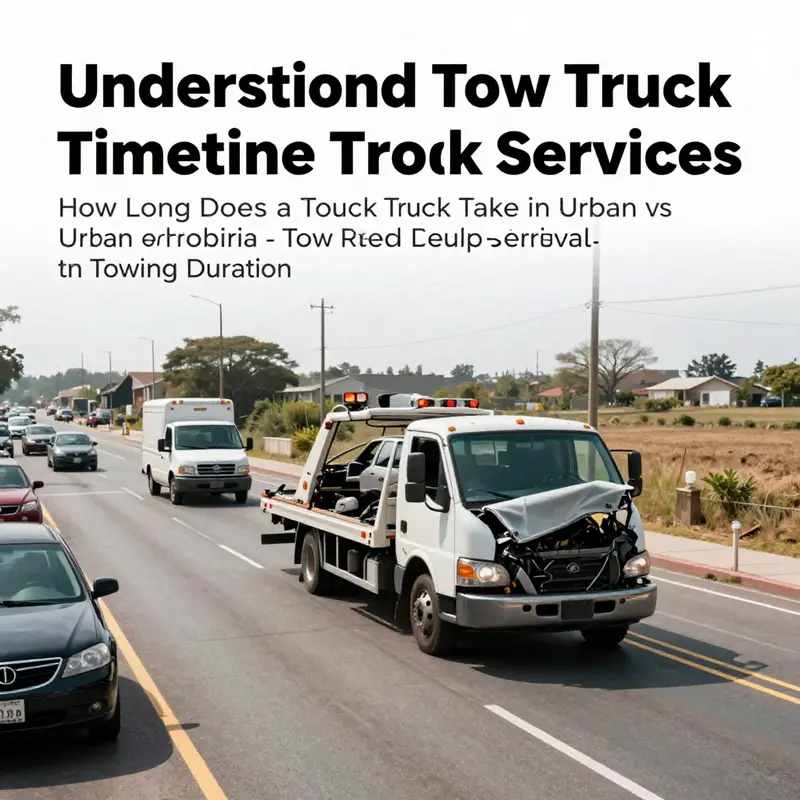
When a vehicle breaks down, the clock starts the moment the call is placed. Many people imagine a tidy, uniform countdown: the dispatcher assigns a nearby wrecker, and help arrives within a predictable window. In practice, tow-truck timing unfolds as a layered story driven by location, traffic realities, and the availability of service providers. In cities, where streets teem with activity and firms cluster around major corridors, response times tend to compress into a more dependable range. In stark contrast, rural and remote areas carry a different tempo. Fewer trucks, longer drive distances, and less robust communication networks can stretch arrival times from minutes into hours, especially when weather or road conditions deteriorate. This variability is not a flaw in the system but a reflection of the geography it serves and the way dispatch networks are structured to meet different needs.
In urban environments the typical picture is one of speed and precision. A well-served city often yields an arrival window of roughly 15 to 30 minutes after a call. The drivers are drawn from a dense pool of operators who operate under contracts with insurers, municipalities, or large fleets. Dispatch systems in these areas leverage GPS for real-time routing, live traffic feeds, and predefined service zones that minimize travel time between a breakdown and a tow. The road network itself supports rapid movement: better-maintained streets, readily accessible pull-offs, and coordinated access to incident scenes help to shave minutes off each leg of the journey. In this context, the tow’s first mile is as engineered as a well-timed public transit ride, and the actual loading—once the truck arrives—often mirrors that efficiency, provided the vehicle is accessible and not obstructed by hazards.
Rural settings tell a different tale. Here, the typical response time stretches beyond the urban norm, commonly ranging from 45 minutes to several hours. The reasons are practical. There are simply fewer tow trucks stationed across broad swaths of countryside, so trucks may be farther away when a call comes in. Distances matter; a breakdown on a winter night in a sparsely populated county might require a longer drive to reach the scene, and the same weather that makes a storm surge through a city can magnify delays overnight in a rural corridor. Communication networks may be less robust, which can complicate updates and lead times. Weather, road conditions, and the prioritization of incidents within a regional or state framework all play into the final ETA. In some rural regions, non-emergency requests may wait longer as priorities are set to address urgent incidents first, a reality that reflects how regional contracts and resource allocation shaped by policy and budget can ripple down to a single stranded roadside moment.
Regardless of setting, the act of towing itself—once the wrecker arrives—tends to be a lean operation, usually taking about 15 to 30 minutes for a standard tow if the vehicle is accessible and the scene is straightforward. The complexity of the job matters. A simple hook-and-drape recovery or a basic wheel-lift tow can stay within that brief window. But every mile of road, every obstacle at the scene, or the need for specialized equipment can lengthen the process. A standard hook-and-chain approach is typically quicker than a heavy-duty recovery that requires a rollback or a flatbed, especially when slope, obstruction, or unstable ground demands careful setup and additional safety checks. In practice, the more complex the scenario—say, a vehicle buried in snow, a car perched on a slope, or a flatbed needing extra stabilization—the longer the on-scene time and the overall job duration.
This is where expectations must be tempered with context. The numbers—15 to 30 minutes on arrival, 15 to 30 minutes for loading—form a baseline, not a guarantee. The driver’s ability to access the car, unlock doors, or deal with a compromised ignition can alter the timeline. Weather conditions, peak travel times, and the sheer density of traffic or road construction can introduce additional delays. Even the best dispatch software operates within real-world constraints: it cannot conjure a truck closer than what the local fleet can supply, nor can it replace the weather with a more favorable forecast. That is why the most accurate estimate comes from calling a local service and sharing precise details about the scene. In practice, the two layers—dispatch time and on-scene execution—intertwine to produce the total experience of roadside assistance.
For readers navigating this landscape, practical awareness matters as much as speed. Providing a clear, precise location is essential. A description of the vehicle’s surroundings, nearby landmarks, and any access nuances—such as gate codes, a locked gate, or a narrow driveway—helps crews reach the scene faster and avoid backtracking. If the breakdown occurs on a busy highway, noting traffic conditions, lane closures, and the safest pull-off area can reduce the time drivers spend waiting for a safe and legal place to operate. If the car is in a garage or on private property, identifying who holds permission to move vehicles and whether there are any property access restrictions can prevent delays. While you wait, staying with the situation, maintaining safety, and keeping a clear line of communication with the dispatcher is crucial. The dispatcher can provide updates, but those updates are only as good as the information you supply.
To illustrate the practical dynamics, consider a typical urban call in the middle of a weekday rush hour. A driver in need dials the service, a dispatcher identifies several nearby units, and a vehicle exits within minutes toward the breakdown. The GPS-guided route eliminates backtracking and identifies the fastest corridor around congestion. The tow arrives, the doors open, and the operator begins the loading sequence, verifying the vehicle’s status and securing it for transport. In the same scenario, a rural call might involve a single unit farther away, a longer approach route, and potentially more time spent coordinating with landowners or local authorities if the site requires special permissions. The difference in milliseconds matters, but the bigger delta is the geographic footprint and the distribution of service resources that define the window from call to completion.
In both environments, the numbers serve as rough guidance rather than a promise. The National Highway Traffic Safety Administration provides guidelines and statistics that help frame roadside assistance performance in a broader context, reminding readers that regional variation is an expected feature of road help rather than a failure of the system. For a more expansive view of how these systems are designed to function, you can consult those resources alongside the local information you obtain from your chosen service provider. On a practical level, the best course is to contact a local tow operator for the most precise ETA and to ask about any factors that could affect timing in your area. If you want a quick example of a local roadside option, see Mikes Roadside Service. Mikes Roadside Service.
In short, urban centers compress the time between request and arrival through higher service density, advanced routing technologies, and coordinated networks that move vehicles quickly through busy streets. Rural areas elongate that moment due to distance, fewer providers, and variable weather conditions. The actual towing, once the truck is on site, tends to be a compact, predictable operation, but even that final phase can stretch when the scene requires extra care. The most reliable strategy for planning is to recognize the regional context, prepare with precise location details, and maintain realistic expectations about the inherent variability of roadside assistance. For a broader frame of reference on roadside services, consult the guidelines and statistics provided by the National Highway Traffic Safety Administration: https://www.nhtsa.gov/roadside-assistance-and-towing-services.
Tow Time After Arrival: Decoding the Steps and Timelines Behind a Tow Truck’s On-Scene Process
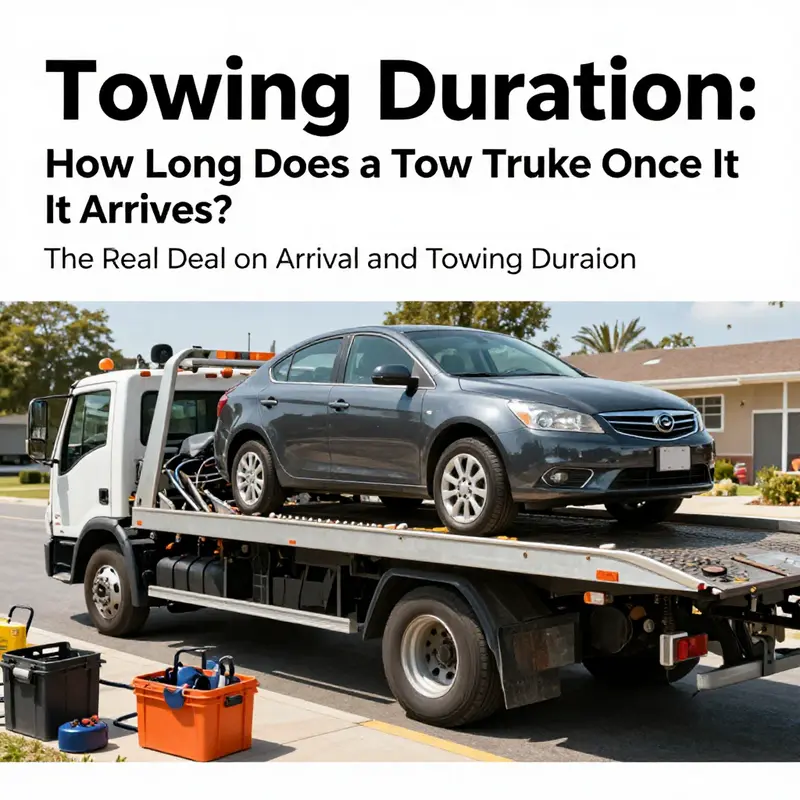
When a tow truck arrives, the clock is already counting, but the pace isn’t driven by a single action. It unfolds as a sequence of deliberate steps, each chosen to protect people and vehicles while moving toward a safe destination. In practice, the on-scene portion of a towing job typically takes roughly 15 to 30 minutes, assuming access is straightforward and no unusual complications arise. This window isn’t a rigid rule, but it provides a practical baseline for customers trying to gauge how long a tow will take once help has arrived. The rhythm of those minutes depends on a handful of factors that, together, shape the final timeline from curb to drop-off. Understanding these elements helps separate the common, efficient tows from the more intricate recoveries that can stretch the clock longer than expected.
First, the act of securing the vehicle is foundational and time-sensitive. Straps or chains must be placed to restrain movement in all directions, with attention paid to the vehicle’s weight, balance, and any structural damage. A careful attachment prevents shifting during transport, which is essential for safety and for avoiding further harm to the vehicle or the tow operator. The level of damage can influence this phase as well. A car with compromised tires, leaking fluids, or a misaligned frame may require additional stabilization steps or protective underlays to prevent contact with delicate surfaces. In some cases, the need to protect airbags, shattered glass, or exposed components can add minutes to the process, though this is usually a modest extension rather than a dramatic one.
Positioning the tow truck is the second pivotal moment on scene. The operator assesses access routes, ground conditions, and any nearby hazards. If the vehicle is on a busy street, at an awkward angle, or perched on uneven ground, the crew may take extra time to reposition the truck, set wheel chocks, or even coordinate with bystanders or traffic control. Good positioning minimizes the risk of damage during loading and ensures a smooth transfer to the transport platform. It’s on this step that the chosen towing method—wheel-lift, flatbed, or classic hook-and-chain—begins to shape the clock. Each method carries its own profile of speed versus versatility.
Transporting the vehicle to its destination follows securing and positioning. The actual drive is relatively straightforward, but it isn’t merely point A to point B. The operator plans the safest route, accounts for traffic conditions, and adheres to weight distribution principles that protect the truck and the towed vehicle alike. For a standard passenger car, this portion tends to be the quickest, especially when the vehicle rests securely on a wheel-lift or a light-duty tow bed. In more complex situations—such as towing a vehicle with substantial damage, a hybrid or electric vehicle, or a car with a stubborn starter or transmission issue—people on the ground may need to make last-minute checks, verify that the load is balanced, or adjust the immobilization devices before the vehicle is secured for transport. These checks, though sometimes brief, contribute to the overall duration and reflect a commitment to safety.
The method used to lift and secure the vehicle matters a great deal. Wheel-lift tows, which lift either the front or rear wheels off the ground while the other wheels remain on the road surface, are typically faster for routine recoveries. They are well-suited to disabled cars or minor accidents where the vehicle can be rolled onto the bed with minimal fuss. Flatbed tows, by contrast, involve loading the entire vehicle onto a flatbed platform. This method is often favored for high-value cars, all-wheel-drive models, or situations where wheel damage would complicate a lift. The trade-off is clear: flatbeds are usually more time-consuming on scene due to wheel immobilization, alignment checks, and the careful ramping required to avoid scraping or misalignment. Hook-and-chain systems, while less common today, can introduce complexities that lengthen the process because of the need to secure and tension the chains properly and the additional steps to protect the vehicle’s exterior. The choice among these methods isn’t arbitrary; it’s guided by the vehicle type, the road surface, and the operator’s assessment of risk.
Beyond the mechanical steps, a handful of situational factors determine whether the clock ticks toward the lower or higher end of the 15–30 minute range. Vehicle type plays a large role. A compact sedan is generally quicker to load than a sizeable SUV or a pickup with heavy cargo. The car’s condition matters as well: a damaged frame, a stuck steering system, or a transmission issue can necessitate extra stabilization and special equipment. Terrain and weather introduce their own time penalties. Rain, ice, or uneven ground can slow setup and loading as crews take additional safety precautions to prevent slips and mishaps. In urban cores with dense traffic, the team may face more traffic control tasks, whereas in rural settings, the absence of spacing can complicate on-scene positioning but reduce the complexity of the loading itself.
Complex scenarios illustrate how the simplest-tow day can evolve into something longer. Severe vehicle damage, a car that’s tilted or trapped, or an accident involving multiple cars often requires stabilization work, the use of specialized gear, and coordination with other responders. In these moments, time is spent not just on the mechanical steps, but on ensuring that the extraction is controlled and that no one on site is exposed to avoidable risk. Even when everything goes smoothly, a tow crew may pause to confirm that all safety protocols are met, that the load is secured under the correct tension, and that nothing is dangling from the vehicle that could detach during transport.
For readers who want a practical lens on the experience, consider the way local operators approach the same scene. A representative, neighborhood service provider can illuminate how they balance rapid response with on-scene diligence. In many communities, the crew arrives ready to work, quickly secures the vehicle, makes concise safety checks, and proceeds to transport. When discussing these times with a local service, you’ll find that the cadence is shaped by the mix of standard calls, the types of vehicles commonly towed in that area, and the equipment deployed in the fleet. To get a clearer sense of local practice, you can explore a nearby provider such as Mikes Towing, which offers a window into how crews coordinate the chain of events from arrival to release. See Mikes Towing for a concrete example of on-scene efficiency and safety-focused procedures.
Ultimately, the 15–30 minute benchmark reflects typical efficiency, not a guaranteed duration. Real-world tows can finish faster when access is easy and the vehicle is ready to go, or take longer when extra precautions, heavier loads, or unusual circumstances come into play. The best way to set expectations is to recognize that arrival time and on-scene duration are governed by both the vehicle’s specifics and the environment surrounding the scene. If you’re planning around a tow, ask your local provider for a transparent estimate that accounts for the vehicle type, the location, and any special considerations. It’s not about chasing a perfect minute count; it’s about ensuring safety, securing the load properly, and delivering the vehicle to its destination with as little disruption as possible. For broader context about how these processes fit into overall roadside assistance timelines, external resources offer a wider view of towing practices and safety standards in action. External Reading: https://en.wikipedia.org/wiki/Towing
Tow Timelines in Turbulent Weather: Understanding What Delays a Tow Truck in Adverse Conditions
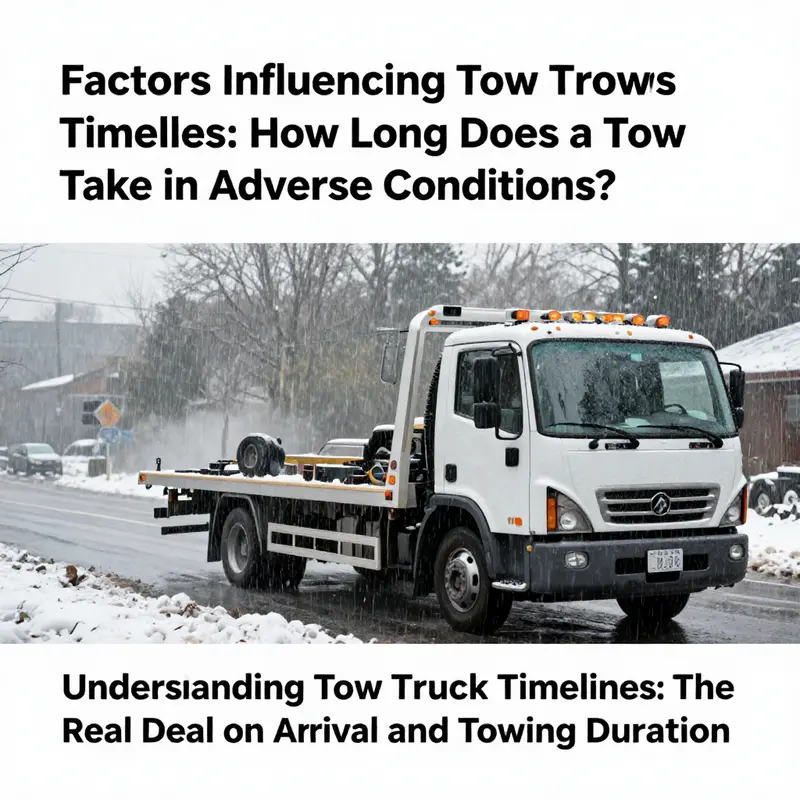
When a vehicle stalls or an accident blocks a lane, people want two things above all else: speed and certainty. The question of how long a tow truck takes to arrive or complete a job is less a single number than a moving equation. It depends on where you are, what the weather is doing, how many other calls are waiting, and how far the dispatcher must reach to locate a crew with the right equipment. In urban centers, most companies aim for a first response within a 30 to 60 minute window after a call, a target born from high service density and frequent real-time updates. In rural or hard-to-reach areas, those arrival times can stretch much further, occasionally slipping into two to four hours or more, especially during peak periods or when storms limit road access. Once a tow truck reaches the location, the actual loading and securing of the vehicle typically take 15 to 30 minutes, assuming the scene is straightforward and the vehicle is accessible. When the breakdown is simple and standard equipment is sufficient, a quick hook-and-tow can be completed with little delay; in contrast, more complex recoveries—such as those requiring a rollback, a flatbed, or specialized equipment for a heavy vehicle—tend to add minutes or even hours to the operation due to safety checks, rigging, and the need for multiple crew members. These broad ranges are useful benchmarks, but the true timing unfolds in the moment, shaped by conditions that can surprise even the most seasoned dispatch teams.
The factors that drive these timelines are not isolated; they interact in a complex, often unforgiving way. Distance to the incident is a primary determinant. A tow truck dispatched from a distant depot must traverse roads, negotiate traffic signals, and contend with congestion that can compound a delay. The number of nearby tow trucks available at the moment matters just as much. If a region has a tight supply of service providers, each incoming call must compete with others for limited crews, tools, and the appropriate type of rig. The severity of the incident itself—an entry point for more personnel and heavier equipment—can shift a routine tow into a staged operation that requires careful coordination, additional safety precautions, and sometimes road closures or traffic management. Then there are the current traffic conditions and environmental hazards: a city grid locked by rush hour, a highway clogged by an accident, or floodwaters that block access routes all add to response and loading times. In adverse conditions, these factors no longer act in isolation; they amplify each other. A longer distance plus heavy traffic during a storm, for example, can push a straightforward tow into a longer wait and a slower onsite process.
The reality of adverse conditions is starkly illustrated by larger industry data. In normal weather and typical urban settings, the range of arrival times tends to stay within the 15 to 30 minute band for many dispatches, with rural regions stretching toward 60 minutes. But when severe weather, natural disasters, or major disruptions occur, those timelines can expand dramatically. A leading national study highlights that emergency response times—including tow support—tend to be delayed by a substantial margin during natural disasters, driven largely by road blockages and heightened safety considerations for responders. The increase is not merely a few minutes; it can translate into hours of waiting. This is why forecasts or current conditions are frequently consulted by both drivers and passengers who want a realistic sense of what to expect. The takeaway is simple: the more severe the conditions, the more variable the timetable becomes, and the more important it is to prepare for a wider range of possibilities rather than rely on a single fixed estimate.
In today’s connected roadside environment, technology offers a cushion against some of the unpredictability. Real-time updates from dispatch platforms, GPS tracking on live units, and dynamic routing enable drivers and passengers to understand where a tow truck sits relative to the destination, and how traffic flows might shift the outlook by the minute. For drivers seeking closer visibility, many providers now offer mobile tools that display approximate arrival windows and estimated on-site times. These innovations can help reduce anxiety by turning mystery into information, while also enabling better decision-making about safety, timing, and alternatives if conditions deteriorate. For readers who want to understand a provider’s approach more directly, a local roadside service resource can illuminate how a dispatcher balances urgency with safety and equipment readiness. See Mike’s Roadside Service for a concrete example of how a nearby operation communicates with customers during peak demand and adverse conditions. Mike’s Roadside Service
The practical implications of all this are meaningful for anyone who might find themselves waiting on a roadside emergency. If you are on the road, sharing precise location details—your exact street, nearby landmarks, and any cross-streets—can help reduce miscommunication and speed up articulating the correct response path. Clear information about vehicle status, hazards at the scene, and accessibility for the tow rig matters as well. For instance, if the vehicle is on a narrow shoulder or is partially obstructing traffic, safer staging may require a slight delay to ensure both your safety and the crew’s efficiency. If conditions are deteriorating, opting for a rescue plan that prioritizes safety—such as using hazard lights, remaining inside a heated cabin if possible, or moving away from the lane when it is safe—can prevent complications during loading. Whenever weather or road quality is poor, be prepared for a longer window than you would normally expect and consider alternative options, such as a ride to a nearby shelter, a stay with a friend, or arranging an earlier follow-up appointment when conditions improve. While these steps cannot shorten the time to completion, they can help minimize stress and improve outcomes by aligning expectations with the reality of the situation.
Ultimately, the timeline for a tow is not a single metric but a reflection of a dynamic system. Knowledge of the factors at play helps demystify the process and empowers drivers to interact more effectively with the responders. The best approach is to use available information, be ready with precise location details, and recognize that adverse conditions introduce a layer of variability that even the most efficient dispatch networks must accommodate. For readers who want to explore more about how modern dispatch frameworks work and how real-time information is used to refine arrival estimates, the broader landscape of roadside assistance resources offers a useful backdrop. And while every incident has its unique twists, understanding the core drivers of timeliness can help anyone prepare for the unexpected on the road. External context from a national resource notes how weather, infrastructure disruptions, and resource allocation significantly shape emergency response timelines, underscoring why a careful, patient, and informed approach matters most when time is critical. https://www.aaa.com/
Final thoughts
Understanding how long a tow truck takes to respond and tow is vital for business owners managing fleets. By knowing response time variations between urban and rural areas, the duration of different towing processes, and the external factors that can affect timeliness, businesses can make informed decisions. This knowledge not only fosters better communication with service providers but also enhances overall operational efficiency when faced with vehicle breakdowns.