
In the towing industry, knowing whom to contact in an emergency can make all the difference. For business owners and individuals relying on towing services, having the right phone numbers readily available is crucial. This article delves into the primary contact numbers for Mike’s Towing, which operates in multiple states, enabling efficient service when you need it most. The first chapter focuses on how to contact Mike’s Towing directly through their established phone lines, while the second chapter elaborates on the specific service areas covered by these contacts. This comprehensive overview ensures that you have immediate access to professional assistance under various circumstances.
Dialing for Help: Mapping Mike’s Towing Phone Numbers Across NJ and FL
When a roadside crisis hits, the first instinct is simple: find a number you can trust and make the call. But for a company that operates across locations, the phone lines can be as critical as the tow itself. In the case of Mike’s Towing, reliable access hinges on understanding that different service points may be reachable through distinct numbers. The story of how to contact Mike’s Towing unfolds not as a single digit to memorize, but as a pattern of local lines that correspond to the place where the breakdown happens. This is not just about dialing a sequence of digits; it is about knowing which city or town you are in and recognizing that the right number is the one tied to that local service point. In practical terms, it means dialing the Bridgewater Township, New Jersey office when you are in that area, or the Jacksonville, Florida location if you are closer to the Atlantic coast and in need of on‑the‑spot assistance there. The geography matters because towing networks are usually organized to respond fastest when the dispatcher can attach a service unit to a nearby block or highway ramp, rather than routing a request to a central desk far away.
For Bridgewater Township in New Jersey, the contact line tends to be the one associated with the local service point: (908) 722-2122. If you are stranded along the Garden State Parkway, a dimmed dashboard light, a tire with a slow leak, or an unexpected engine warning, this number is the one that connects you to the team that knows the local roadways, traffic patterns, and the typical arrival times in that zone. For Jacksonville in Florida, you should use (904) 642-9340 when you need the nearest, most knowledgeable crew to navigate downtown streets or stretch along the coast. The distinction is not merely geographic trivia; it translates into faster response times, clearer directions for the dispatcher, and a more accurate estimate of when help will arrive. The practical value of having two distinct lines is tangible when you are in a hurry or in a hazardous situation where seconds count and a wrong number could waste precious minutes.
Yet identifying the right local number is only part of the picture. A growing share of information about these numbers circulates online in a way that can blur lines between official channels and third‑party listings. In the digital age, the reliability of a phone number depends not just on the digits themselves but on the source that presents them. An official website or a verified directory listing typically reduces the risk of misdialing or ending up with a contractor who is not authorized to respond under a given name. In the research material surrounding Mike’s Towing, the most straightforward guidance points away from speculative posts and toward two anchor practices. First, check the company’s official site or a trusted directory that explicitly verifies the local service point. Second, be mindful that a domain’s WHOIS record may reveal ownership details or registrar information that is useful for due diligence, but it does not usually serve as a customer service contact. The distinction matters when you are trying to determine whether a number you found is active and legitimate or simply a placeholder that someone set up for another purpose.
The dual‑location reality also underscores an important consumer behavior: verify before you dial. If you are on the move and relying on search results, you may encounter variations in how numbers are displayed or listed by aggregators. Some entries will show a single generic number that could route your call to a central desk, while others will present location‑specific lines. In fast‑paced roadside moments, that difference can shape the quality of the service you receive, the ability of the dispatcher to assign nearby units, and even the accuracy of the ETA you receive. This dynamic is a reminder that the act of contacting a tow service is not simply about the digits; it is about aligning each dial with the precise service point that corresponds to your location.
Behind these practical considerations lies a broader framework of information stewardship. The official channels, when accessible, are the safest harbor for a customer seeking assistance. The research notes point to two kinds of sources: direct customer inquiries through the company’s own site or its local business pages, and third‑party directories that list the same numbers but with varying degrees of verification. The value of an official channel is that it typically reflects current service areas, hours of operation, and any temporary dispatch constraints, such as weather disruptions or traffic incidents that can impact response times. The risk of relying solely on a third‑party listing is that the number may not be updated promptly if a location changes its line or if a service point closes temporarily. The study of these channels also reveals a cautionary tale about domain administration and what it can reveal about a business’s online footprint. In the case of a domain registered under a corporate umbrella or a private registration, the publicly visible information may be limited, but it still helps explain why a direct customer service line might not be listed on a WHOIS page the way a consumer would expect.
From a user’s perspective, translating this information into action means treating the location‑specific numbers as the default course of contact, rather than chasing a single, company‑wide hotline. For Mike’s Towing, that means recognizing that (a) Bridgewater Township, NJ has its own dialing path, (b) Jacksonville, FL has its own, and (c) both lines should be corroborated with at least one official source before you rely on them in a crisis. It also means understanding what you are asking for when you dial. If you need immediate roadside assistance, you might specify your vehicle’s exact location, the nature of the problem, your preferred service window, and any hazards on the scene. If you are seeking a jump start, fuel delivery, or a lockout service, stating those needs upfront helps the dispatcher triage the request and deploy the closest available unit. This approach reduces back‑and‑forth and increases the likelihood that you will receive timely help.
The practical steps for verifying contact points begin with locating the right local page. A Bridgewater NJ page, for instance, tends to present the local phone line in the context of other nearby service details such as service hours, typical response times, and coverage norms. While the page itself is not a substitute for confirmation, it offers a trustworthy signal that the numbers associated with that location are current. The Bridgewater page, in particular, can be accessed through a dedicated route that specifically identifies the local towing point. For readers who want a direct path to the Bridgewater information, the designated page presents a concise set of details that align with the street grid of the town and the surrounding highway access points. The structural logic is straightforward: if you know where you are, you should reach for the number that corresponds to that place, because it is the line connected to the unit closest to your location. In this way, the geographic dimension of contact information becomes a practical advantage rather than a mere curiosity.
This chapter, while centered on the numbers, also nods to the broader ecosystem of how such services are interconnected with online presence. The official site is not just a catalog of phone numbers; it is a gateway to a network of roadside services that can include automobile diagnostics, on‑the‑spot repairs, or flatbed towing depending on the circumstances. The possibility that a service point might offer additional on‑site support—such as car trouble assistance or minor repairs at the roadside—depends on the local capabilities distributed to the fleet and the policies that govern dispatch decisions. A caller who knows the local line and can convey the precise nature of the problem helps the dispatcher route the most suitable unit. In turn, this improves not only the speed of the response but the likelihood that the right equipment is sent, whether it is a standard tow truck, a flatbed, or a wrecker that can handle specialized loads.
In the context of this information landscape, it is worth circling back to how local knowledge interfaces with digital verification. While the two numbers are the formal channels for assistance, the surrounding information economy includes multiple touchpoints. Local business listings, map services, and customer review platforms play a role in confirming operational legitimacy and in shaping expectations about reliability and transparency. The numbers themselves can be validated by cross‑checking with the official site and with trusted directory listings. A cautious approach—cross‑checking the Bridgewater and Jacksonville numbers against a verified local listing, ensuring the area code and city correspond with the service point, and looking for confirmation of hours—is a practical habit that can save time and reduce frustration when you are stranded. It also helps to be mindful of potential scams or misrepresentations where numbers appear generic or are posted without clear ties to a specific location. In emergency contexts, the cost of misdialing or misrouting is not merely monetary; it can affect the safety and well‑being of everyone involved.
For readers who want to connect more directly with the Bridgewater locale, there is a straightforward way to explore the local page that anchors that region of the network. The Bridgewater NJ page provides a clear reference point for the local number and the scope of services available in that municipality. In practice, using this link in your own research helps ensure that you are aligning with the right service point and reduces the cognitive load during a stressful moment. It is a small detail, but in the world of roadside assistance, small details — a precise location, a verified number, a trusted sender — can determine whether help arrives in minutes or hours. The link you can follow for the Bridgewater context is anchored in the phrase Bridgewater NJ towing service, which points directly to the relevant page: https://mikes1towing.com/mikes-towing-bridgewater-nj/. This hyperlink format keeps the flow of the narrative intact while giving readers a practical, actionable path to confirm the local contact information.
As we close this loop on numbers and how to navigate them, it is helpful to keep a few core takeaways in view. First, always identify your actual location before dialing and use the number that is tied to that locale. Second, rely on official channels and trusted directories rather than generic listings that may lag behind real changes in service area, hours, or dispatch rules. Third, recognize that the digital footprint of a towing service—its domain, its WHOIS details, and its public registrations—serves as background verification rather than a customer contact channel. This layered approach—local knowledge, official channels, and careful digital verification—provides the best chance of a smooth, timely response when you need roadside assistance most.
In summary, the practical value of knowing Mike’s Towing phone numbers is rooted in geography, verification, and effective communication. The Bridgewater Township line (908) 722-2122 and the Jacksonville line (904) 642-9340 are more than digits; they are your lifelines to trained crews who know the roads you travel, the threats you might encounter, and the fastest path to safety. If you want a direct pointer to the Bridgewater page for quick reference, you can follow the Bridgewater NJ towing service link noted above. And if you are curious about the broader digital traces that accompany these numbers, a general domain lookup can offer context on ownership and registration that might help you assess the reliability of online sources. For readers seeking a further external reference on domain details, a trusted lookup service provides a comprehensive view of mikestowingllc.com and its registration. You can consult a WHOIS‑style resource such as https://whois.domaintools.com/mikestowingllc.com to explore registration history, registrar notes, and related metadata that shed light on the online footprint behind the service you are hoping to contact in an hour of need.
Tracing Service Lines: How Mike’s Towing Connects Locations to a Live Phone Map
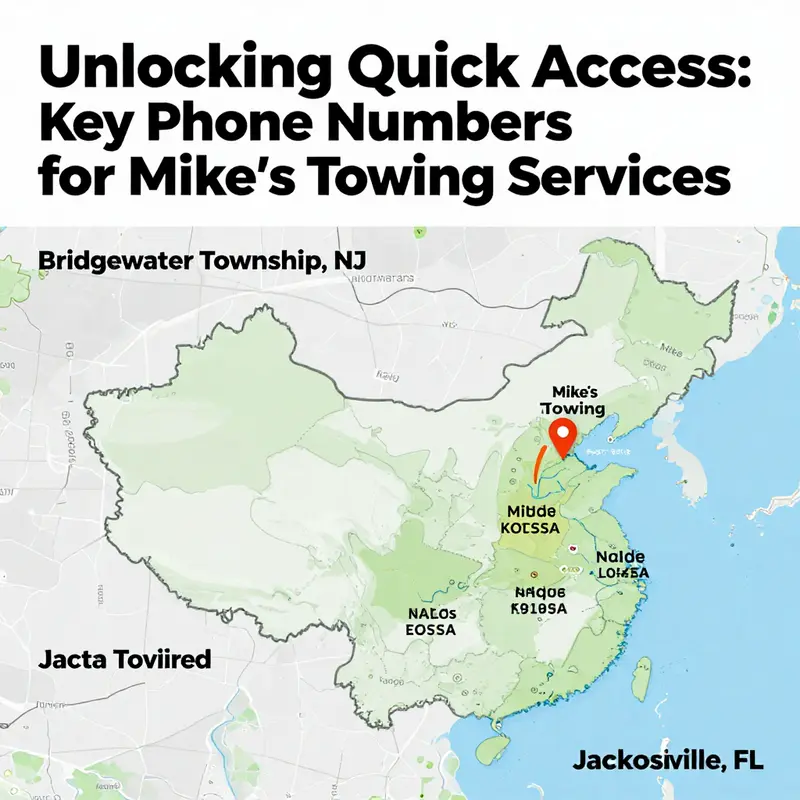
Mike’s Towing operates a network of regional contact points rather than a single national line. This structure helps callers reach a locally knowledgeable dispatcher. Bridgewater Township, NJ uses (908) 722-2122; Jacksonville, FL uses (904) 642-9340; Stockton, CA anchors the West Coast presence via a physical address in Stockton, CA. Each number is tied to a specific service area, which improves ETA accuracy and ensures the dispatcher knows local routes and roadside policies. The separation prevents misdirected requests and helps the fleet deploy the right truck quickly.\n\nReaders will find that region-specific dialing translates into faster, more reliable towing and roadside assistance. For example, Bridgewater callers are connected to a team that understands Bridgewater streets, snow routing, and nearby parking rules; Jacksonville calls connect to a team familiar with coastal traffic, storms, and local detours. The Stockton address anchors the network’s California operations, while a caution is given about similarly named entities to avoid confusion.\n\nExternal resource: https://mikes1towing.com/mikes-roadside-service/
Final thoughts
Having the right contact information for Mike’s Towing ensures that business owners and individuals are prepared for any towing situation. Quick access to phone numbers and knowing the service areas can expedite the response time in emergencies, leading to better outcomes. Whether you find yourself in Bridgewater Township or Jacksonville, having these contacts on hand supports timely assistance, fostering peace of mind while on the road. Proper planning is essential for navigating unforeseen circumstances efficiently.