
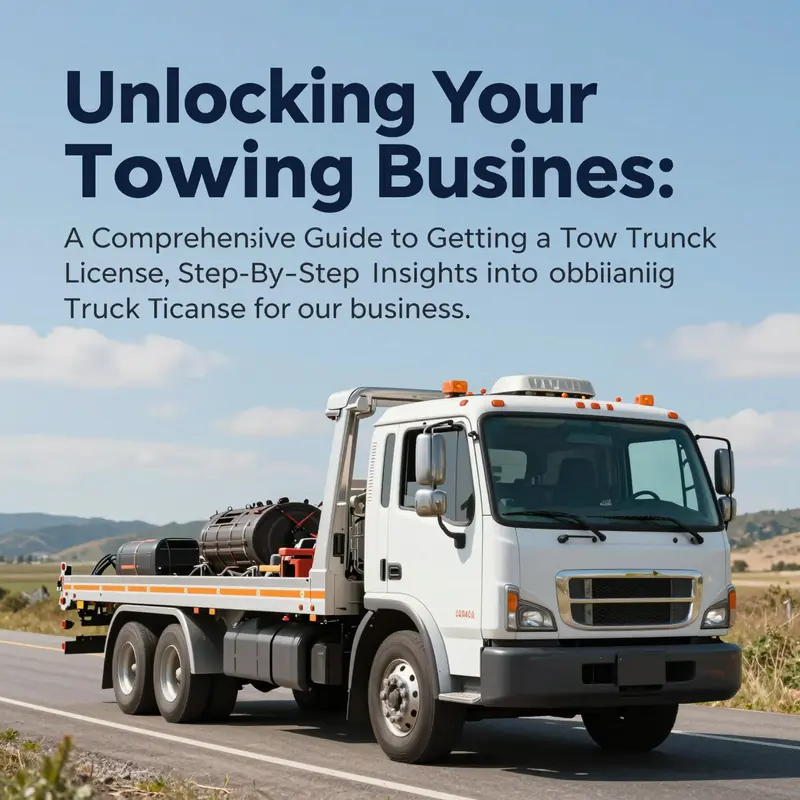
Securing a tow truck license is essential for business owners looking to operate within the towing industry. Understanding the requirement processes will not only ensure compliance with legal standards but also enhance your operational capabilities. This guide will delineate the systematic steps necessary for acquiring your tow truck license, followed by an examination of the required training and certification processes. By the end of this article, you will be equipped with the knowledge needed to navigate the complexities of licensing in this vital sector.
null
null
From Classroom to Road: Mastering Training, Certification, and Compliance on the Path to a Tow Truck License
A tow truck license is not just a credential; it is a promise of competence, responsibility, and safety when every roadside situation demands precise action under pressure. The journey from a first learner’s permit to a fully authorized operator intertwines technical mastery, rigorous evaluation, and a clear understanding of local rules. Although the specifics can differ by state or country, the underlying arc remains remarkably consistent: you must prove you can drive a heavy vehicle, you must demonstrate the ability to connect, secure, and recover loads without creating new hazards, and you must align with the regulatory framework that governs commercial road service. The chapters of this path are designed to be navigable rather than punitive, offering a route that rewards careful preparation as much as it rewards practical skill. In many places, the license is earned through a blend of formal education, a demonstrable driving record, and a formal endorsement that authorizes you to operate for hire or in a professional capacity.
The first hinge on this door is the commercial driver’s license, or CDL. In practical terms, most tow-truck operators begin with at least a Class B CDL, which is tied to vehicles with a substantial gross vehicle weight rating. This is more than a heavy credential; it is a guarantee that you can handle the physical mass and the momentum of a vehicle designed to move other vehicles. The weight threshold that triggers Class B versus Class A is tied to GVWR, and the exact demarcation can vary by jurisdiction. In some places, lighter tow rigs that fall under a specific GVWR may operate with a standard commercial license or even a non-commercial license, depending on how the local rules define towing activities. For the heaviest and most specialized fleets, a Class A CDL might be required, with additional endorsements arranged to reflect the tow equipment and the nature of the loads you’ll handle. Within this framework, the endorsement landscape becomes a crucial map: the need for a towing-specific endorsement, often labeled as “T” in many regions, signals that your license carries authority for towing operations beyond ordinary driving.
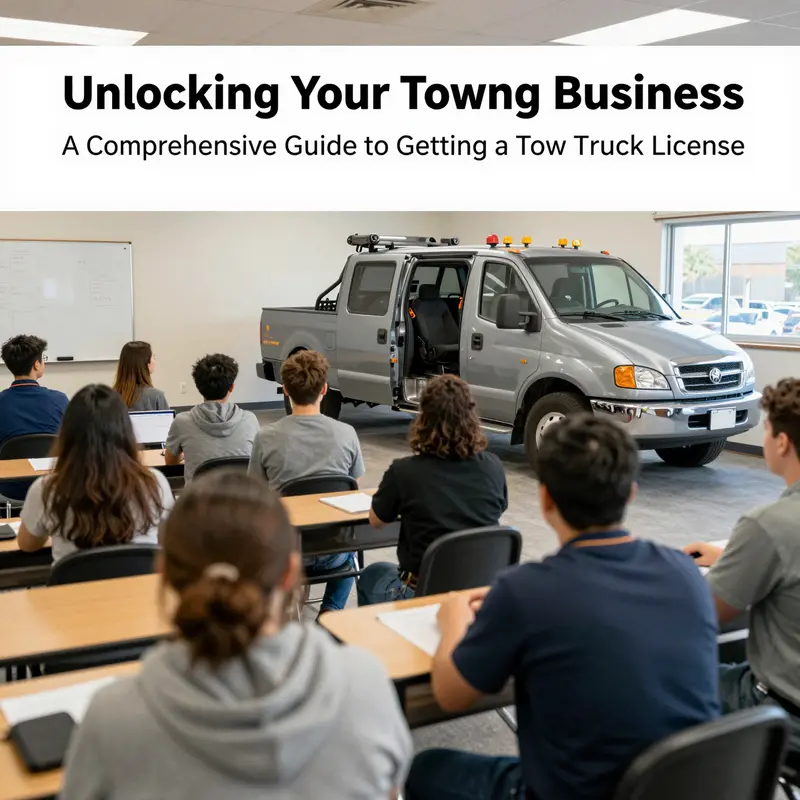
With the foundation set, the route advances into formal training. The aim of specialized tow-truck training is not merely to pass a test; it is to cultivate a disciplined habit of safety, problem-solving, and procedural clarity. Training programs exist in various formats, from community colleges and private trucking schools to employer-sponsored academies and state-approved courses. What binds them is a core curriculum: traffic laws as they apply to heavy vehicles, safe towing practices that minimize risk to passengers and bystanders, and practical handling of the specialized equipment that typically characterizes tow operations—hydraulic systems, winches, and the array of securing devices used to prevent load shifts during transit. Trainees also learn how to assess a scene: the type of vehicle, the surface condition, lighting requirements at night, and the hazards that emerge in cases of collision or mechanical failure. The course often includes emergency response procedures, which are essential when you are first on the scene and time is of the essence. In many jurisdictions, state-approved training is a prerequisite to any licensing step, meaning you must complete a program that meets or exceeds official standards before you can apply for your license. This requirement reinforces the idea that a tow operator is both technician and first responder, not merely a driver who happens to be behind the wheel of a heavy truck.
The practical component of training culminates in examinations designed to evaluate both knowledge and hands-on competence. You typically encounter a written knowledge test that covers traffic regulations, towing safety, load distribution principles, and vehicle inspection procedures. This test is designed to ensure you understand not only the letter of the law but the rationale behind it—why certain tie-down patterns and weight transfer methods reduce the risk of rollover or load loss, for instance. The skills portion is equally important: you must demonstrate your ability to back up a tow truck with precision, secure loads effectively, and maneuver in tight spaces with minimal disruption to other road users. Passing these exams is not a mere formality; it signals that you have internalized a system of checks and procedures that will guide you in high-stress environments.
Even after you have cleared the written and practical exams, the licensing journey does not end. A safety and compliance mindset continues through vehicle inspection and operational readiness checks. Your tow truck must pass a comprehensive safety inspection before it is cleared for service. Inspectors look at critical components that can determine whether a tow operation is safe on the road: the brakes, lighting, and signaling, and the specialized towing equipment like winches, chains, binders, and other securing devices. It is not unusual for regulators to require documentation beyond the vehicle itself, particularly for commercial operations. You may need proof of liability insurance, a business license, or operating permits that tie your vehicle to a specific service area or business model. The goal of this layer of oversight is straightforward: to ensure that every tool used in the towing process is reliable and that the operator has the financial and regulatory compliance to support continuous, legitimate service.
As the technical and regulatory steps settle into place, a crucial decision point emerges: the form your license will take. In most regions, obtaining the tow truck endorsement is the decisive step that legalizes your capacity to operate a tow truck for hire or in a business setting. Some jurisdictions grant this authorization as a distinct endorsement appended to your existing license; others issue a separate permit that accompanies your driver’s license. Either path requires that you have met all prior requirements and that you are in good standing with the licensing authority. The endorsement or permit is not a passive credential; it is a formal declaration of your ability to meet the standards of the towing industry, a recognition by the state that you can perform a specialized service with accountability and safety at the forefront.
For many people, the licensing journey also includes a practical, business-oriented layer. If your goal is to operate a tow-truck service rather than simply towing as an employee, you will likely need to consider business registration, insurance requirements, and local zoning regulations. These steps are not merely bureaucratic hurdles; they reflect the realities of running a service that intersects with public safety, emergency response, and commercial transportation networks. Some regions require a separate business license in addition to your driver’s license endorsement, while others place emphasis on corporate compliance, tax registration, and workplace safety programs. The sequence is important: you should not apply for a tow-endorsement until your business parameters are clear, or you risk misalignment between your practical operations and the regulatory framework you are meant to satisfy.
Throughout this journey, the regulatory landscape remains a constant variable. The specifics can shift from one jurisdiction to another, and even within the same country, different states may interpret rules in subtly different ways. The common thread is the necessity of due diligence: you must actively seek out the official guidance that applies to your locale. Your local Department of Motor Vehicles, or its equivalent, is the authoritative source for licensing steps, training approvals, and examination schedules. In practice, this means that the path you walk is not a fixed ladder but a customized itinerary shaped by your location, the weight class of your intended tow equipment, and whether your plan includes a standalone towing business or a role within a broader service provider.
If you are exploring a practical way to frame your preparation, consider the value of engaging with a recognized training path and then coupling it with a careful review of your local regulatory requirements. An example of how a prospective student might approach this is to start with a reputable program that offers a clear roadmap to certification and licensing, such as an established tow-truck training curriculum. In this context, you may encounter resources that help you navigate the sequence—classroom instruction, hands-on vehicle practice, examinations, and the administrative steps to obtain documentation. For those seeking a concrete, local example of a training pathway, you can explore the options available through regional providers and, where possible, compare them with the formal requirements published by your DMV or transport authority. If you are looking to see a practical example of how others frame their training journey, one might consult local operators or training centers that publish their pathways and outcomes online. In many cases, a well-curated program will publish its alignment with state requirements, helping you gauge how closely the curriculum matches the licensing standards you must meet. A practical step is to consult prospective training programs and look for their stated alignment with the licensing authority, which often translates into a smoother certification process and fewer surprises in the exam room.
For readers who are actively mapping their path, a concrete, positive signal is the presence of a locally recognized training option. Some aspiring tow operators prefer to start with a program that has established connections to employer networks, ensuring that the training not only covers theory but also creates pathways into apprenticeship or entry-level roles. A typical narrative from students who succeed often emphasizes two themes: disciplined practice and strategic timing. The disciplined practice means building a rhythm of study, mock inspections, and repetitive maneuvers on a training lot until muscle memory reduces uncertainty on the roadway. Strategic timing involves aligning your training completion with the licensing window—knowing when exams are offered, what documents you must bring, and how long the processing time tends to be so you can plan your employment or business launch accordingly.
In this context, the importance of a safety-first mindset cannot be overstated. The towing environment places operators at vulnerable points on the road, often in constrained spaces, near traffic, and under urgent pressure to minimize disruption to the normal flow of life for motorists and road users. Training programs stress not only the technical aspects of securing a vehicle but also the situational awareness that prevents secondary incidents. You learn to establish a safety perimeter, coordinate with other responders when incidents occur, and maintain professional conduct that protects the public, the vehicle owner, and your own crew. The intent is that once you hold your license, you retire not from learning but into ongoing professional development. Regulations may require periodic updates, re-certifications, or refreshers, particularly as equipment technology advances or as state policies evolve. The capability to adapt—keeping current with the evolving standards—becomes part of the professional identity of a licensed tow-truck operator.
As you progress through these stages, an important practical matter emerges: how to recognize the right path for you. Some people are drawn to the discipline of a formal classroom setting, while others prefer an intensive, hands-on boot camp that simulates real roadside scenarios. Regardless of the chosen format, the outcome you should pursue is clear: a validated, auditable record that demonstrates you have both the knowledge and the hands-on skills to perform tow operations safely and compliantly. You should expect to provide a combination of documentation: proof of identity, proof of residency, your current driver’s license, and evidence of successful completion of the training program and examinations. The licensing authority will also require information about the vehicle you intend to operate, including its GVWR, and, if you plan to operate commercially, proof of liability insurance and possibly a business license. In short, your path to licensing is a structured process that builds from fundamental driving competency toward the specialized expertise that towing demands, all under the watchful eye of regulators who enforce minimum standards to protect everyone who uses the roads.
For readers who are ready to take the next concrete step, consider connecting with a well-regarded training option that can serve as a practical launchpad for your journey. A reputable program can provide not only the core curriculum but also mentorship and guidance about the licensing steps in your jurisdiction. For many, this is a meaningful way to translate intention into action, turning the desire to work in towing into a well-supported plan that increases the likelihood of success. If you decide to pursue a local training path, you may discover that your chosen program will offer more than classroom learning; it may provide access to practice yards, test-day simulations, and opportunities to observe experienced operators during real shifts. Such exposure is invaluable for translating theory into reliable on-road performance.
As you bring training to completion and prepare for examinations, remember to maintain a holistic view of the licensing process. It is easy to become fixated on the exam itself, but the broader objective is to cultivate a professional capability that endures beyond the moment you receive your endorsement. The process of learning to tow safely involves integrating system-wide thinking: how weight distribution affects stability, how different chains and straps interact with various vehicle geometries, how environmental factors such as rain or snow change the approach to securing and transporting a vehicle, and how to manage the human elements of a roadside scene—communication with the vehicle owner, with dispatch, with other responders, and with bystanders who may be curious, anxious, or uncooperative.
The licensing journey also invites you to consider your broader professional aspirations. If your aim is to operate a business, the endorsement marks the entry point into a regulated industry where insurance, licensing, and compliance form the backbone of customer trust. If you are planning to work as part of a fleet, the endorsement serves as a credential that reassures employers of your readiness to uphold safety standards and to contribute to a compliant, efficient operation. In either case, a steady commitment to ongoing learning will be your most valuable asset. The road to being a licensed tow-truck operator does not end at a test center; it continues in the maintenance of your vehicle, the refinement of your load-handling techniques, and the thoughtful, consistent application of safety practices in every scene you attend.
For those seeking a practical touchpoint on how to begin this journey, consider reviewing local resources and speaking with current licensed operators in your area. They can offer firsthand perspectives on the challenges and opportunities that come with the license they earned. And as you plan, remember that the key to a smooth process is organization: gather your documents early, confirm the exact form your endorsement will take in your jurisdiction, and arrange your training with a provider whose program aligns with the licensing authority’s requirements. A thoughtful, well-structured plan can make the difference between a quiet path to a license and a delay-filled process that requires repeated testing or supplementary documentation. In the end, the license is not merely a credential to be collected; it is a signal that you have committed to the standards that keep roads safer and services dependable for those who rely on towing in moments of need.
If you are looking to explore the practical, local pathways that can help you begin this journey, you may find it useful to consult established industry resources and regional providers. For example, a local tow service network may publish guidance and contact points for training programs that align with the licensing requirements in your area. Engaging with such networks can provide a clearer sense of how training translates into real-world performance and employment opportunities. This approach helps you connect the dots between classroom instruction, on-the-ground practice, and the regulatory steps that certify your readiness to operate a tow truck. As you move through the process, you will discover that the path to a tow truck license is not a single moment of achievement but a cumulative sequence of learning, verification, and compliance that culminates in the ability to serve communities with competence and care. In the end, the journey is as much about building a professional identity as it is about earning a permit to drive a heavy vehicle.
For readers who want a concrete pointer to continue exploring, a practical step is to visit a local provider’s overview of their training offerings and to compare it against the official licensing requirements published by your state or national authority. Such a comparison can reveal how closely the training aligns with the standards you must meet on the day of examination and on the day you begin service. The process is slow enough to ensure accuracy, yet accessible enough that a determined learner can accumulate the necessary credentials with a clear sense of progress. The result is not only a license but a durable foundation for a career built on safety, reliability, and professional integrity.
External resource for official guidance: For a comprehensive overview of licensing pathways and regulatory expectations, consult the U.S. Department of Transportation’s guidance on commercial vehicle licensing and operator certification. https://www.transportation.gov
Internal resource cue: If you want a local example of ongoing industry engagement and training pathways, you can explore practical program details and outcomes offered by regional tow-truck services and training centers, such as the information and services provided by mikes-towing.
Final thoughts
Acquiring a tow truck license involves understanding and fulfilling various operational laws and safety requirements. By diligently following the outlined steps and investing in training, you can ensure not just compliance but also an advantage in the towing industry. Whether you’re starting afresh or upgrading your existing operations, this knowledge empowers you to navigate the licensing landscape effectively.