
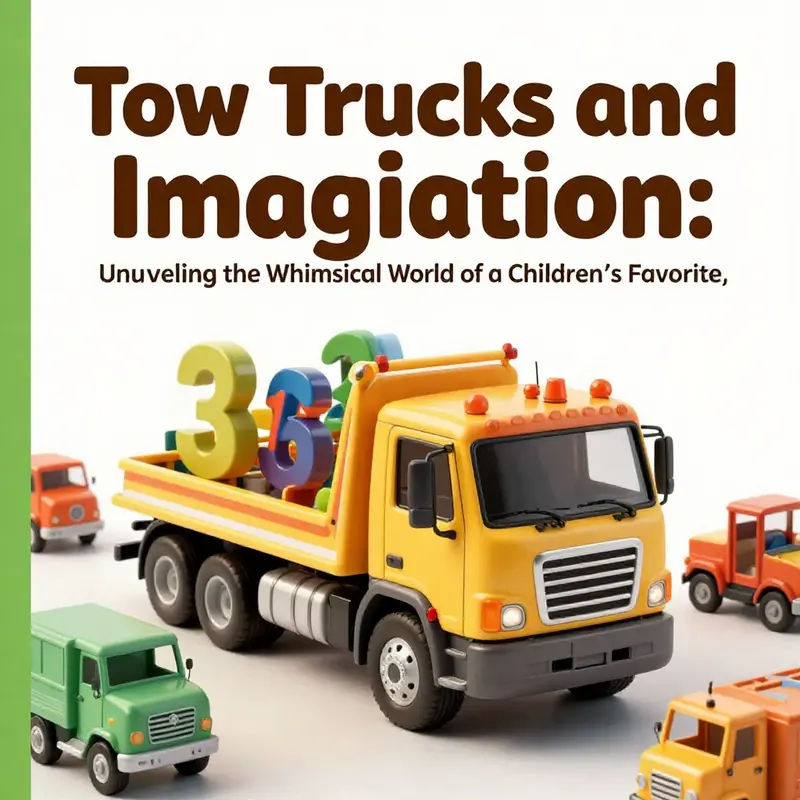
The enchantment of children’s literature often lies in its ability to blend reality with whimsy. One such book, “How Many Trucks Can a Tow Truck Tow?” by Charlotte Pomerantz, showcases playful exaggeration to teach young minds about towing while engaging their imaginations. For business owners in the towing industry, this book transcends mere storytelling; it’s a gateway into understanding how the themes of creativity and transportation intersect. This article endeavors to examine the lessons and implications derived from both the book’s narrative and the technical realities of towing capacities, ultimately guiding business owners to appreciate the subtleties of their profession through a child’s perspective.
Counting Tow Trucks: Whimsy, Limits, and Real-World Physics in a Picture-Book Quest
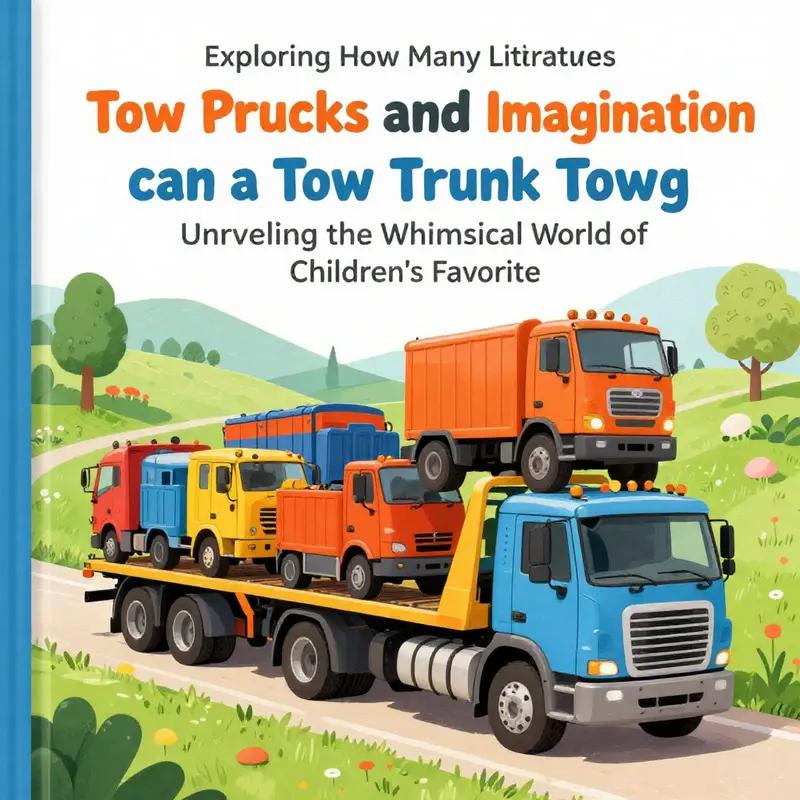
The book How Many Trucks Can a Tow Truck Tow? invites young readers to lean in, squint at bright illustrations, and wonder aloud about a question that sounds simple but quickly becomes a doorway to bigger ideas. Published in 1997 by Random House Books for Young Readers and authored by Charlotte Pomerantz, it treats a seemingly straightforward topic—the towing of vehicles—as a springboard for imagination rather than a manual of specifications. The narrative follows a determined little tow truck who aims to help three stranded trucks, each one a little more tangled in the journey than the last. Through playful exaggeration and a sky full of color, the book nudges children to observe, experiment, and talk about what makes transportation work. The humor rests not on bare data but on the kinds of lively questions that children naturally ask when they see a tow truck maneuvering, pulling, and nudging its way through a series of comic misadventures. The result is a story that feels buoyant and inviting, a gentle invitation to think about movement, tools, and teamwork without being weighed down by numbers and charts.
In this study of a picture book that asks a tall, almost impossible question, the power of story becomes clear: it gives a stage for curiosity and for the social and cooperative skills that accompany any technical endeavor. The little tow truck in the tale embodies a spirit that many learners recognize—perseverance, problem-solving, and the willingness to ask for help when a plan needs adjusting. The helper dynamics among the trio of stranded trucks—each with its own quirks and stubbornness—offer a quiet lesson about collaboration. It’s not merely about muscle or machinery, but about how people and machines work together to move a problem forward, one careful step at a time. The illustrations do more than decorate the page; they illuminate action, intention, and consequence. Faces, gestures, and the angle of a tow line all convey information that complements the text, turning the book into a visual primer for basics like direction, balance, and the importance of steady control when a vehicle is being moved from one place to another.
What makes the book a robust tool for early readers is its refusal to present towing as a single, static act. Instead, it frames towing as a process that involves planning, adjustment, and safety—all ideas that resonate with older siblings and parents who know that even a simple task requires attention to risk and consequence. The narrative’s playfulness is not a license to ignore physics; it is an invitation to wonder how the forces at work on a tow can be seen, felt, and understood. In classrooms and households, that invitation often blossoms into questions and conversations about why certain decisions are made when vehicles are on the move, how weight distribution affects control, and why speed, angle, and distance matter when a heavy object is being pulled. The book’s charm lies in the balance between whimsy and real-world logic, a balance that mirrors the best approaches to teaching science and engineering to young minds.
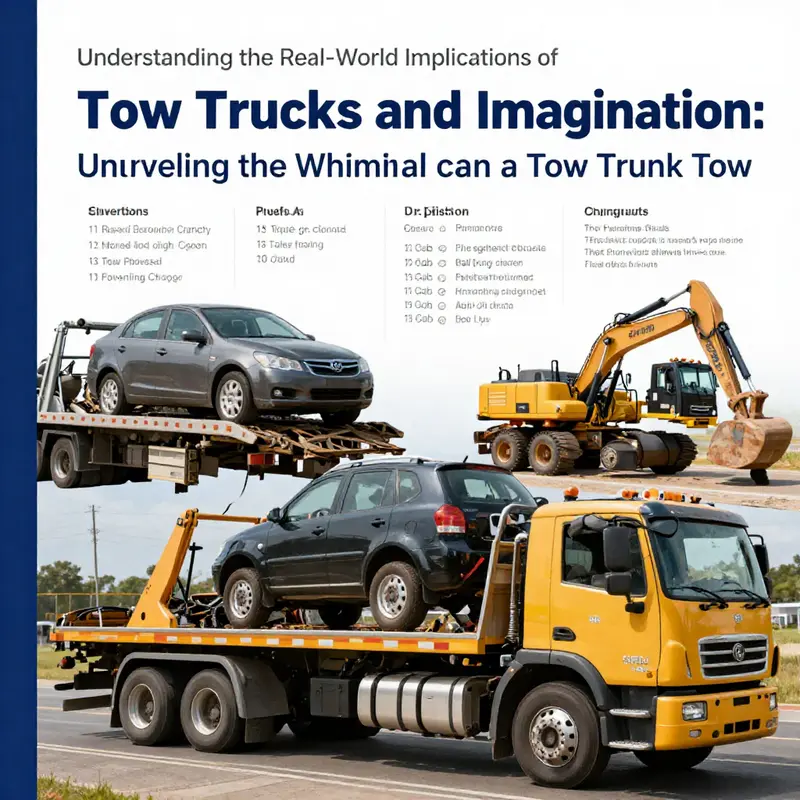
Despite its imaginative premise, the book does not pretend to replace technical manuals or engineering texts. A careful reader will recognize that the question posed in the title is more rhetorical than prescriptive. The reality behind the pages is more nuanced: a standard tow truck is designed to handle one vehicle at a time, primarily for safety, control, and mechanical reasons. Real-world operations require exacting standards, calibrated procedures, and adherence to regulations that keep both the operator and the vehicles safe on public roads. In plain terms, the fiction glosses over numbers because the educational aim is not a precise statistic but an understanding of limits, responsibilities, and the careful planning that goes into moving something as heavy and potentially dangerous as a vehicle. The underlying lesson is about safety first, followed by the appreciation that expertise and preparation enable a small machine to accomplish significant, worthwhile work.
This distinction between fiction and fact becomes a teachable moment. When children ask, “How many trucks can a tow truck tow?” educators and parents can respond with a story-language that honors curiosity while gently introducing the physics of towing. A one-at-a-time rule becomes a straightforward talking point: the alignment of force, the need for a stable connection, and the importance of a tow line’s angle and tension. The book’s world suggests a limit—one vehicle at a time—yet it also leaves room for discussion about the kinds of specialized equipment used in more complex recoveries. In some settings, heavy-duty tow operations do involve specialized rigs and sequential towing plans that must consider weight distribution, braking, steering control, and the safety of bystanders. Those are not numbers scribbled on a chalkboard, but a set of practices that protect people and property while bringing about a solution. The distinction is essential: the book invites wonder; real life requires discipline.
For educators seeking to translate imagination into inquiry, the story offers a ready-made entry point into several cross-disciplinary conversations. The language of the book—descriptive, vivid, and concrete—lends itself to vocabulary development around movement, direction, and mechanical function. Children can learn to label parts of a tow operation, from the tow truck’s cab to the hook, the chain, and the towed vehicle, while also exploring verbs that describe action—pull, guide, align, balance, steady. The illustrations can anchor a discussion about visual literacy: how color, perspective, and composition convey momentum and effort. Practical extensions might include simple physics ideas like balance, center of gravity, and friction in a way that respects the children’s developmental stage. Teachers can invite students to imagine other scenarios—perhaps a tow truck assisting a bus or a motorcycle—asking what changes in approach might be necessary and why. This kind of exploration fosters critical thinking, a core goal of early science education, while preserving the playful tone that makes picture books so inviting.
The narrative’s gentle humor also supports social-emotional learning. The tow truck’s persistence, and its willingness to partner with other vehicles, mirrors collaborative problem solving in real life. It models a growth mindset: a problem is a problem because we don’t yet know the best way to solve it, and with patience, teamwork, and attention to detail, a solution can emerge. In a classroom, these moments translate into discussions about responsibility, safety protocols, and the ethics of moving objects that belong to someone else. The book thus serves not only as a curiosity catalyst about vehicles and mechanics but also as a text that helps children understand how communities manage shared spaces—highways, streets, and driveways—where a tow truck’s arrival changes the traffic pattern for everyone. The storytelling becomes a scaffold for learning about civic responsibility and the careful balance between ambition and prudence.
For readers who want to connect this picture-book experience to real-world practice, a local example of towing expertise can ground the conversation. In neighborhoods across the country, professionals demonstrate the kinds of precise, safety-conscious behaviors the book hints at in a more playful key. When families or classrooms discuss practical applications, a good entry point is to explore how a local service operates, how they plan a safe move, and how they communicate with one another during a complex maneuver. This concrete connection between fiction and everyday practice helps demystify the work of tow operators and reinforces the idea that expertise is built from careful habits, not just from bold ideas.
If you’re curious to see how such ideas translate in a real-world setting, you can explore local resources like a nearby tow service in Houston to observe the procedures and safety measures professionals emphasize during towing operations. For example, tow service in Houston TX provides a window into the practicalities of organized response, the roles involved, and the sequences that unfold when a vehicle needs assistance. This kind of exposure helps children connect the dots between the imaginative scenarios in the book and the disciplined practice that keeps roads safer for everyone. It also offers a healthy reminder that while stories encourage big questions, real-world work relies on training, planning, and a shared respect for safety rules that govern every move on the road.
The value of How Many Trucks Can a Tow Truck Tow? rests not in teaching a precise numeric fact but in shaping a mindset comfortable with curiosity and responsible inquiry. The book’s charm lies in its capacity to invite questions, speculate about possibilities, and then steer conversations toward the reasons behind limits. By framing towing as a collaborative, safety-first pursuit, the story models an approach that can be carried into science talks, writing exercises, and even everyday family conversations about how to handle helping others in need. Children learn to value caution and preparation as much as courage and determination. In doing so, they gain confidence not only in their questions but in the pathways that turn questions into understanding.
For those who want to revisit the original publication or explore the book’s publication history, the authoritative listing can be found through standard book retailers with the original edition details. In addition to the narrative wonder, the text offers a snapshot of how a mid-to-late twentieth-century picture book treated transportation concepts with optimism and clarity, providing a lasting resource for parents and teachers alike who wish to cultivate curiosity without sacrificing accuracy. The interplay between fiction and real-world physics in this book is instructive precisely because it refuses to flatten the world into a single answer. Instead, it encourages readers to examine how we think about movement, how we test ideas, and how we value safety as a guiding principle in all solutions.
In sum, the picture book serves as both a mirror and a doorway: a mirror that reflects a child’s natural questions about trucks, pulling, and movement, and a doorway into conversations about physical forces, engineering reasoning, and communal responsibility. The fictional premise—how many trucks can a tow truck tow?—remains a playful invitation to explore beyond numbers toward a broader understanding of how things move in the real world. The book’s enduring appeal lies in that very balance: imagination paired with a foundation of safety, skill, and cooperative problem solving. For families and educators, that balance offers a sturdy launching pad for literacy, science, and social learning, all wrapped in a story that invites a child to look closely, listen carefully, and dream ambitiously about the possibilities that lie just beyond the last page.
External resource for further context and the original publication details can be found here: Amazon listing.
null
null
Final thoughts
The journey through “How Many Trucks Can a Tow Truck Tow?” serves not just to entertain but also to plant seeds of understanding about the world of towing. For business owners, this playful narrative underscores the importance of creativity while navigating the technical aspects of their industry. As you reflect on the whimsical tales found in children’s literature, remember that fostering imagination in your team can lead to innovative thinking within your towing operations, enhancing service and community engagement. Combining the joy of storytelling with real-world applications can ultimately bridge the gap between dreams and practical solutions.