
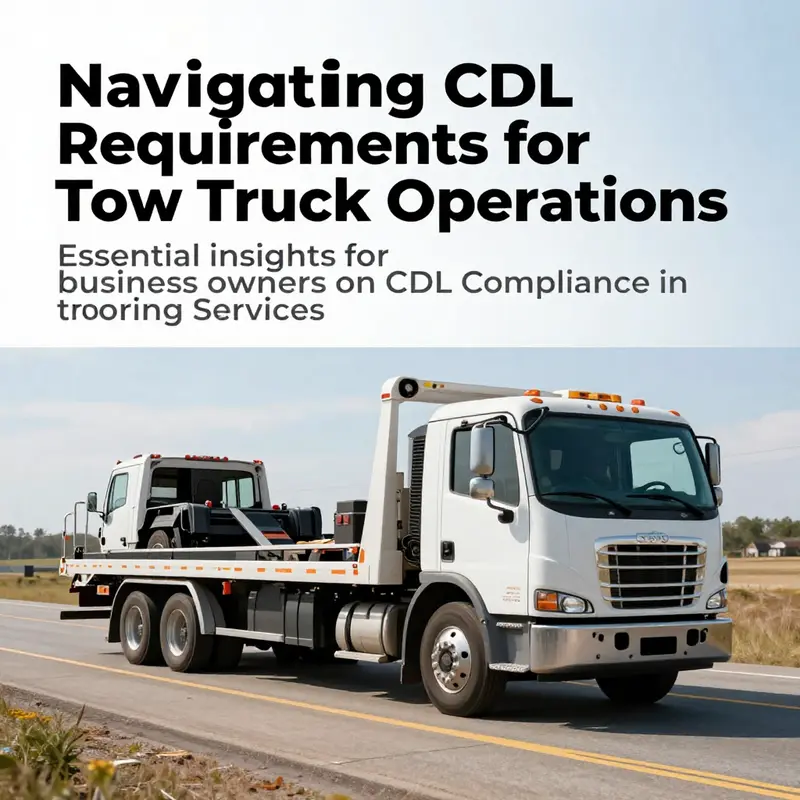
Understanding whether a Commercial Driver’s License (CDL) is required to operate a tow truck is crucial for business owners in the towing industry. CDL regulations vary based on a vehicle’s weight and the load being towed. This article breaks down the various weight classifications, state-specific regulations, and key insights into compliance, helping you navigate the often complex landscape of towing laws. Each chapter provides detailed insights into these aspects, ensuring your business operates within legal boundaries and maintains safety on the roads.
Weight, Wreckers, and the CDL: How Licensing Shapes Driving a Tow Truck
Tow trucks are more than simple hook-and-pull machines. They operate in the same traffic mix as everyday cars, but they come with size, weight, and risk profiles that demand serious regulatory footing. Because of this, the question Do you need a CDL to drive a tow truck? isn’t a matter of opinion so much as a matter of numbers, jurisdiction, and safety. The weight of the vehicle itself, the weight of what is being towed, and where the work takes place together determine whether a Commercial Driver’s License (CDL) is required. In practical terms, most operators encounter the CDL threshold when the tow truck’s GVWR—its Gross Vehicle Weight Rating—exceeds 26,001 pounds, or when the towed vehicle pushes the combined load over certain weight limits. These thresholds reflect federal intent: to ensure that drivers who operate heavy, potentially hazardous equipment have demonstrated the knowledge and skills to manage large vehicles safely on public roads. The rule is not arbitrary; it is grounded in the realities of maneuvering, braking, hook-ups, and quick decision making in traffic. It also means that a substantial portion of the towing workforce may need at least a Class B CDL, since many wreckers and carriers are configured as single-unit trucks with heavy GVWRs. And beyond weight, there are endorsements that can come into play if the job involves unique elements—such as transporting hazardous materials or carrying passengers—which adds another layer of training and testing to the licensing process. Industry practice and the letter of the law both push toward a professional standard for anyone who handles a vehicle on public roads in a tow configuration. For readers seeking a practical sense of how these rules feel on the ground, it helps to consider the way state rules can diverge from federal baselines. Some states impose CDL requirements for any tow-truck activity on roadways, regardless of weight, reflecting local priorities for road safety and incident response. This means the precise path to licensure can vary significantly depending on where the work is performed. The key takeaway is to verify your state’s DMV guidance in addition to the federal framework. Even with a general rule in mind, the exact licensing path should be tailored to your vehicle configuration, your workload, and your operating region. The process typically starts with a Class B CDL, appropriate for most heavy straight trucks and tow units, and then progresses to endorsements as needed. An “S” endorsement for straight trucks, while common, is only part of the picture. If your operation requires pulling trailers or handling specialized equipment, you may encounter additional endorsements that reflect those duties. The end result is a licensing path that aligns with both the physical capabilities of the tow truck and the on-road contexts in which it will work. The training and testing side of the equation is equally explicit. To obtain a CDL, applicants must pass a written knowledge exam that covers traffic laws, vehicle inspection protocols, and safe driving practices relevant to CMVs. The skills test then verifies hands-on competence: a rigorous pre-trip inspection, the ability to control a heavy vehicle under a range of conditions, and the proficiency to execute towing maneuvers that reflect common real-world scenarios. The training is designed not just to prove you can move a tow truck, but to confirm you can do so responsibly and predictably in high-stress settings. If the operation touches hazardous materials (H) or passenger transport (P), those endorsements add further verification steps to ensure the operator understands the specific risks and safety procedures involved. The precaution against risk is not merely theoretical. The legal and financial stakes are meaningful. Operating without a CDL when one is required can lead to substantial fines, potential suspension or revocation of the license, and, in the event of an accident, heightened liability exposure. Insurance coverage can be affected as well; providers may deny or restrict coverage if licensure is found lacking, complicating post-incident recovery for both the driver and the company. In practice, the financial and professional burden of noncompliance often dwarfs any initial savings from forgoing licensing. The meaning of compliance extends beyond avoiding penalties; it shapes the reliability and reputation of a towing operation. For people weighing their options, the right move is to map the rules to equipment and routine. Start by calculating the tow truck’s GVWR and the weight of any towed vehicle. If either figure crosses federal thresholds, plan for a CDL with the appropriate endorsements. Then align your training plan with the expected job scope, scheduling time for both the written exam and the behind-the-wheel testing. Some operators choose to phase in CDL training, coordinating course work with ongoing service calls to minimize downtime while maintaining business continuity. It is essential to remember that state rules can alter the calculus, especially in jurisdictions with stricter rules around on-road recovery. To place this in a practical frame, consider how a routine tow call might evolve into a scenario that tests your license’s scope—nighttime, tight streets, unpredictable roadside hazards, and the pressure to restore traffic flow quickly and safely. For broader industry context and reflections from practitioners, you can explore the mikes-towing page. This resource offers a window into daily operations, training, and the kinds of considerations a tow operator faces: mikes-towing. The point is to connect the formal requirements with the lived reality of on-road work, where planning, safety, and compliance converge on every call. In the end, the regulatory framework is not a rigid obstacle but a framework that supports safer streets and steadier service. The path to licensure emphasizes skill, discipline, and continuous training, mirroring the ongoing nature of vehicle safety in the towing world. For those who plan to pursue a career in this field or expand a fleet, the question remains straightforward—do you need a CDL to drive a tow truck? In most cases, the answer is yes, but the exact route to compliance depends on weight, function, and jurisdiction. The careful, methodical approach to licensing mirrors the careful, methodical approach to every tow call: plan, verify, execute, and review to keep roads safer for everyone. For official guidance on CDL requirements, consult the FMCSA Website: FMCSA Website.
null
null
State Lines and Heavy Loads: Understanding CDL Rules for Tow Truck Operation Across the States
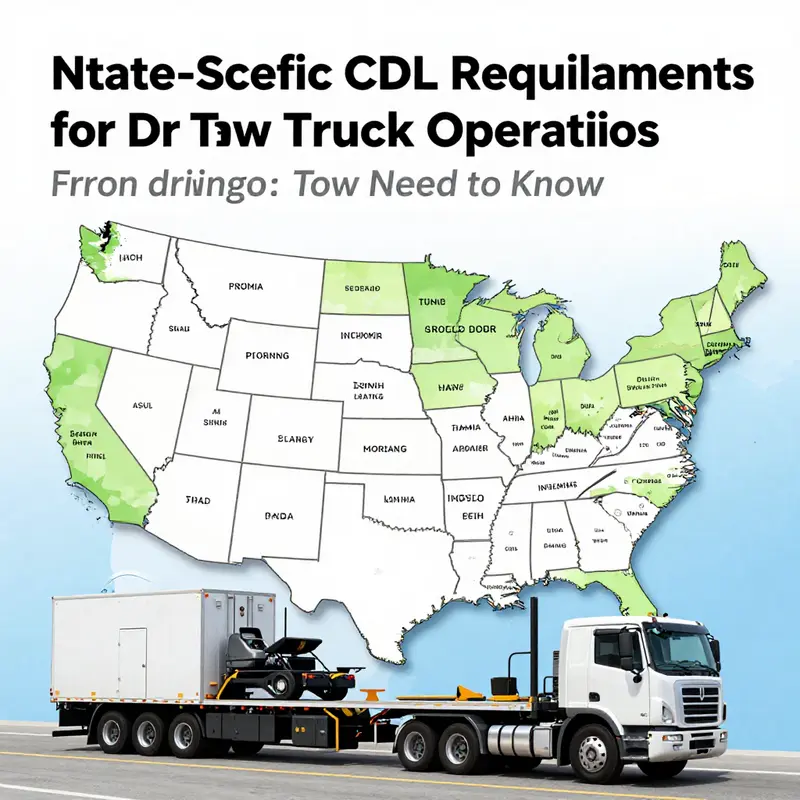
When you ask whether a CDL is required to drive a tow truck, the answer hinges on weight, vehicle configuration, and the state you’re in. The broad framework starts with federal guidelines that set a baseline, but the practical rules arrive through state licensing authorities. In most cases, a CDL is needed for a tow truck, and the deciding factors are the gross vehicle weight rating (GVWR) of the tow truck itself and the gross combination weight rating (GCWR) if you’re towing another vehicle. The general rule is straightforward: if the tow truck weighs more than 26,001 pounds GVWR, you’ll typically need a Class B CDL to operate it. If the act of towing pushes the combined weight over the threshold, a CDL can also come into play even when the truck’s own weight sits below the limit. On paper, this creates a kind weight-based gate that separates entry from operation, but the real landscape is much more nuanced because states tailor the framework to their own fleets, road types, and enforcement priorities.
In practice, the most common pathway for tow-truck operators is the Class B CDL, mostly because many tow trucks are single-unit vehicles with GVWRs that land in the heavy category. Yet the curveball appears when you consider what you are towing. A vehicle well under 10,001 pounds being hauled by a tow truck does not automatically exempt you from CDL requirements if the combined weight crosses a state-defined boundary. That boundary is not a single universal number; several states align with the federal 26,000-pound line, while others use 25,000, 27,000, or similar thresholds. The distinctions matter not only for licensing but also for endorsements, training, and testing obligations.
From the perspective of a towing business, this means a careful inventory of the fleet and the work you plan to perform. If you operate a fleet that includes heavy wreckers or they’re used to recover vehicles from roadways for a fee, some states view the activity through a stricter lens, sometimes triggering CDL requirements even when the vehicle itself would appear to fall short on GVWR. The practical upshot is simple: operators should confirm their state’s exact criteria, because a few miles of lax interpretation can become costly compliance issues during a roadside shift or a licensing audit. For instance, in North Carolina, the rule is explicit about the threshold: a Class B CDL is required when the towing vehicle’s GVWR exceeds 26,000 pounds. But there’s a twist—if you’re towing a vehicle as part of a combined operation, the GCWR may come into play and push you into CDL territory even if the tow truck alone barely clears the 26,000-pound mark. The same logic likely travels to other states, though the numbers shift slightly, and the exact language can skew toward efficiency or safety priorities as dictated by state regulators.
The state-by-state variation is not merely a legal footnote; it affects careers, insurance, and the cost of doing business. Some states implement exemptions for certain types of tow trucks used in emergency or non-commercial operations, though these exemptions are narrow and typically require clear documentation that non-commercial intent is proven. Others close those doors entirely, treating even basic towing as a regulated transport activity that demands full CDL credentials. Given this patchwork, a responsible operator or aspiring driver should treat the question as a state-specific inquiry rather than a universal rule. The safest route is to consult the licensing authority in the state where you will drive and to review the official CDL information pages that spell out GVWR, GCWR, and any applicable endorsements.
Endorsements add another layer to the equation. The standard Class B CDL is the foundation in many contexts, but additional endorsements can be required or advantageous depending on the equipment attached to the tow truck. An endorsement for straight trucks, often labeled with an “S,” may be relevant, and some situations call for endorsements tied to specific equipment components, such as air brakes or other complex systems. Training and testing do not disappear with the flag of a state line; they remain the gateway to legal operation, and they are designed to ensure that drivers can manage the weight, the loads, and the road environment safely. The process includes both written knowledge tests and practical, on-the-vehicle skills examinations that assess handling, braking, signaling, and the ability to recover a vehicle in a controlled manner.
For operators who navigate multiple jurisdictions or whose work crosses state borders, the question becomes even more practical. It’s not enough to know the law in one state; you must understand how neighboring states interpret the same weight thresholds and whether any cross-border rules apply to endorsements or special permits. Staying compliant means building a documentation bundle that includes your vehicle specifications, your licensing status, the endorsements you hold, and a clear record of the work you perform. It also means maintaining ongoing education, as regulations evolve with changes in vehicle technology, road use, and enforcement priorities. The upshot is that CDL requirements for tow trucks are not a single gate but a gateway with multiple paths, depending on your vehicle, your work, and where you drive.
If you want a sense of the kinds of trucks and configurations that commonly appear in metropolitan fleets, a practical reference is to explore the typical lineup and operation in major service areas. For context on the types of tow trucks used in large urban settings, see Tow Trucks in Houston. This resource can illuminate how fleets balance weight, capability, and licensing across an operator base that must respond quickly to incidents while staying compliant with state rules. It’s a reminder that the day-to-day realities of towing—equipment options, response times, and fleet composition—are inseparable from the licensing requirements that govern who may drive the vehicle in the first place.
In summary, your CDL status as a tow-truck driver is a function of weight, towing configuration, and state law. Federal guidance provides structure, but state regulations shape the practical implications: the exact weight thresholds, the existence of exemptions, and the endorsements you may need. The safest approach is to determine your state’s specific thresholds, verify the GCWR against any planned towing, and prepare for the licensing process with a clear, accurate map of what you will operate. As you gear up, remember that the right CDL—not just the intent to drive a tow truck—protects you, your employer, and everyone on the road.
External resource: New York DMV CDL Information
Final thoughts
In conclusion, understanding the requirements for obtaining a Commercial Driver’s License (CDL) for tow truck operations is essential for compliance and safety. As illustrated, regulations vary significantly based on weight classifications and state laws, which can impact your towing business operations. It’s vital for business owners to stay informed about these regulations and ensure that all drivers possess the appropriate licensing to mitigate legal risks and enhance operational reliability.