
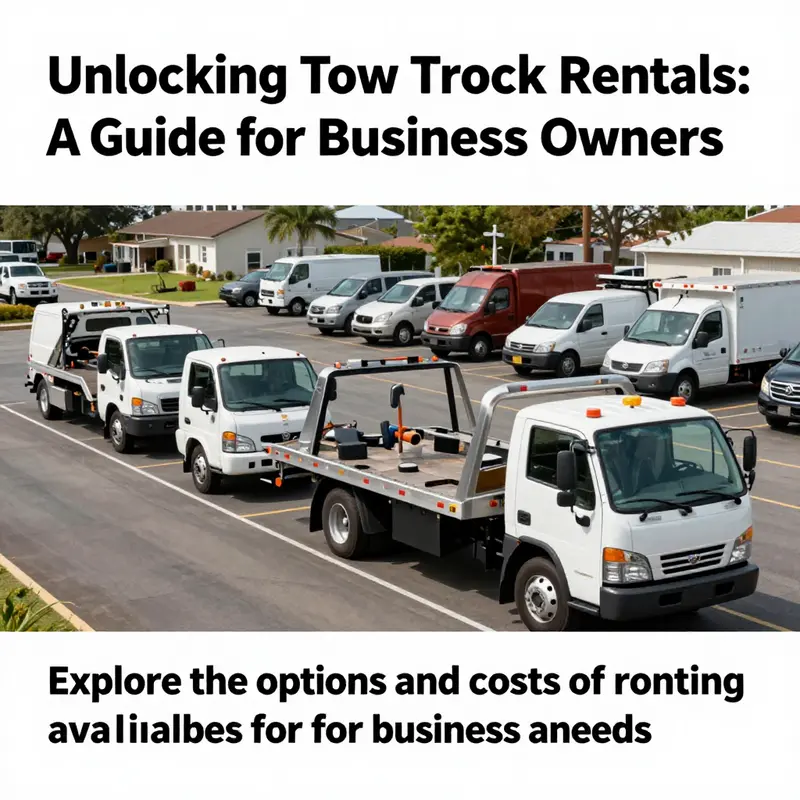
Renting a tow truck can offer invaluable flexibility and efficiency for business owners needing to transport vehicles or machinery. Whether for roadside assistance or equipment relocation, understanding rental options is essential. This article will delve into the ins and outs of renting a tow truck, focusing on the availability of services and the associated costs to aid in strategic decision-making. Both chapters will provide insights that are crucial for making an informed rental choice, ensuring you choose the best solution for your business operations.
Renting Tow Power: A Practical Guide to Tow Truck Rentals, Costs, and Availability
Tow trucks are tools of necessity for vehicle recovery, transport, and logistics. When a car breaks down, when a bus needs repositioning, or when a business needs to move equipment across town, the ability to access a tow vehicle can be the difference between a delayed deadline and a smooth, timely operation. Renting a tow truck is not the same as renting a typical passenger vehicle, even though the hiring process may look familiar at first glance. The options vary by region, the types of vehicles available, and the purpose you have in mind. What you gain from renting is flexibility: the power of a capable machine without the long-term commitment of ownership. Yet with that flexibility comes responsibility. You need to understand the kind of vehicle you are renting, the terms of the rental, the associated costs, and the safeguards that keep you and others safe on the road. In this chapter, we explore what it means to rent a tow truck, how to evaluate your needs, what price ranges you can expect, and how to plan for a rental that serves your project without turning a routine job into an expense you wish you could avoid. The goal is not just to find a vehicle, but to align the rental with safety, legality, and efficiency—so the job gets done right the first time.
To begin with, it helps to distinguish between different classes of rental vehicles people commonly use for towing. On one end of the spectrum are heavy-duty pickup trucks that are engineered to tow significant loads and haul heavy equipment. These are often built on three-quarter- or one-ton frames and come with factory towing packages, enhanced brake systems, stronger transmissions, and upgraded suspensions. On the other end are specialized tow trucks and wreckers used by professional towing services. Those are purpose-built machines with hydraulic winches, wheel-lift systems, and integrated recovery equipment. When you rent a tow truck from a mainstream rental company, you’re usually getting a heavy-duty pickup with a towing package rather than a dedicated tow truck. This distinction matters because it determines what you can tow, how you hook it up, and how you drive with a heavier payload. The same principle holds whether you are moving a stranded vehicle, transporting a trailer, or relocating equipment for a job.
With that baseline in mind, the practical questions begin to unfold: What exactly can you rent, and under what terms? In many markets, rental agencies offer 3/4-ton and 1-ton trucks designed for towing projects. These trucks are robust enough to handle the payload of typical cars, light trucks, and small trailers, and they usually come with features that make towing safer and more manageable—powerful engines, reinforced frames, and integrated towing hitches compatible with common trailer couplers. They are not, however, the ultra-specialized rigs used by professional tow services in every situation. If your project requires a wrecker-style machine, hydraulic rotators, or wheel-lift capabilities for heavy recoveries or complex vehicle extractions, you may need to contract a towing service or explore a different class of rental vehicle, when available. The key is to align the vehicle’s capabilities with the job’s demands and to be honest about what you need the vehicle to accomplish.
Pricing for these rentals tends to reflect both the vehicle class and the duration of the rental. In general terms, you can expect daily rental rates to start around ninety dollars and rise toward or beyond two hundred dollars per day for higher-end or longer-term arrangements. A typical breakdown might show a baseline rate in the neighborhood of $90 to $150 per day for a capable heavy-duty pickup configured for towing, with additional mileage charges—often around fifty cents per extra mile—applied after a threshold distance. Some rentals also incorporate or add charges for specific equipment such as hitch adapters, brake controllers, or extra towing accessories. If you anticipate extensive driving, or if your project will involve long-distance transport, it’s important to factor in mileage estimates into the overall cost and to confirm whether the rental agreement includes any mileage caps or concessions for longer trips.
These cost structures are not merely numbers on a screen. They shape decisions about how to approach a job, how to allocate budget, and how to schedule work. The daily rate interacts with how many miles you expect to travel, how many days the vehicle will be in your possession, and what add-ons you may require for safe operation. To illustrate, consider a scenario where you need to recover a vehicle from a distant location and transport it to a shop for a repair. If you rent a tow-capable pickup at $120 per day and drive 120 miles in a day, you would face the base rate plus the mileage fee. If the drive extends to several days or if additional equipment is required at the job site, those costs escalate accordingly. In practice, you’ll often find value in planning for a longer rental period if it minimizes per-day charges or prevents repeated pickup and drop-off fees. Several rental providers also offer long-term terms that can reduce average daily cost, particularly when the project spans weeks rather than days.
Availability is the next practical consideration. Availability varies by geography and by demand. In some markets, you’ll find a steady supply of heavy-duty pickup-style tow vehicles through large rental networks; in others, the selection may be more limited. The simplest way to assess availability is to call ahead or check online for real-time inventory, especially if your job requires a specific date or a tight schedule. Seasonal demand, local events, and proximity to busy service areas can all influence how quickly a vehicle can be secured. It is not unusual to encounter gaps between the advertised capacity of a rental fleet and the actual on-the-ground availability, particularly on weekends or during peak travel seasons. If you’re aiming to book in advance, you might request a hold or a guaranteed reservation, and you should always confirm any required deposits and cancellation policies.
Before you sign a rental agreement, gather and verify the documentation you’ll need. Most rental providers require a valid driver’s license, a credit card in the driver’s name, and proof of insurance that covers the rental period. Some agencies may request an additional driver to be present at pickup, especially if more than one person will operate the vehicle. If you’re not the primary vehicle operator, make sure the person who will be driving the rental is added to the rental agreement and that their license information is accurate. Age restrictions vary by company and location; while drivers under twenty-five may still be eligible in some markets, they frequently encounter young-driver surcharges or additional restrictions. Understanding these requirements ahead of time reduces the risk of last-minute delays that could derail a project and ensures you have the right credentials to get the job done.
Insurance and liability sit at the heart of any vehicle rental, but they take on particular importance when the vehicle has a towing capacity. Rental agreements typically include a basic insurance package, but many operators offer supplemental coverage or waivers that protect you from the cost of damage or theft beyond the standard policy. It’s essential to understand what is covered and to assess whether you need additional protection for your specific use case. For instance, a basic collision policy might cover damages to the tow truck itself but not to the vehicle you are towing or the trailer you are moving. If your operation involves risky maneuvers, uneven terrain, or long-distance low-speed towing across uneven roads, a higher level of coverage can be a prudent investment. The safer path is to ask precise questions: What does the policy cover exactly? Are there exclusions for certain terrains, weather conditions, or types of loads? Is there a deductible, and can it be reduced or waived by purchasing extra coverage? These questions ensure you don’t encounter unexpected bills when an incident occurs. In addition, it’s prudent to verify your own liability and cargo coverage in cases where you’re transporting someone else’s property or moving large equipment, so you are not left financially exposed in the event of damage to a third party’s property.
The equipment loadout you receive with a tow-capable rental is another important consideration. Most rental trucks will come with a standard hitch, basic lighting, and standard towing hardware compatible with common trailers. However, this is not universal, and some fleets offer optional add-ons—such as extended towing mirrors, sway control, or auxiliary braking systems—that can influence both safety and maneuverability on the road. If you anticipate towing larger trailers or navigating tight urban spaces, ask about available equipment upgrades. The goal is to ensure the vehicle you rent comes with the right tools to manage the job securely and efficiently. At the same time, you should be cautious about paying for fancy add-ons you won’t actually use; a practical audit of the job’s needs will keep the bill in check while preserving safety.
From a practical standpoint, the choice between a rental truck and contracting a tow service hinges on the job’s complexity, the distance involved, and the level of control you want over the operation. If you are running a small operation that requires occasional towing or vehicle recovery, renting a tow-capable pickup may deliver the right balance of cost and control. For more complex recoveries, or when time is of the essence due to safety or regulatory concerns, engaging a professional towing team with a dedicated wrecker might be the more reliable option. Either route demands an upfront plan: a clear understanding of the load to be moved, the route you’ll take, and the expected duration of the project. Beginning with a precise load estimate helps you pick a truck with an appropriate towing capacity and ensures you won’t exceed the vehicle’s mechanical limits on the road.
It is also worth noting how the rental experience can vary by provider and location. In some regions, major rental companies offer 3/4-ton and 1-ton trucks specifically marketed for heavy-duty towing, with straightforward pickup procedures and online inventory checks. In other markets, independent fleets may provide more flexible terms or a broader range of configurations, including automatic transmissions, electric or hybrid options for eco-conscious drivers, and flexible rental terms that accommodate extended projects. Practically, this means you should compare the available fleets in your area, reading the fine print on mileage caps, fuel policies, maintenance responsibilities, and any penalties for early returns. If possible, visit a location in person to inspect the vehicle’s condition, confirm the presence of essential towing equipment, and verify that all safety features are functional before you commit to a rental.
For readers in specific regions or cities, the availability and options can be even more nuanced. For example, in a major metropolitan area with a diverse fleet, you might find a City Car & Truck Rental that offers self-service pickup and a mix of automatic transmission vehicles, plus options for longer-term arrangements. While this illustrative example comes from a Toronto context, the broader lesson is universal: a self-service or streamlined pickup option can reduce wait times and let you get to work faster. If you happen to be in a market where such services exist, leveraging them can be a real advantage when time is tight and you need immediate access to equipment. The key is to verify the local offerings, confirm outside-the-city travel restrictions, and ensure that the vehicle’s configuration aligns with the task at hand. If you’re curious about regional options or want to see how local fleets compare, you can explore a representative example online while focusing on the core factors that matter most to your project: payload capacity, hitch compatibility, and the rental terms that best fit your budget and timeline.
When you start the booking process, it’s helpful to approach it like any other equipment rental, but with closer attention to safety and legal requirements. Clear communication about the job’s scope helps the rental company match you with a vehicle that has the right capabilities and the proper equipment. That includes specifying the estimated load weight, the number of miles you expect to travel, any weather contingencies, and whether you’ll be towing trailers or carrying heavy equipment. It’s also wise to request a brief orientation or a quick walk-around of the vehicle at pickup so you can verify the hitch, brake lights, tow mirrors, and any auxiliary devices function correctly. A simple checklist can save you a lot of trouble down the line: confirm the fuel level, verify tire condition, test the winch or braking assist if included, and ensure that all required safety equipment—such as wheel chocks, reflective triangles, and working lighting—are in place. A well-prepared operator reduces risk and helps you deliver results without delays.
The practical takeaway is that renting a tow-capable pickup can be a smart solution when the job’s scale and timing align with what a rental fleet offers. The costs, while not trivial, are often reasonable given the flexibility, immediate availability, and the ability to avoid ownership costs for a temporary need. By understanding the distinctions between a rental pickup and a professional tow truck, you can make a more informed decision about whether to rent, hire a service, or combine both strategies for a given project. If you decide to pursue a rental, you can start by querying local fleets online, then follow up with a quick phone call to confirm availability for your exact dates and to clarify any restrictions related to distance, load types, or operational conditions. As you weigh the options, the ultimate goal remains clear: secure a vehicle that can perform the job safely, within your budget, and on your schedule.
For readers who want to explore a concrete example of a nearby, practical option while staying within a general framework, there is real-world value in reviewing local provider pages or fleet listings. When you consider a rental, you might encounter an entry-level cost of around $90 per day, with additional mileage charges and occasional add-ons. This is not a universal rule, but it provides a useful ballpark for budgeting, especially if you plan the use case around a few days of towing or transport rather than a single afternoon. If you’re exploring how to structure a rental plan for a multi-day project, it can be worthwhile to balance the daily rate against the mileage cap and the potential savings of a longer-term arrangement. Long-term rentals can sometimes reduce the average daily cost, especially if they come with included miles or fewer penalties for extended usage. The trade-off, of course, is commitment—keep a firm calendar and an exit plan in case the project timelines shift. In the end, the right choice aligns your operational needs with a rental package that offers reliability, predictable costs, and a straightforward return process.
To connect with broader resources and see how this topic fits into the larger ecosystem of vehicle services, you can explore external information about rental options and regional availability. For those who want more practical context and current pricing realities, a well-rounded external resource to consult is the official site of a leading rental option that aggregates heavy-duty vehicle availability and terms. This external reference can provide a sense of typical terms, warranty considerations, and how rental agreements are structured across different regions. City Car & Truck Rental is one such example that illustrates how flexible terms, self-service pickup, and varied vehicle offerings can work in practice. You can review their approach to self-pickup, vehicle options, and flexible rental terms to help frame your expectations when shopping for a tow-capable rental in your area. External resource: https://www.citycarandtruckrental.com/
In the end, renting a tow-capable pickup can be a practical path when you need forceful, reliable equipment for a finite period. It offers the balance of power and flexibility without the long-term costs of ownership, while still demanding careful planning and prudent risk management. The road to a successful rental experience is paved with a clear understanding of the vehicle’s capabilities, a precise plan for the job, and a readiness to ask the right questions before you sign on the dotted line. If you want to see a real-world example of where this path can lead, you can explore a dedicated towing resource that discusses regional availability and service options for tow trucks and related road service needs. For more focused exploration of regional options, you might also consult a detailed listing such as the one found on the platform that aggregates towing services and related resources, which can offer context on how rental choices intersect with ongoing service work. And for readers seeking a direct view of local fleet options and to compare specific truck configurations, you can explore targeted fleet pages that describe heavy-duty pickup configurations suitable for towing tasks and related transport needs. The overall message remains practical: with the right planning, a tow-capable rental can be a dependable tool in your operational toolbox, offering capability, flexibility, and control when you need them most.
Internal link reference (for context within this article): you can explore a related fleet option at tow-trucks-in-houston to see how a regional fleet presents similar capabilities in a local market.
Tow Truck Renting Demystified: Costs, Choices, and Practical Planning
Can you rent a tow truck? The short answer is yes, and for many people the ability to rent a tow truck opens up options that range from recovering a stranded vehicle to moving heavy equipment or transporting a trailer over a distance. The topic sits at the intersection of vehicle availability, safety, and budgeting, and it rewards careful consideration of both the machine you choose and the terms of the rental. In practice, renting a tow truck is not just about securing a vehicle with wheels and a winch. It is about matching the right towing capability to the job, understanding how the rental structure works, and planning for the responsibilities you take on as the operator. When approached with a clear sense of needs and constraints, renting a tow truck becomes a practical and efficient solution rather than a stopgap or a trail of surprises when the clock starts ticking and the miles begin to accumulate.
The most important distinction in any tow truck rental is the type of vehicle you select and the kind of towing system it employs. Tow trucks come in several forms, with flatbed models and wheel-lift configurations among the most common for basic vehicle recovery and transport, while heavier-duty diesel models are built to move heavier loads and operate in more demanding environments. For a simple recovery or short-distance transport, a light- to mid-duty setup may suffice. If your needs include moving large equipment, handling long trailers, or dealing with vehicles that require careful handling to avoid damage, a flatbed can be worth the extra investment. The weight capacity, stability, and specialized equipment—such as winches, wheel-lift mechanisms, or hydraulic ramps—will not only influence cost but also affect the safety and efficiency of your operation. In other words, the right gear is as essential as the right driver.
Costs vary widely depending on the vehicle’s capabilities and the rental model. On a baseline level, daily rental rates can range from very affordable levels for basic pickup-like configurations to significantly higher figures for heavy-duty diesel models. In some markets, basic pickup trucks may rent for roughly twenty dollars per day, while the most capable heavy-duty diesel models can exceed two hundred dollars per day. Many renters fall somewhere in between, with capable half-ton tow trucks commonly landing in the range of one hundred to two hundred dollars per day. It is also common to see incremental costs accrue as you go beyond a preset mileage allowance. A typical mileage fee can hover around fifty cents per mile, though exact figures depend on the provider and the specific rental package. When you extend the rental period beyond the daily rate, or when you request additional towing equipment or specialty attachments, you should anticipate further charges. These fees are the practical reminder that renting a tow truck is both a service and a machine with a defined scope of use, and the cost structure is designed to reflect both.
What often makes the budgeting exercise more predictable is what is included in the base rental price. In many cases, the daily rate covers not only the use of the tow vehicle but also basic insurance and fuel. The protection of liability and collision coverage, even if minimal, can save you from potentially steep outlays if something goes wrong during a recovery or transport. Fuel is commonly included in the sense that the vehicle is delivered with a full tank and returned with a reasonable level, but some operators operate on a purchase-and-refill model where you pay for what you use. The exact inclusions and exclusions vary by provider, and it is essential to read the rental agreement carefully. If you already carry commercial liability or commercial auto insurance, you may be able to extend or supplement coverage through your insurer. If not, you should not assume that the rental price automatically includes comprehensive coverage; confirm what level of protection you’re obtaining and whether you need to provide proof of insurance or a deposit as a condition of rental.
Beyond the price tag, there are practical decision points that guide whether renting a tow truck is the right move for your situation. First, consider weight capacity. Tow trucks are engineered to move different loads, and you don’t want to be underpowered for the task at hand. If you need to recover or transport a vehicle, you’ll want a rig whose wheel-lift or flatbed mechanism is rated for the weight and dimensions of the vehicle you’re dealing with. For larger trailers or oversized equipment, a heavy-duty diesel model might be necessary. The second decision factor is the type of towing you intend to perform. A flatbed tow truck offers the safety and versatility of loading whole vehicles onto a bed, which minimizes the risk to the towed vehicle and can simplify the setup for certain kinds of recoveries or transports. A wheel-lift system, on the other hand, can be more efficient for specific kinds of on-road towing where a full bed isn’t necessary. Understanding the nature of your load and the terrain you’ll operate on helps ensure you choose a configuration that makes the job safer and easier.
The rental terms themselves also deserve careful attention. Documentation is a standard requirement across providers. A valid driver’s license and proof of insurance are commonly requested, and for commercial operations, a business license or evidence of business use may be necessary. Some rental agreements require a credit card on file for the security deposit, while others may ask for a larger initial hold. If you’re renting for a one-off event or a single job, a short-term rental with a straightforward daily rate may be sufficient. If you anticipate a longer engagement or recurring needs, you’ll want to look at weekly or monthly rates and negotiate consistent terms, including mileage caps and the availability of support or roadside assistance. The ability to access reliable customer support during a rental period is not a luxury but a practical safeguard; towing operations rely on a chain of functioning equipment, clear communications, and timely assistance if something doesn’t go as planned.
For anyone navigating these choices, the practical next step is to locate local providers or online platforms that list tow truck rentals and compare the offered packages. A careful comparison can reveal not only price differences but also variations in included equipment, availability, and flexibility. It is wise to ask questions about what kind of pre-inspection is performed before the rental starts, what safety features are standard on the truck, and what maintenance or breakdown coverage the operator offers. You may discover that some providers are more flexible with attached equipment like winches, chains, and straps, while others may supply only the bare minimum. If your job requires specialized attachments or configurations—such as wheel dollys, extra lighting, or specific towing adapters—confirm these are available and whether they carry an additional fee.
The decision to rent should also be weighed against other options, such as hiring a tow service for the job rather than assuming ongoing rental duties. If your need is sporadic, renting could be more economical, but if your yourself or your team requires constant access to towing capacity, a long-term service arrangement or even leasing the equipment via a fleet rental can deliver more value and predictability. You might also consider a hybrid approach: rent a tow vehicle for a defined period to handle a surge in workload, then dowse into a service provider for ongoing support when demand declines. Regardless of the path chosen, the key is to align the vehicle’s capabilities with the job’s requirements while maintaining a tight eye on the total cost of ownership over the rental period.
When it comes to finding the right fit, it’s helpful to think through a simple criteria checklist. Start with the weight and size of the towed load. Then map out the typical travel distances and whether you’ll operate on highways, city streets, or uneven terrain. The towing method should match the job’s specifics: for example, you may prefer a flatbed for sensitive or high-value vehicles to avoid draping the vehicle on a hook or bar. If you’re transporting trailers or heavy equipment, ensure the hitch or coupling system and the bed’s ramp are compatible with your loads. Consider safety as a core requirement. Confirm that the vehicle has working lights, tire integrity, secure tie-down points, and measurement equipment to verify the load remains stable during transport. It’s not just about getting the job done; it’s about getting it done without creating additional risks for your team or for other road users.
Another practical aspect is how you go about selecting a rental provider. In many markets, you’ll find a mix of local fleets and larger, nationwide platforms. Local operators can offer more personalized service and faster response in case of a breakdown or a scheduling hiccup, while larger networks may provide broader availability and standardized terms. The key is to request a clear quote that itemizes the daily rate, any mileage fees, and potential charges for additional equipment, as well as the expected return conditions and fuel requirements. It’s reasonable to ask about insurance minimums and whether you can bring your own coverage, especially if you operate under a commercial license or if your organization carries a fleet policy. A request for a written contract with terms spelled out helps prevent misunderstandings once the wheel starts turning.
For readers who want a sense of how this flows in practice, imagine a scenario where a contractor needs to retrieve a disabled work vehicle from a remote site and deliver it to a repair shop. The contractor weighs options: a light-duty tow configuration that can manage modest weight and a short haul, versus a heavy-duty option capable of handling heavier loads and longer distances. After weighing the job’s demands and the costs, the contractor chooses a mid-range setup with a comfortable daily rate and an acceptable mileage cap. The rental includes basic insurance and fuel, and a few essential towing attachments are available as needed. To ensure smooth operations, the contractor coordinates with the rental provider to arrange a pickup window, confirms documentation, and notes the required safety checks before set out. This kind of planning reduces the chances of delays or surprises and keeps the project on track.
If you want to explore options in a particular locale, some readers find value in looking up local resources that specialize in roadside services and towing equipment. For those curious about regional availability in a major metro area, you might search for nearby listings of tow trucks and compare the different configurations offered. A helpful practical resource within the broader ecosystem is a page dedicated to tow trucks in a specific city, which can provide insights into typical truck configurations, regional pricing, and the kinds of attachments commonly requested by local operators. This type of resource can be a useful reference when calibrating expectations about what is feasible in your area and how to negotiate effectively with a rental provider. For readers who want to explore a concrete local example, you can learn more about the options available for tow trucks in Houston through the dedicated page linked here: tow trucks in Houston.
The path to renting a tow truck is not about simply choosing any vehicle with a hook. It is about matching equipment to the job, understanding the cost structure, and preparing for the responsibilities that come with operating a heavy vehicle on real roads. This means becoming familiar with the vehicle’s controls, understanding load limits, and knowing how to secure a load safely. It also means considering the vehicle’s maintenance status and the availability of roadside support should something go awry during a job. Companies that provide tow trucks for rent typically expect you to bring a responsible level of compliance with safety standards, and they may offer guidance or training resources to help you use the equipment correctly. If you’re new to towing, don’t hesitate to ask for a quick tutorial or a demonstration on basic operation and safety checks before you embark.
In the end, renting a tow truck can be a prudent and flexible solution when you need towing capacity for a specific job, a temporary project, or a surge in workload. It’s important to approach the decision with a clear sense of the job’s requirements, a careful eye on the cost structure, and a readiness to manage the responsibilities that accompany using a heavy vehicle. As you navigate the rental landscape, keep in mind the practical realities—the weight you must move, the distance you’ll cover, the type of towing mechanism that best suits the load, and the safety practices that guard against mishaps. When these elements align, a tow truck rental becomes not just a tool, but a reliable partner in getting the job done efficiently and responsibly.
External resource: https://www.enterprise.com
Final thoughts
In summary, renting a tow truck can significantly enhance operational capabilities for businesses in need of transportation solutions. By understanding the various rental options available along with the associated costs and fees, business owners can make strategic decisions to optimize their resources. This informed approach can lead to better service offerings and improved customer satisfaction, ensuring that you are always equipped to handle unexpected challenges effectively.