
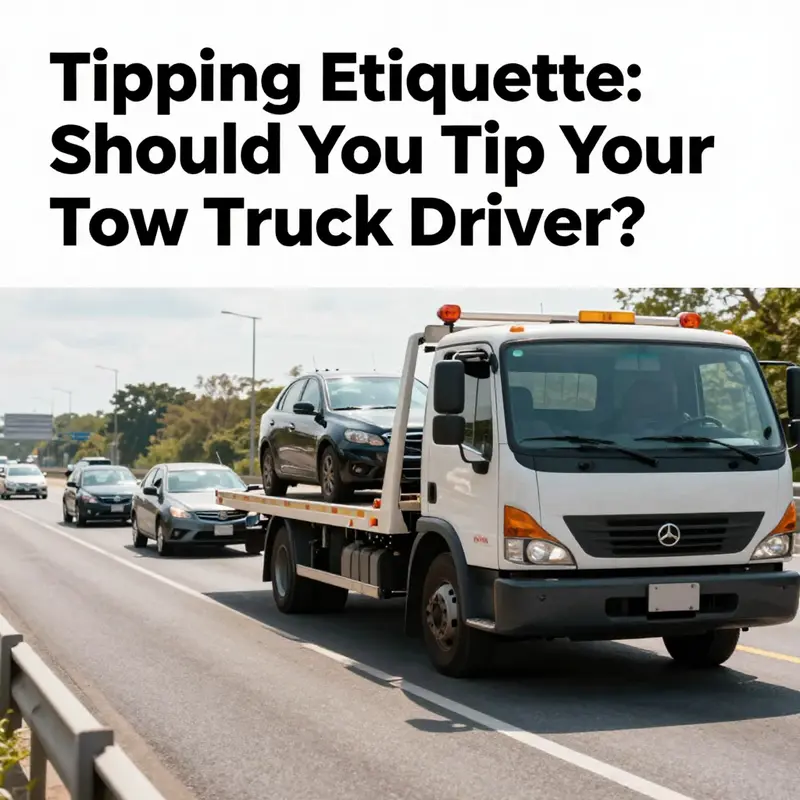
In a world where gratuities often enhance service experiences, the question of whether to tip tow truck drivers remains a point of confusion for many business owners and vehicle owners alike. While tipping is commonplace in various service industries like restaurants and ride-sharing, the towing industry treats tipping differently. Understanding the norms around tipping tow truck drivers, especially in commercial contexts, is essential for business owners who may find themselves needing these services. The complexities surrounding payment for towing services and the nuances of customer expectations will be explored in two distinct chapters. The first will clarify the typical norms regarding tipping in this sector, while the second will address specific situations where tipping may or may not be appropriate, providing insights that can guide your practices and interactions with towing services.
Gratitude on the Road: Understanding When and Whether to Tip Tow Truck Drivers
The question of tipping a tow truck driver often arrives with the rustle of a roadside emergency—the moment when time feels elastic, the car feels heavy, and every decision seems to hinge on getting back on the road. In those moments, people want to express thanks, to acknowledge a driver who has done more than move a vehicle from point A to point B. Yet the etiquette surrounding tipping in this specific service context is not always clear. The broad consensus you’ll find in reputable etiquette guidance is that tipping tow truck drivers is not expected or customary in most situations. The work they perform—relocating a disabled vehicle, often under time pressure and in challenging conditions—is typically covered by a fixed fee or an hourly rate set by the company. The price you see, whether arranged through insurance, roadside assistance, or direct payment, usually factors in the driver’s labor as a standing part of the service, not as a channel that relies on gratuities from customers. In short, the act that many people associate with personal service and individual discretion—tipping—does not translate neatly to the towing context. This framing helps protect both customer expectations and professional boundaries, reducing awkwardness in what can be a stressful moment. It’s helpful to view the tow as a service transaction with defined terms, rather than a discretionary performance that invites a tip in addition to the stated price. For those who want a broader sense of tipping norms across various services, a respected guide offers a thorough comparison that covers when gratuities are welcome and when they aren’t. The distinction matters, because it shapes how people respond in the moment and how drivers interpret actions once the job is done. In this sense, the question becomes less about universal rules and more about alignment with the service context, emergency or otherwise, and the expectations of the company you’re working with. If you’re curious about how a towing company frames its pricing and interactions with customers, you can explore a quick overview at mikes-towing. This internal reference provides a compact sense of the standard practices that frame the encounter, including the typical routes of payment and the kinds of additional assistance that might appear in a tow scenario. The link keeps the focus on professional boundaries while still guiding readers toward practical, real-world steps you can take during a stressful moment. mikes-towing
The practical field reality supports this view. Tow trucks are dispatched as a routine business service. The fee structure is designed to cover fuel, vehicle wear, insurance, and the driver’s time, with the expectation that the customer’s compensation is that fixed amount or the insurance-approved payment. In many cases, the driver’s compensation is not contingent on tips, and refusing a gratuity is not unusual or improper. This is different from hospitality or delivery work where compensation structures frequently rely on tips to boost earnings or incentivize performance. The towing industry’s emphasis on predictability in pricing helps both customers and operators manage expectations in an environment that is inherently uncertain. When a driver is working under a time constraint—say, to clear a vehicle from a dangerous roadway or to reach a stranded motorist before a forecasted storm—the focus tends to be on safety and efficiency rather than gratuity. The driver’s skill is valuable, of course, but the customary exchange remains a straightforward fee for service rather than a performance-driven pay model. The result is a practical default: tipping is not expected, and offering a tip might feel out of place to the driver or to the company policy that governs the transaction. This clarity benefits both sides, reducing the risk of miscommunication and helping the customer feel confident that the right amount is paid up front.
That said, humans are nuanced, and norms are not universal. There are legitimate exceptions where a small gratuity can be appropriate and appreciated. In the moments when a tow driver goes above and beyond the standard call of duty, a gesture of appreciation can acknowledge the additional effort. If a driver arrives exceptionally quickly in an emergency or stays late to ensure your safety, or if they take extra time to explain what happened or to guide you through a tricky situation—checking tire pressures, offering a jump-start when it’s needed, or giving practical advice about next steps—a small tip can be a meaningful show of gratitude. In these scenarios, the gesture is less about tipping as a formal expectation and more about recognizing exceptional care and thoughtful service. A modest amount—often a small bill or a few dollars—can convey appreciation without implying that the service is dependent on a tip. The key is to ensure the tip feels proportional to the extra effort and not as a standard expectation for routine work. The exact amount can feel personal, but the spirit remains consistent: gratitude expressed when a driver delivers more than the minimum standard.
Another practical nuance concerns the mechanics of tipping. Cash in hand is the most straightforward method, especially in the field where card processing might not be immediately available. If a tip is offered, it should be given directly to the driver in a discreet, respectful manner, with no pressure or awkwardness. If you prefer to pay by card due to safety or convenience, some companies may permit a tip via the payment method you’re already using, though this can vary by company policy. If tipping is explicitly discouraged by the company, it’s prudent to respect that rule and instead offer a sincere verbal expression of thanks, a written positive review, or a recommendation to others. In that way, you still contribute to the driver’s reputation and the company’s standing without crossing professional boundaries. In instances where the service is part of a roadside assistance program, such as an insurance-backed plan, the policy might specifically address gratuities. If the plan discourages tipping or if the driver is acting under a dispatcher’s control, following the policy is wise. The overarching principle remains: do what you can to acknowledge the driver’s effort within the established framework of payment and company guidelines. Revealing your appreciation through a positive online review, a note to the company, or even a word of thanks while maintaining the professional boundaries can be a meaningful alternative when tipping is not appropriate or allowed.
From a broader cultural perspective, tipping norms around tow services can vary by country and region. In many places, the default stance is that tipping is not expected for essential vehicle services. That said, audiences notice when a service provider has gone the extra mile, and people still want to show gratitude in practical, non-disruptive ways. The goal is to preserve the integrity of the service interaction while honoring genuine acts of care and competence. If you’re navigating this decision during a stressful moment, the most reliable compass is to respect the established pricing structure, observe the driver’s cues, and consider how best to express appreciation within the boundaries of the company’s policies. In the end, the aim is to acknowledge good service with sincerity, not to contravene a rule or create confusion about what the price covers. To better understand the landscape of towing services and to explore how customers often frame their expectations, a quick reference on pricing and service standards can be useful. For a concise sense of how a towing operation frames its work, you can look at the overview provided by Mike’s Towing. The link offers a snapshot of the professional context in which drivers operate, illustrating the balance between service delivery and the economics of the industry.
In sum, tipping tow truck drivers is not a standard practice, but selective generosity in exceptional circumstances is a thoughtful, humane response to outstanding service. Treat the situation as a professional transaction with a defined price, and reserve tipping for moments when the extra mile is truly obvious. Instead of feeling compelled to tip, you can opt for clear communication with the company, a direct expression of thanks to the driver, or a positive review that benefits both the individual and the organization. If you want to reflect on your experience and help others in similar situations, sharing your feedback can be an equally powerful form of appreciation. For more guidance on tipping etiquette across services and contexts, consider consulting a reputable etiquette resource. The New York Times offers a comprehensive examination of when tipping is appropriate and when it risks creating confusion, including practical examples that you can apply to roadside emergencies. You’ll find practical guidance and nuanced scenarios in their tipping etiquette coverage, which helps readers approach these moments with confidence. https://www.nytimes.com/2026/02/14/style/tipping-etiquette-tow-truck-drivers.html
Reading the Moment: When It Might Be Appropriate to Tip Tow Truck Drivers
When you call for a tow, the situation is rarely about a reward for a simple favor. It is about safety, timing, and the practical realities of roadside distress. In the quiet after the sirens die down, the question about tipping can linger, because tipping is not a universal expectation in towing the way it is in some other service industries. The prevailing norm, reinforced by insurance coverage, roadside assistance programs, and the standard rate set by a company, is that the tow is paid for through a prearranged fee. Yet as with any human service encounter, there are moments when a customer might feel compelled to express appreciation in a tangible way. The key is to calibrate your response to the context, to the policies of the company, and to the driver’s behavior in the moment. A clear sense of situational awareness helps you distinguish routine support from exceptional effort, and it guides you toward a gesture that is appropriate rather than confusing or inappropriate for everyone involved.
In most cases, tipping tow truck drivers is not expected or customary. The payment you make is typically tied to an agreement reached before the vehicle is moved. Even when the tow is arranged through an insurer, a roadside-membership program, or a direct contract with a tow company, the compensation is anchored in the service contract rather than in gratuities. This structure matters because it underpins a predictable pricing model for the customer, while the driver’s income is built around the business model of the company, not the generosity of individual clients. For many people, that means the sensible approach is to focus on timely, respectful communication and a smooth handoff at the scene rather than on an added cash incentive. When the driver has already been paid through a dispatch system or an insurance claim, a tip can create confusion about who is owed what, and it may even violate company policy, which is designed to avoid situations that could be misinterpreted as favoritism or pressure on staff.
Nevertheless, life has a way of presenting exceptions, and there are moments when a tip can feel earned and appropriate. The first factor is exceptional service. If a tow operator goes beyond the standard duties—moving your car from a hazardous location, securing it in a way that minimizes risk in icy weather, or staying with you through a tense moment to provide reassurance and practical guidance—these acts can change the dynamics of the service. In such cases, a small token of appreciation—often a modest amount rather than a larger, sweeping gratuity—may be interpreted as genuine gratitude rather than a ticket to better treatment in the future. A practical range people sometimes consider is in the neighborhood of ten to twenty dollars, though the exact amount should reflect your comfort, the local cost of living, and the perceived level of extra effort. The important nuance is that the gratuity remains discretionary and proportionate to the specific behavior you observed, not a fallback for the inconvenience of the situation.
A second important factor is the nature of the help you receive. Towing can involve more than simply transporting a vehicle. If a driver provides detailed explanations about the process, answers questions with patience, or assists in navigating the situation at the roadside—such as helping you chain or strap a vehicle safely, explaining the steps for insurance submission, or coordinating with a dispatcher to keep you informed—the value of that supportive, knowledgeable assistance becomes more tangible. It is not just a ride from point A to point B; it is expertise that reduces risk, saves time, and lowers stress in a moment when you are most vulnerable. In those moments, a discreet, cash-based gratuity can convey appreciation for the extra effort without turning the exchange into a public spectacle. Even when you decide against a tip in cash, expressing sincere thanks in words can carry substantial weight, because politeness and acknowledgment are universally understood currencies that do not carry the same potential for misunderstanding as a tip might.
The third dimension to weigh is the policy landscape of the towing company itself. Some firms explicitly discourage or prohibit accepting tips, fearing conflicts of interest or complicating relationships with customers and insurance providers. The policy might be framed to protect staff from perceived pressure or to maintain fairness across a large client base. In such cases, offering a tip without checking can place the driver in an awkward position or put the company in a difficult spot. A prudent approach, then, is to ask directly whether tipping is acceptable before you hand over any cash. A quick, respectful inquiry can prevent an awkward moment and gives the driver control over whether they are willing to accept gratuities. If the driver or company declines, respect that boundary with a gracious thank you and move forward. If the driver does accept, you can proceed with a clearly stated amount and a brief note of appreciation that emphasizes the specific actions you found valuable.
Even when a tip is deemed appropriate, there are ethical and practical considerations that shape how you proceed. Consider your own context: the severity of the breakdown, the weather, the time of day, and your personal safety. A late-night breakdown in a hazardous location is not the same as a routine pickup, and your response should reflect that. The gesture should never be coercive or disproportionate to the service rendered. It is not a price adjustment for inconvenience; it is a formal, voluntary expression of gratitude for exemplary conduct under pressure. In many cases, verbal thanks and a courteous demeanor are enough to acknowledge the driver’s effort. When you decide to provide something tangible, keep it modest and discreet, avoid large denominations in the open, and place it in a way that ensures the driver can take it without feeling pressured or obligated to perform further tasks beyond what was asked.
For readers already accustomed to a broader world of roadside assistance and vehicle recovery, a reminder can be helpful: the act of tipping is a cultural practice, not a universal rule. If you want to anchor your decision in a broader frame, consider how ordinary people handle gratitude across essential services. In a setting where the service is delivered as part of a contractual agreement or as part of an insurance-based arrangement, gratuities tend to blur lines rather than clarify them. Yet in rare instances, the expression of thanks in a tangible form can be a valued signal when the driver has shown a level of dedication that transcends the basic call of duty. If you are curious about how other providers approach similar situations, you can explore a related, practical resource at the following link: mikes-roadside-service.
The practical takeaway is clear: tipping tow truck drivers is not a given, and it is not a guaranteed way to influence the quality of service. The decision rests on situational awareness—what the driver did, how they conducted themselves in a potentially dangerous or uncomfortable scenario, and whether the company policy permits gratuities. In everyday emergency and emergency-adjacent scenarios, the safest course is to focus on clear communication, gratitude, and, where allowed, a modest gesture that honors the moment without complicating the contractual relationship. If there is any doubt, verbal appreciation is a language that transcends policy or currency. It recognizes the human effort behind the operation and acknowledges the toll emergencies can take on drivers as well as on customers. The subtle art here is not about prescribing a fixed rule but about reading the moment with empathy and practicality, so that your response aligns with both the service you received and the norms of the service industry at large.
For readers seeking a broader examination of tipping etiquette across services, particularly in scenarios where payment structures differ from standard retail or hospitality, a respected external overview offers additional context. It notes that the etiquette around tipping varies widely by industry, culture, and the specific circumstances of the encounter, and it emphasizes that gratitude can come in many forms beyond cash. This broader perspective complements the careful, situational approach described above and helps ensure you experience a sense of control and confidence no matter the outcome of a roadside incident. For those who wish to explore this subject further, see Roadside’s tipping tips for towing situations: https://www.roadside.com/towing-tips/.
Final thoughts
Navigating the world of tipping, particularly concerning towing services, may initially seem perplexing, but clarity is essential for both drivers and customers. Typically, tipping tow truck drivers is not a common practice, as their compensation is generally based on set rates rather than gratuities. Understanding this norm helps in maintaining professionalism and respect within the service context. However, recognizing specific circumstances where tipping might express gratitude can enhance customer relationships and ensure a positive interaction with service providers. Ultimately, your approach to tipping should reflect your values, the context of the service, and an understanding of industry standards.