
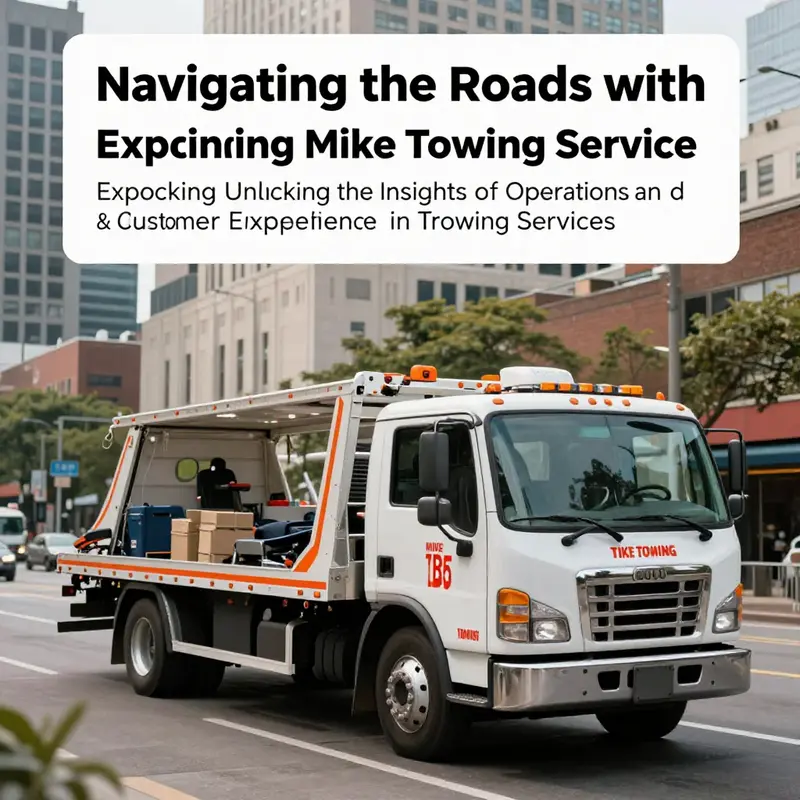
Understanding towing services is essential for business owners who rely on vehicle fleets or require reliable roadside assistance. With various companies like Mike Towing Service operating across the country, it’s vital to gain insights into their operations and customer satisfaction. In the following sections, we will explore the intricacies of Mike Towing Service’s operations, highlighting service offerings and operational frameworks, while delving into customer experiences that reflect satisfaction levels and areas for improvement. This comprehensive overview not only endeavors to define what makes these towing services stand out but also sheds light on the importance of effective customer relations in fostering trust and reliability within the towing industry.
On Call and On the Move: Inside Mike Towing Service’s 24/7 Operations and Roadside Solutions
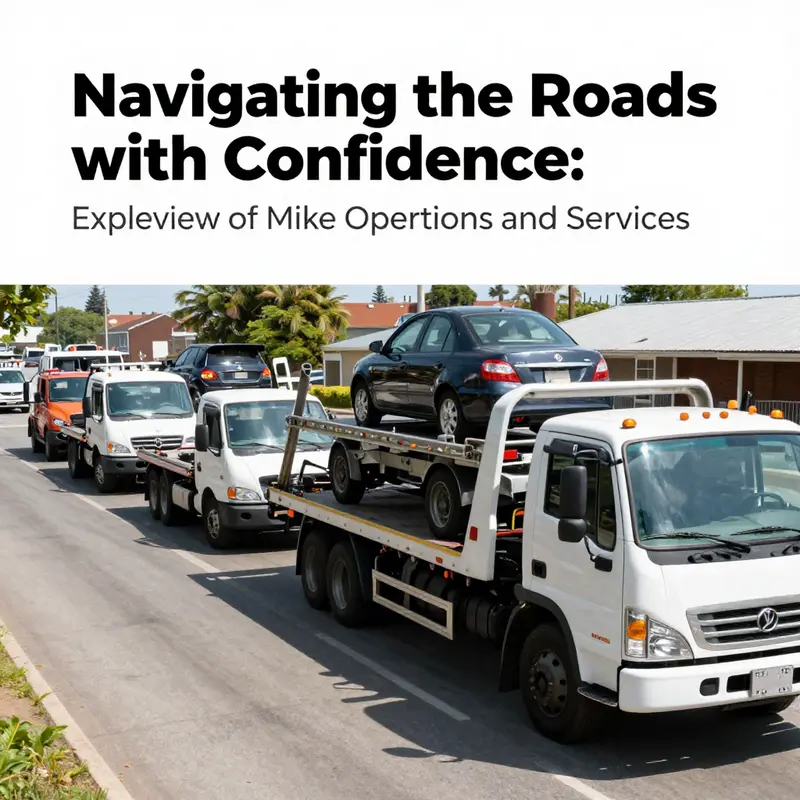
When a vehicle stalls on a highway shoulder, in a city alley, or beyond a rural exit, the difference between frustration and safe resolution often hinges on one thing: a reliable towing and roadside service that answers the call quickly and follows through with care. The Mike Towing Service family, found in multiple regions across the United States, embodies a model of responsiveness that travelers and fleet operators alike rely on. While the name may appear across several companies with similar branding, each location operates within its own jurisdictional framework, weathering different traffic patterns, local regulations, and consumer expectations. The overarching story of Mike Towing Service is not just a catalog of services but a narrative about how dependable, intelligently run roadside support becomes a vital component of daily mobility. It is a reminder that professional towing and roadside assistance are less about drama and more about disciplined execution, where timing, safety, and clear communication converge to keep people moving and, ultimately, safer on the road.
In practice, the service proposition of Mike Towing Service revolves around a promise that sounds both simple and essential: we are available whenever you need us, and we are prepared to respond wherever you are. This 24/7 availability is not merely a marketing hook; it reflects a dispatch philosophy that prioritizes rapid assessment, accurate triage, and efficient movement of vehicles from point A to point B. The call may come during a late-night hour or at dawn, in a congested urban corridor or a quiet county road. The dispatch team, often supported by GPS-enabled tracking and a network of licensed drivers, quickly determines the nearest available unit, the best route, and the expected arrival time. The goal is not just to arrive but to arrive prepared. A technician arrives with the right equipment, the right expertise, and a readiness to adapt to evolving circumstances—whether a vehicle needs to be towed on a flatbed to minimize further damage, or a complex recovery after an accident that requires careful articulation of a scene for safety and insurance compliance.
The core services offered by Mike Towing Service can be understood as a practical toolkit designed to address the most common roadside disruptions. Emergency towing stands at the forefront, translating urgency into action without sacrificing safety. When a vehicle is disabled after a breakdown or involved in a collision, the emphasis shifts from mere transport to careful recovery. The goal is to remove the vehicle from danger zones—freeway shoulders, opposing lanes, or compromised ramps—and position it in a secure location for further assessment or repair. The emphasis on professional recovery reflects a broader commitment to protecting the vehicle’s integrity during transport, reducing the risk of secondary damage that can complicate repairs and insurance claims.
Another pillar of the service lineup is flatbed towing. This method, which uses a specialized tow truck with a bed that can tilt and slide under the vehicle, is particularly important for cars with sensitive undercarriages, luxury models, or vehicles that must be transported without wheel-to-ground contact. By keeping the vehicle firmly in place during transport, flatbed towing minimizes the chance of suspension damage, misalignment, or cosmetic harm. This is not a luxury feature but a practical safety choice for many modern passenger cars and some commercial vehicles. The availability of flatbed towing within the Mike Towing Service family speaks to a thoughtful calibration of equipment to the needs of a diverse fleet and customer base, from everyday commuters to clients with high-value vehicles.
Local transportation rounds out the core offering by addressing the need to move a vehicle only a short distance, a scenario common to lot relocations, dealership transfers, or simply placing a car in a more convenient parking spot while awaiting service. The capability to relocate a vehicle locally is particularly valuable for fleet operators who must optimize parking, staging, or maintenance workflows. The ability to relocate a car without requiring long-haul towing reduces cost and downtime, helping drivers reconnect with their schedules sooner.
Roadside assistance, often viewed as the “in-between” service, rounds out the package with practical, short-term interventions designed to get a driver back on the road quickly. Battery jump-starts, tire changes, fuel delivery, and lockout services form a safety net for moments that can otherwise escalate into extended delays. Each of these interventions requires specific equipment and the right kind of technician on site. Consider a battery that is not just weak but failing; a tire that is punctured or damaged beyond the point of quick repair; a fuel emergency that necessitates careful handling to avoid spills; a lockout situation that demands compliant, non-destructive entry. The success of roadside assistance rests on the tiny details: the correct tools, the training to use them properly, and an approach that respects the vehicle and its occupants.
In addition to the direct services, Mike Towing Service emphasizes collaboration with other players in the automotive ecosystem. Insurance companies, auto dealerships, and rental agencies form a network that accelerates the process of claims, vehicle exchange, and relocation. When a fender-bender occurs, for example, a coordinated effort that includes towing, documentation, and prompt notification to the insurer can streamline the claim and reduce the waiting period for the customer. A dealer might rely on a towing partner to move a vehicle from a showroom lot to a service bay, or a rental agency might need a quick vehicle swap to minimize downtime for a customer. In each case, the towing service acts as the connective tissue that binds the different moving parts of the consumer’s automotive experience. The result is not merely a transport service but a structured, dependable workflow that respects the customer’s time and the financial realities of insurance and rental processes.
Within this landscape, the sense of local variation becomes evident when one considers the different Mike Towing Service operators in distinct regions. In Stockton, California, for instance, Mike’s Towing Service, Inc. has established a footprint with a long-standing presence and a published business schedule. The clear, consumer-facing contact options—an address in Stockton and a weekday operating window—signal a local business model that centers on reliability within a defined geographic area. By contrast, a Los Angeles-based Mike Towing Service is renowned for its responsiveness in a dense urban core, where traffic conditions and urban logistics demand rapid dispatch, sophisticated routing, and the capacity to handle a high volume of calls without compromising safety. The New Jersey entry, Mike & Myriam Towing Service LLC, demonstrates the regional variation that characterizes the broader field. While information about registration dates or precise addresses may be less transparent, the underlying service narrative remains: a local operator who understands the nuances of resident traffic patterns, road infrastructure, and the expectations of a particular community. Then there is the Wichita Falls, Texas location, which shares the same core mission but adapts to the needs of a city with its own rhythms, climate considerations, and service demands. The existence of multiple operators with similar names across disparate states highlights a practical reality: a driver seeking assistance must confirm the exact location and contact details to ensure they are engaging the correct service provider. This caution is not a reflection on quality but a reminder of how branding can cross state lines while the ground reality of the experience varies from town to town.
All of this points to a broader truth about modern towing and roadside assistance. The industry has evolved beyond the stereotype of a lone driver and a tow truck. It now rests on a networked system of responsive dispatch, specialized equipment, and an integrative approach to service that touches insurance, automotive sales, and rental logistics. The equipment choices—ranging from light-duty trucks designed for quick curbside interventions to heavy-duty tow rigs capable of hauling larger vehicles—reflect a deliberate alignment with the needs of the customer. The drivers themselves are not merely operators of machines; they are problem-solvers who must interpret a situation at a glance, prioritize safety, communicate clearly with the customer, and execute a plan with precision. That combination—response speed, professional handling of the vehicle, and transparent communication with the client—forms the backbone of why a consumer would choose Mike Towing Service over a rival offer. It is a reminder that towing is service work with consequences: the way a company handles a breakdown or an accident can influence everything from the cost of the repair to the timeline of a journey, and, in the worst moments, the safety of the people involved.
A reader navigating this chapter should also understand that the economics of towing are nuanced. Prices can be influenced by factors like distance, time of day, vehicle type, and the complexity of the recovery operation. A straightforward jump-start on a calm afternoon commands a different price point from a multi-vehicle recovery on a freeway at night, under slick pavement and cold rain. Even when the core services remain constant—emergency towing, flatbed transport, local shuttling, and roadside assistance—the situational variables shape the final bill. The human element adds another layer: a dispatcher who communicates clearly about fees and ETA, a driver who arrives promptly with the right equipment, and a company that stands behind its work with transparent billing practices. Readers should approach the decision with a simple, practical checklist: confirm the exact service needed, ask about the estimated arrival time, request a rough price range or a binding quote, verify licensing and insurance, and inquire about the availability of a flatbed for delicate vehicles or a recovery plan for more challenging scenarios. In practice, this approach helps demystify the process and reframes roadside support as a collaborative effort between the customer and a trusted service partner.
To connect these ideas with a tangible cue for readers who want a concise sense of the service landscape, consider exploring the core offerings from a respected operator’s perspective. A quick reference point can be found on the service’s dedicated page that outlines the range of support provided by Mike Towing Service. There, visitors can see how the dispatch logic aligns with the specific categories described above—emergency towing, flatbed transport, local vehicle movements, and an array of roadside interventions designed to rescue drivers from the most common roadside predicaments. This reflective snapshot demonstrates how a cohesive service model translates to real-world outcomes: faster response, safer handling, and an outcome that keeps people moving rather than stranded.
With a broader view of the networked nature of these services, readers can appreciate how Mike Towing Service operates as more than a collection of trucks on the road. It is a system built around reliability, safety, and the assurance that when a vehicle breaks down, help is not a luxury but a practical, well-supported option. The reputation of a provider is shaped by countless moments—one driver returning a battery with a boost that gets someone to a critical appointment, another owner whose car is carefully loaded onto a flatbed to ensure no further damage during transport, and a dispatcher who manages to find a solution that aligns with a consumer’s timeline and budget. In the end, the value of such a service lies not in the spectacle of a dramatic rescue but in the quiet competence that allows someone to resume their day with minimal disruption and maximum peace of mind.
For readers who want a direct pathway into the service ecosystem, a compact overview of the offerings is available through the company’s main towing page. This link provides a succinct summary of how the service categories map onto real-world needs, from emergency response to the nuanced handling required for delicate or high-value vehicles. mikes-towing offers a window into the structured approach that keeps a vehicle secure and a driver informed from first contact to final drop-off. By grounding expectations in a clear set of service categories, customers and partners alike can anticipate the kind of coordination that makes the experience smoother and more transparent, even in stressful circumstances.
As the road curves and the miles accumulate, the narrative of Mike Towing Service continues to unfold through the everyday acts that comprise roadside care: the precise mechanics of a wheel change without damage, the careful placement of a vehicle on a flatbed to avoid scraping or misalignment, the careful staging of a tow to minimize disruption to a busy shopping center, and the courteous communication that helps a driver decide whether to wait inside a warming vehicle or proceed with alternative travel plans while the tow is in progress. It is these small, repeated acts of professional service that elevate a routine tow into a reliable support system. And because the service network spans multiple regions, the insistence on local knowledge—what works in Stockton, what commuters in Los Angeles demand, what a Wichita Falls resident might expect in a storm—becomes a feature rather than a risk. The result is a service that respects both the universality of a roadside emergency and the particularities of the local roadways, traffic conditions, and customer expectations.
In closing this exploration, the message emerges with clarity: Mike Towing Service represents more than a brand or a line item in a consumer’s budget. It is a practical instrument for maintaining mobility, safeguarding vehicles, and preserving safety in moments when everything else feels uncertain. The alignment of rapid response, careful handling, and cooperative arrangements with insurers and dealers creates a service that supports not only individual drivers but also fleets, rental agencies, and the broader economy that relies on reliable transportation. The chapter has traced the core services, touched on regional variations, and highlighted the elements that transform a roadside interruption into a manageable, predictable process. For readers who seek further details or real-time updates, the official site provides ongoing insight into service options, regional availability, and the evolving capabilities of the network that strives to keep roads moving, one call at a time. For an overview beyond the local operators, see the national provider site: https://www.miketowingservice.com.
Tow Lines and Trust: Weaving Customer Experience Through a Nation of Mike Towing Services
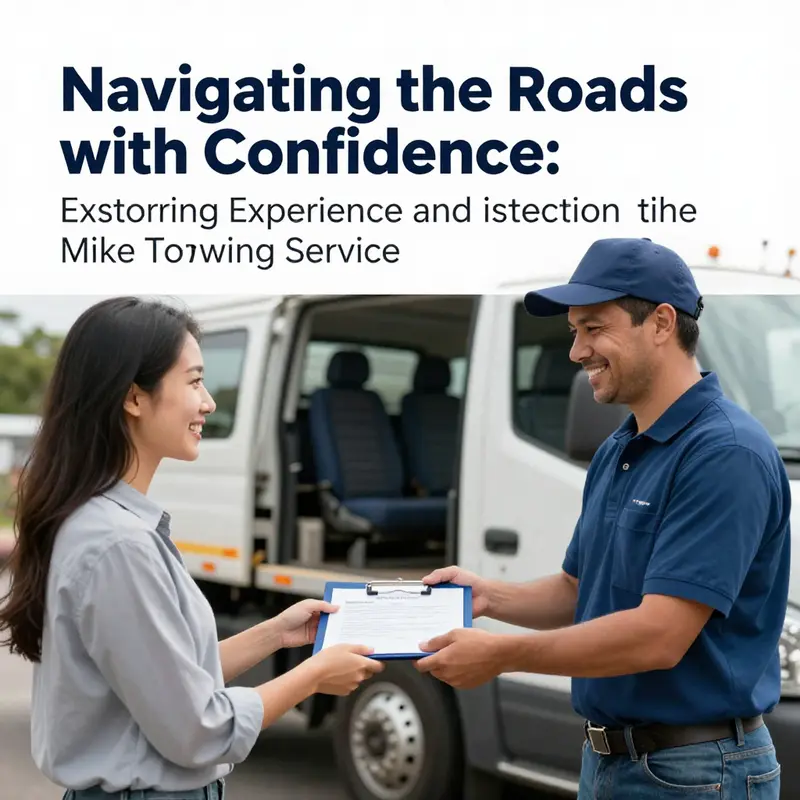
The road is a living test of a service industry built on urgency, reliability, and the quiet dignity of showing up when you’re needed most. When a brand is as common as a traffic signal across the United States, and the name Mike Towing Service spans cities, counties, and neighborhoods, the true measure of that brand isn’t the sign on the bumper but the texture of each encounter with a driver in distress. This chapter surveys the customer experience and satisfaction surrounding Mike Towing Service in its many local incarnations, recognizing that a national identity often hides a patchwork of local practices, personalities, and outcomes. The conversation centers on what customers actually experience, what they expect, and how the industry’s best operators translate those expectations into actions on the ground. In the end, the goal is not to produce a single standardized formula for every call but to illuminate how consistency, transparency, and respect shape trust when every mile matters.
Across the country, Mike Towing Service takes many forms. The records and anecdotes point to a mosaic of operations that share a brand but differ in locale, leadership, and day-to-day realities. For instance, Mike’s Towing Service, Inc. operates in Stockton, California, with a long-standing presence dating back to 1995. Its local footprint—an address on W. Scotts Avenue, a mid-morning to late-afternoon weekday schedule, and a direct phone line—illustrates the standard pattern of a regional towing business: a storefront anchor, a hotline, and a predictable window when customers can expect a response. Meanwhile, Mike Towing Service in Los Angeles signals a reputation for reliability and speed in a much larger metropolitan ecosystem, where the density of traffic incidents, the variety of road surfaces, and the frequency of service requests press the crew to balance volume with care. These two exemplars, separated by distance and scale, reveal a common truth: the quality customers notice most often emerges from how a company handles the moment of need in a specific place.
The landscape grows more intricate when one considers affiliated or similarly named entities that operate under state lines. Mike & Myriam Towing Service LLC in New Jersey, for example, presents a reminder that local regulatory environments, licensing requirements, and business disclosures can shape service delivery in ways customers may not immediately recognize. The differences are not merely bureaucratic; they influence dispatch routes, pricing transparency, and the cadence of communication with clients awaiting assistance. In Wichita Falls, Texas, Mike’s Towing Service adds its voice to the chorus of regional operators with its own hours and contact patterns, reinforcing the idea that a single brand is, in practice, many distinct relationships with separate communities. Taken together, these snapshots underscore a central point: when a consumer seeks help on a roadside emergency, the first conversation—between the driver on the ground and the person seeking aid—depends on where that encounter happens and who is answering the phone that day.
The customer experience, then, becomes a study in perception as much as in logistics. A review from February 2026 on a popular consumer platform captures both the strengths and the tensions that can accompany Mike Towing Service experiences. It notes that a Mike’s Towing truck was observed in the vicinity of a customer’s home, seemingly parked across the street while a Time Warner truck was being handled. The critique is not about the technical performance of the tow itself but about context—the positioning of the vehicle, the proximity to a residential area, and the potential implications of logistics in a neighborhood setting. This moment highlights a recurring dilemma in roadside assistance: speed must be matched with sensitivity to place. Customers want a rapid response, but they also want to feel that the operation treats their neighborhood with discretion and respect. The takeaway, for both operators and their clients, is clear. Service excellence isn’t only about a fast hook-up; it is about the considerate choreography of curbside work—where the tow truck positions itself, when it lights up the scene, how it minimizes disruption to neighbors, and how clearly it communicates with the homeowner about what is happening and why.
Industry standards reflect the same orientation toward humane efficiency. A commonly cited customer charter for service providers in this space emphasizes that needs should be attended to as quickly as possible, but in a professional and welcoming manner. Those words—quickly, professional, welcoming—are not aspirational slogans; they encode practical expectations: an ETA that respects the caller’s time, a technician who introduces themselves, safety briefings for pedestrians and occupants, and a transparent explanation of the steps involved. When a company translates this charter into practice, it often manifests as a disciplined dispatch process, courteous on-site interaction, and documentation that makes the encounter legible for the customer after the fact. If a consumer leaves a call feeling seen and informed, the likelihood of a negative long-term perception diminishes, even if the weather is uncooperative or the location proves challenging.
This is where the local realities of Mike Towing Service matter most. The narrative cannot rest on a single story or a single city; it must acknowledge that the experience is trained by the specifics of each operation. In Stockton, a family-run ethos can shape the way technicians talk to homeowners and neighbors, with emphasis on minimizing noise and blocking, while in Los Angeles, the sheer pace of the environment presses crews toward lightning-fast dispatch coupled with careful adherence to safety protocols amid dense traffic. In New Jersey or Texas, the regulatory and logistical textures differ again, guiding how credentials are displayed, how receipts are handed over, and how the company communicates the expected time of arrival. The point to take away is pragmatic: if you want to understand customer satisfaction in the Mike Towing Service ecosystem, you cannot rely on a single anecdote or a slick marketing claim. You have to read the range of experiences expressed by local customers, weigh the consistency of service delivery, and examine how well the company translates its stated values into consistent behavior on the road.
How, then, can customers navigate this landscape with greater confidence? First, verification matters. Given the proliferation of similarly named providers, confirming the exact location, operating hours, and contact details of the specific Mike Towing Service you intend to call is essential. A call for towing in Stockton is a different engagement from a request in Wichita Falls, with distinct city ordinances, neighborhood expectations, and street configurations that can influence the on-site approach. Second, conversations ahead of the tow can set the tone for the interaction. Asking the dispatcher to brief you on the expected ETA, the anticipated approach for the scene, and whether the tow truck will stage in a particular position can prevent misinterpretations. Third, the on-site demeanor of the technician matters as much as the technical outcome. A courteous introduction, a concise explanation of what will happen, and a commitment to keep you informed if delays arise—all of these habits, when practiced consistently, become the quiet backbone of customer satisfaction.
There is also value in looking beyond the single incident to the broader service ecosystem around Mike Towing Service. A robust roadside operation can be complemented by a broader suite of services, such as roadside assistance, lockout services, jump-starts, fuel delivery, and tire changes. When a customer knows that a trusted provider can handle a cascade of needs in one call, the sense of relief grows. To illustrate this possibility, consider an option often highlighted by providers with a similar service mix: a connected approach to roadside support that blends towing with quick, value-added assistance. For drivers who want more than a tow, a consideration of an integrated roadside service portfolio can improve the overall experience by offering continuity, predictability, and a familiar point of contact across different emergencies. This layered approach aligns with a philosophy that prioritizes customer concerns at every step—from the initial request to the completion of the service and the post-service follow-up.
In reflecting on the experience of a national brand with dozens of local offices, one recurring lesson stands out: consistency matters, but it must be practiced at the local level. A national narrative can set a standard, yet the customer’s day-to-day reality is shaped by the person who answers the phone, the driver who arrives, and the way the company communicates during the event. The most satisfying encounters tend to be those in which customers feel respected, informed, and involved in the process. When a tow truck arrives promptly, when the driver is clear about what will be done and how long it should take, and when the homeowner feels that the service is mindful of the neighborhood and the environment, satisfaction rises even if the outcome is not flawless. The converse is equally true: when communications feel murky, when the vehicle appears without warning and with little explanation, when there is ambiguity about costs or timing, satisfaction can plummet regardless of the technical success of the tow.
To translate these insights into practical improvements, local operators can reinforce several channels of accountability. First, dispatch systems should offer real-time status updates that customers can access via text or a brief call. ETA accuracy is not merely a scheduling matter; it shapes the emotional arc of the encounter. If you tell a customer 20 minutes and arrive in 25, a small delay can be perceived as a larger disruption; a proactive update is a confidence builder. Second, on-site communication should include a brief safety overview—what will be done, what the driver will require from the customer, and how long the process is expected to take. Third, the end-of-service handoff should include clear documentation: a simple receipt, a brief explanation of any charges, and an invitation to share feedback. Even a neutral prompt asking customers to rate their experience and provide a note about what could have been better can seed a culture of continuous improvement. Finally, a transparent pricing framework—clearly explained, with any potential extra fees identified in advance—helps prevent misunderstandings that can erode trust after the call is completed.
Customers can also take an active role in shaping their outcomes. Before a tow, gather essential information: the exact location, any street restrictions or access concerns, whether parked cars might complicate the approach, and any local preferences for vehicle placement. During the encounter, communicate expectations succinctly and respectfully, and confirm the driver’s approach if there is any ambiguity about staging or maneuvering in tight spaces. After the service, review the receipt and, if something seems off, seek clarification promptly. Hypothetically, imagine a scenario where a resident near a home asked for a careful approach to minimize disruption; a dispatcher who notes that preference and a driver who adjusts positioning accordingly can turn a potentially tense moment into a demonstration of courtesy. These small acts accumulate into a larger measure of satisfaction: trust that a provider will be there when needed, will treat you and your property with respect, and will communicate with honesty and candor throughout the process.
For readers who want a broader sense of customer sentiment and how real customers describe their Mike Towing Service experiences, it is instructive to consult the local voice on reviews. While no single review can capture an entire network, the scattered feedback provides a practical compass. A common theme across narratives is the balancing act between speed and care. Some customers celebrate quick response times and friendly, professional conduct, while others recall moments of confusion or concern—such as uncertainties about where the tow truck would park or whether the on-site process would intrude on neighbors. These cues remind operators that satisfaction rests not only on the mechanical success of the tow but on the perceived stewardship of the scene. That is, customers value operators who treat the situation as a partner in safety and relief rather than as a mere transaction. This perspective helps explain why a well-implemented customer charter, supported by effective communication and neighborhood-aware practices, can convert a stressful moment into a trustworthy experience. A few well-timed updates, a courteous tone, and a visible commitment to safety can transform a call from a mere emergency response into a trusted service relationship that endures beyond the immediate need.
In weaving together the threads of local variation and universal expectations, the chapter returns to a central premise: the Mike Towing Service family, regardless of city or state, gains credibility through how it honors the human element of every call. The people at the heart of the service—the dispatcher, the technician, and the homeowner—shape each other’s experience. A dispatch that anticipates questions and a driver who speaks with humility and clarity can soften the stress of a roadside incident. Conversely, a missed update, an unclear explanation, or a misstep in parking can stain the entire encounter. The skill of a successful towing operation is thus not merely in the mechanics of hooking up a vehicle but in choreographing a humane, communicative, and dependable process that respects the customer’s time, space, and dignity.
For readers who want to explore adjacent service options while considering a tow, there is value in examining broader roadside offerings. A linked resource that explores a broader suite of services can illuminate how a well-rounded provider can complement a tow when the call extends beyond a single need. Mike’s Roadside Service provides a window into how predictive coverage and on-demand assistance can support a seamless experience for motorists facing a variety of emergencies. This interconnected approach reinforces the idea that the strongest roadside providers are not defined by a single service but by their ability to deliver calm competence across a spectrum of urgent situations.
In closing, the landscape of Mike Towing Service experiences is both diverse and instructive. The mix of positive feedback and critical observations is not a sign of inconsistency but a mirror of the environments in which the service operates. Each city, each dispatcher, and each technician contributes a stitch to a larger fabric of customer experience. The best operators, local and national alike, recognize that satisfaction depends on more than the successful lift; it hinges on transparent communication, considerate operations, and an unwavering commitment to treating customers with respect at their most vulnerable moments. By foregrounding these elements, Mike Towing Service—and the broader towing and roadside industry—can elevate the standard, ensuring that every encounter aligns with the dual goals of speed and humanity. The road is long, and every call is a chance to prove that a tow can be more than a service—it can be a trustworthy, reaffirming presence on the side of the road.
External resource: https://www.yelp.com/biz/mikes-towing-lexington
Final thoughts
Mike Towing Service stands as a crucial player in the towing industry, offering essential services that business owners often depend upon. Through examining their comprehensive operations and customer experiences, it becomes evident that effective communication, swift service, and dedication to customer satisfaction are paramount in this field. By engaging with a reliable towing service, businesses can ensure the safety and accessibility of their vehicles, ultimately enhancing operational efficiency. Growing and nurturing partnerships with trusted service providers like Mike Towing Service can be a valuable strategy in safeguarding business interests on the road.